1:06:27
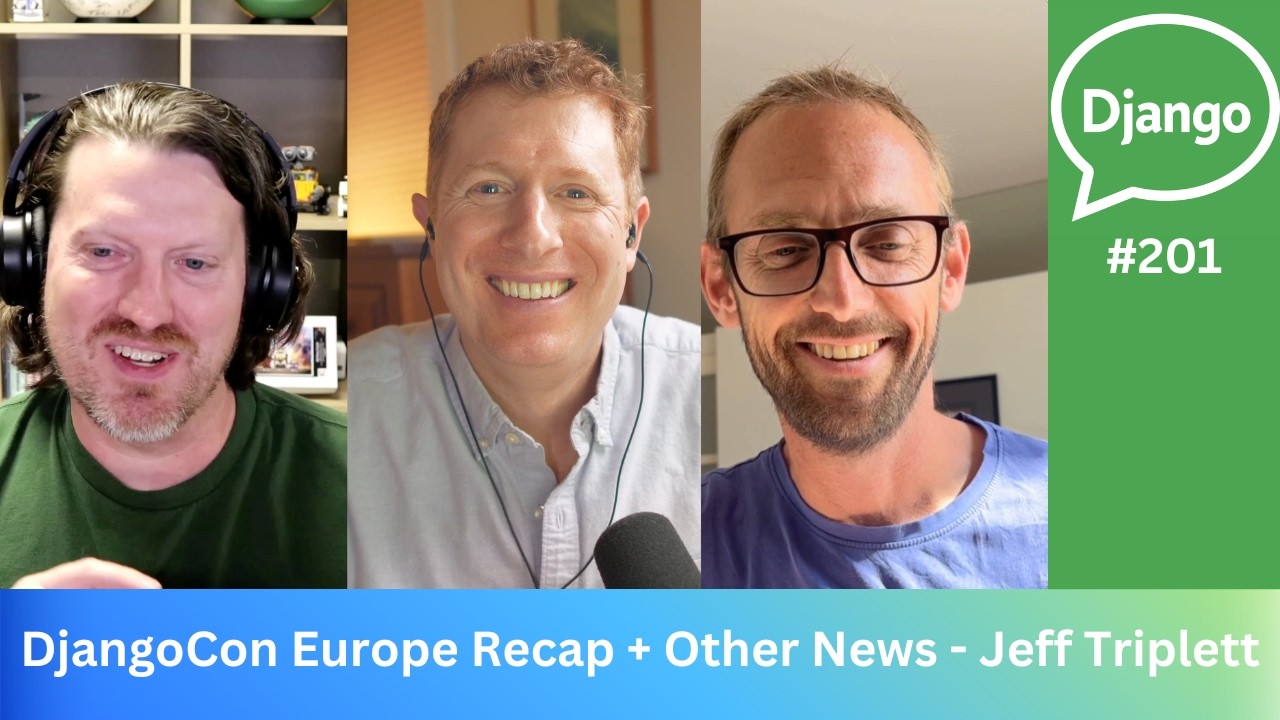
DjangoCon Europe Recap + Other News - Jeff Triplett
Published April 28, 2026
This video features Jeff Triplett at DEFNA Interviews 2019 .

In this episode we talked with Jeff Triplett about his involvement in DjangoCon, the DSF and the PSF.
We also talk about the current and future state of conference due to the COVID-19 pandemic and other topics.
Jeff Triplett explains that stepping down as DEFNA president lets new people lead while he remains involved with DjangoCon and the Python Software Foundation. He argues that Django events should expand beyond the United States, with Spanish-language programming and separate DjangoCons in Mexico, Canada, and other regions; adding Django-focused days to existing PyCons could be a low-risk way to start. Virtual conferences improve access by removing travel, visa, and cost barriers, though they lose informal community interaction and require different production and presentation skills. He also describes how DEFNA grew from a community response to a struggling DjangoCon, recommends starting small and volunteering, and says double-blind talk selection helps conferences become more inclusive and reduces the influence of established speakers.
Summarised automatically from the transcript.
Automatically transcribed, so expect mistakes in names and technical terms.
Speaker 1: So today we have we have Jeff Triplet with us and uh Jeff has been has been uh the the person who actually started Depna and um or one of the persons who who started Devna and uh and he was up until recently the president of Devna he's also been very involved with uh Django uh foundation as well as the Python foundation and uh and he's also been very involved with with the organization of uh of Django Khan. Uh how's it going Jeff? Can do you want to talk a little bit more about what you've done?
Speaker 2: Oh well uh yeah first of all, thank you. Uh it's fun to be here. Yeah, I mean as far as like stuff I've done, uh I guess one of the other points too worth mentioning is I'm on the Python Software Foundation board. Um that's part of why I think it made sense for me to not try to do as much from trying to be president of DEFNA plus uh Katya who took over as president will She's done a lot for a long time. So I I think it's a good time to me to step back and let other people step up and, you know, run the organization. I think that's probably the the most healthy way to kind of know like How good is the footing of an organization other than like not staying too long and stepping down and you know letting other people run it? So I'm happy to still be involved with Jenko Conan on the board, but I'm kind of happy to not have to to do it.
Speaker 2: So
Speaker 1: Less responsibilities too. So that's good. Uh that's that yeah, I think that's also that's also a uh a good point. Like there's it's always good whenever new people like kind of steps in and then just coming with like different ideas and all that. So uh talking about that, like what are what are some of the changes that you would like to see for this next uh Django Con?
Speaker 2: I think that probably we've spent too much focus on um, and part of it's because we're a North American uh nonprofit or primarily in the US. I think there's some ideas about bringing like a Spanish track to DjangoCon US, which is long overdue. And again, like, you know, I called it DjangoCon US, but really it's kind of DjangoCon North America. Like our idea is to have North American conferences. So the idea of there being maybe a Django Con that's in Mexico would be really awesome. Um, even like trying to get more of a DjangoCon presence in Canada. and then some of the other places in North America. Like I think that kind of opens up because things I was good at and the nonprofit was good at, um it made it a little harder to expand out in areas that we want to. So that to me is exciting. Um, I think part of it too is I felt like of the group of people we have, I had the least experience when it came to like virtual events and online
Speaker 2: events. And so like Katia's had a podcast, you've had a podcast for a while. Um, I've seen people do video. So, you know, I think it's like kind of putting the people with the right skill sets more in charge to be able to do things that, you know, the organization needs to do this year We haven't talked about it yet, but uh DjangoCon US won't be in, well DjangoCon North America will not be uh an online, well I'm sorry, it won't be an in-person event this year. It'll be a virtual event. And so that kind of changes like our playbook for how to run a good event because 90% of it is things you do in person. So that's kind of a neat change that I'm uh happy to help with, but also happy to see how people who know how to do it better than me do it.
Speaker 1: Yeah, uh I think that that I mean really if you take a look at at other conferences that that they've been doing things virtually this year year. Uh it's that's that's a difficult part, right? Kind of like simulating what we do in person to do it virtually. And I think we're all just kind of learning as we go. I mean It seems like conferences are getting a little bit better towards that. But yeah, that's always a difficult topic. So, I mean, you mentioned that you don't don't have that much experience with virtual events, but the ones that that you've been gone to or that you've attended, uh, what do you think about like have you seen any that that you you've said like uh this is great, this is one thing that uh that maybe they've been doing really, really well
Speaker 1: or not.
Speaker 2: I think I've probably been to a dozen of them over the last year, and all of them are both amazing and terrible at the same time. And I think it's just because nobody really knows how to do them. So every conference I go to, every virtual conference I go to, it just gets a little better than the previous ones. Because I think you have, you know, all these people who are going and they're sharing notes and they're learning. So A, I just think it's amazing from a um, you know Uh I have a child. It's nice for me to be able to go to things where I feel guilty if I leave for a week or I leave for four days away from you know, with my partner and then my child, like it just is an undue stress on them. So I really like being able to watch stuff from home, even though you miss kind of the banter and the random times or Like as organizers, like we always have our room that you know half of half of us just naturally are in.
Speaker 2: And that's kind of the best some of the best parts about going to an event for us, I feel like, is Being able to hang out with people that you've worked with all year and you just have an excuse to, you know, as things come up, you're in one room, but you get to know people at a level you wouldn't get to to meet or to know. And so that part, I don't know how we can mimic that other than maybe having like an online video room or something. But um I love though that some conferences They've done a really good job of you can join anytime and you can go back in time, basically like rewind and start the conference, even though you're three hours or four hours later and be able to kind of quickly catch up between breaks and stuff. And so that to me is just it's it's amazing. And then being able to switch tracks and stuff, um, that's gonna be really hard to to kind of stop whenever we go back to in-person events.
Speaker 2: I'm really looking forward to seeing what hybrid conferences are, even though I feel like they're also going to be in that level of how bad will these be? Because some things you can do better online and some things you can do better in person, but like everything from like where cameras are situated and the way audio works is just very different in person versus online. And so so I don't know. Yeah, it'll it's gonna be things are gonna be weird for a few years, I feel like, but Um, I like from even like a diversity perspective, um, even though like DjangoCon US has done a really good job of raising fundraising, like I forget how much our budgets usually are, but I feel like it's like 20,030,000 a year we tend to raise to get people to the conference. But it's still, you know, depending upon where you're from, it can still cost a couple thousand dollars to get somebody to the conference, which is amazing. But with virtual conferences and stuff.
Speaker 2: Since, you know, we don't you don't have to pay to fly or pay for hotels or Airbnb. Um, there's a lot more we can do with money. And I feel like People can watch it at their own pace as well. So I feel like virtual events have the opportunity to actually be, you know, more inclusive than what an in-person event would be. And so I like seeing, you know, it's interesting to me seeing barriers that I know exist um kind of kind of go away at the idea of a virtual conference.
Speaker 1: Yeah, I think that's a really good point because for instance uh now that you you were mentioning like uh trying to to get a track in Spanish for Django Khan, like PyCon has done that but it's always just like one or I think it the a couple of years ago it was two rooms that they were designed the designated specifically for the the track in Spanish And I'm guessing that that happened because there is not enough room to give like to to give the opportunity to more presenters or Spanish presenters. to actually talk. But in in something like a virtual conference, then you can basically just the only thing that you do is record more things, right? Like you don't need a space. You don't you're not your constraints are not not uh
Speaker 1: in like physical space. So yeah that that might be that that might be something that's uh that's probably already happening and the the only thing is that do you think like in the future uh some of these events like once everything goes back to quote unquote normal, uh do you think like some of these events are just going to go a hundred percent back to in presence and And uh and not and stop doing whatever it is that they're doing for virtual events?
Speaker 2: I think some will. Um I think it's gonna be a challenge like you know, PyCon normally has thirty five hundred people. And then this year, I think they're close to maybe 2,000 tickets with like 30 weeks to go or something. And I'm just kind of sort of making up numbers based on what I heard a couple of weeks ago. Um, I, you know, in in two years when we have a virtual event, well, sorry, in two years when we have an in-person event, I can't imagine that 3,500 people are going to go to a PyCon. And this is my speculation. There's no evidence of this. Same thing with DjangoCon. Last Django Con was you know 450-ish people or so. Um, I would be really surprised if we had 400 people to the next Django Con. And depending on the timing, sure, maybe that thing sells out in a month because people are so excited to get back in person, but I just think with not knowing with vaccinations, not knowing with variations of, you know, the the virus, um, I just feel like the next one's gonna be two-thirds or three quarters the size of what the previous ones were.
Speaker 2: And I and I hope they're that big. But I think also because I think what people don't realize is when you run a conference, the risk factor is really high Like volunteers will basically put a, you know, when we started DEFNA and stuff, we had to put a bunch of money um on our personal credit cards and stuff to start the conference. And so we kind of knew like DjangoCon's gonna be okay. So, but it still was a gamble that if I wasn't running, you know, DjangoCon, if it was another conference, you're just starting from scratch that didn't have a reputation or a name or a community behind it. Um, it it's it's a huge risk to throw, you know, a couple hundred thousand dollars on credit and hope that enough people show up that you you know you can make money. Um and you know, being a nonprofit, thankfully with DEFNET after, you know, six years of running it, we've built up a nest egg so that the risk for us is still there.
Speaker 2: Um, it's just none of us have to put anything out of pocket, at least. And so So yeah, I I I think it's gonna be hard for things to go back at least quickly. I think it's gonna take a couple years to recover from it. And I really hope that somebody starts the hybrid model so that we can learn from it and know like this is an easier way to go so that it's not uh, you know, a $300,000 or in PyCon would be millions of dollars. uh of risk. It would be really nice to know like maybe if there was more like meetup centrics and stuff where like, you know, you could host one in Austin and somebody could host one in like San Diego. And It'd be really kind of cool to see how like those meetup spaces could kind of have their little portion of the conference and then, you know, they meet locally, give their talks, and with streaming, be able to make it kind of magically come together so that
Speaker 2: you know you have continuous content or you know three or four days of content you can tune into
Speaker 1: yeah yeah that's that's uh that's a an interesting idea but yeah I think also like inclusion it's is going to to be or well I mean it's already very important for these and and there is all the people like for instance at least for Django Khan that they needed to to get a visa or something like that which was always kinda trouble So and now I mean if it's only if if it's virtual then they they can actually see everything right without having to to get a visa but but then yeah as you were saying like uh like uh then meeting all that those new people and all that is not is not the same. Do you think there will be a future world where this hybrid model would also be like distributed like maybe there's Django
Speaker 1: Con uh happening in like the US, Mexico or Canada and then there's like smaller meetups just to that like get together to watch the videos and then just kind of create their own smaller I don't know, a chapter or something like that.
Speaker 2: I think so. I think there's just no I don't think anybody's really organized them yet because like I think the Django London group. I saw I think some videos from them yesterday or at least their meetup information. So I started, it's like at least on my Twitter feed, I'm starting to kind of see things trickle in. But I've yet to see really an organization or group say like, let's organize all the Django ones together, all the Python ones together, and then let's try to make like some kind of content. It's honestly like this is a tangent, but it's kind of ironic because we record videos every year for DjangoCon, which we like doing. But when you go back and you look at the number of hits on those videos, like Maybe they're 200, maybe they're a couple thousand, but there never is nearly as many views of videos as what I would think there would be. And I don't know if that's because we don't do a particularly good job of curating and like putting those on Twitter or promoting them.
Speaker 2: But when I look at even PyCon videos, I noticed kind of the same trend. And so that's really valuable material out there, but I I feel like either whether it's curation or It's just, you know, a group of volunteers who really want to help promote that. I feel like there's just a whole um there's just a whole level of um you know improvements that could be made there.
Speaker 1: Yeah, that's a that's a good point. I mean be because I've I've always seen like people referencing conference videos, right? And I have referenced those videos. too but whenever somebody sends up a link to me of a video for a of a past conference I never really watch the entire thing it's just like you kinda fast forward to it because I think also the way that that Whenever somebody's presented something at a conference, it's different than a video that somebody will create for a tutorial or something like that. Like there is more things around it, some overhead that you might not want to to see if you're just looking for an answer. So yeah, do do you think like maybe the videos that the conferences are uh uh
Speaker 1: need to upload to to YouTube or whatever should be a little bit or edited in a different way
Speaker 2: Um, I think people are definitely in an advantage because they've been streaming for the last year or two. And so like I wouldn't even know where to begin to put a camera up in my room. You know, like clearly I've got crap in the background here. Like I don't, it's clearly not optimized for like being on video. But I mean, just a number of people that we see that are have gotten really good at it. You know, it is a muscle, it's a skill that you build. Um, so yeah, I think actually the production value will be really good at a lot of online conferences. I'm really interested to see what's going to happen with PyCon in a couple of weeks because I think that they're actually putting some effort into doing sound checks and video checks for speakers. And so I think those touches you'll see. Py Cascades recently did this too. And I think Piecascades actually did like an A V check and check-in like a week before the conference with everybody.
Speaker 2: And then about half of the conference, I think was pre-recorded. And so especially with pre-recorded content, like pre-recorded, I think, if done well, could be a higher quality than what you can emulate whenever you're just trying to give a live presentation. But I think it also impacts people who, you know, the we have some very talented people in the Python Django world who you can give a microphone to and they could talk for two hours and sound really interesting, but they feed off of that crowd and the an audience. And so I think there's an adjustment now for people who are trying to figure out like how do you bring energy to just staring at your screen with no audience when you're pre-recording a video? So There's definitely trade-offs for that.
Speaker 1: Yeah, definitely. I mean, but I also I guess that just doing a pre-recorded video will be less stressful for the for the speaker right I mean it it's always weird because you don't have uh you don't have the audience there but also you don't have like hundreds of eyes just looking at you
Speaker 2: I mean, I'm definitely somebody who suffers from really bad stage fright. So for me, it's a game changer because I feel like I can do these types of videos and there's no it there's no anxiety trigger for me Um and I know other people that are that way. But sadly I feel like there's also people who probably get the same triggers that I get when there's no crowd and they're just trying to talk to their monitors. So it's kind of an inverse thing, but maybe we can simulate crowds with video or I don't know. Like there's got to be some solution, I feel like, for the in-between, but but yeah.
Speaker 1: Yeah, maybe you get together with some friends, right? It's like just help me out, like I'm I'm gonna record this and you'll you'll simulate the the audio
Speaker 2: Yeah, exactly.
Speaker 1: Yeah. Uh yeah, so what what about uh I mean I think we we we just kinda like flew through it but but what about like uh like integrating uh or moving Django Con also to to or having Django and in different countries like in Mexico and Canada. Why do you think like before like that hasn't happened before?
Speaker 2: I don't think we've had the volunteers to be able to pull it off. Um, if we had a group, and especially like every couple of years, and I say this after we've been in San Diego for two years, and then we've not had a conference in San Diego for two years Um so it feels like we've been in San Diego for like half of the time we've ran the conference. Um, even though we've had the skip, you know, by because of COVID. I the biggest factor is so every couple of years we'll put together a, you know, like a CFP to the community that says, where do you want us to have DjangoCon? And we've only had one bid basically for Canada. We've never had a bid from Mexico. And so part of that opening up is if the community doesn't come back to us, and that's, you know, this isn't the community's fault. It's definitely our fault for not doing a good enough job of letting people know like
Speaker 2: Hello, you know, Django groups of Mexico, we really want to have a conference here. But since we've not been presented with that information, and most of us have been, you know, from the US, Um, I think it skewed things. And because we're a US nonprofit, we understand that a little better. If we had a group from like Pilotom or someplace who has ran conferences in Mexico and they said like Let's add a day of Django Con to our existing platform or a couple of days. Um, you know, I I believe we would have 100% supported that because there's no reason there can't be multiple Django cons or, you know, in the U in North America. And I that 's personally I would like to see that model because it's worked for Australia, it's worked for Africa, it's worked for other groups. Um and so to me that would be a natural good step.
Speaker 2: versus like let's shift everything to Canada or everything to Mexico. Because I think, you know, financially we may take a hit there. I don't know. And it's fine to do it. But personally, like I think that the end goal is let's have Django Cons in these countries. And then, you know, DjangoCon US is Django Con US. DjangoCon Mexico is Mexico. Django Con Canada is Canada. These are big enough countries that everybody should be able to have their own. Same thing with like watching the Django Cons grow more internationally. Like, why isn't there Django Con India? Why isn't there Django Con Japan? You know? These regions are huge, Zhengukon, China. Um, and I think it's probably just because of the limitations of volunteers as well. But, you know, if there's a way to craft that and a way to change it to, you know, promote people.
Speaker 2: feeling more comfortable proposing and how to go through the process than, you know, I I think that's healthy. There's a PyCon in almost every country, so why not a Django Con?
Speaker 1: So yeah, that's the the uh the format that that you were mentioning, uh can you explain that a little bit bit more? Because I I didn't understand you you mean just like uh like maybe if there is another conference in another country that they can add is one day for uh like that the topic will be things only about Django Khan
Speaker 2: Exactly, yeah. So I think PyCon Australia was the first place I heard of that did this. And basically where they have like three days or I'm not sure how many days it is, but let's say three days of PyCon Australia. And then they have another day of this for specialty tracks. And so then they originally rolled out uh DjangoCon Australia just by being a specialty day And so basically, if you're gonna get everybody together in your country into one spot, it's pretty easy to add another day or two onto the existing conference. So if there's already a PyCon, adding a couple of days is pretty It's pretty cost effective because you've already paid for the venue, you already have the dates reserved. Um there's very little risk to the organizations to do that So personally, I think that would be a really good way to start bootstrapping more Django cons and then
Speaker 2: as they get bigger and that day becomes, you know, hundreds of people instead of maybe a fifty people. then it's easier to justify and it becomes kind of its own beast and then you can grow that. So that's the model I think would work really well.
Speaker 1: Yeah, yeah, I think that that that would actually work really well. And then people can start looking into into like what Django Khan is and maybe also volunteering and all that which is is another interesting topic that that you mentioned like uh one of the of the constraints of all of these uh it's uh it's getting more volunteers right in different countries and then just people that that want to participate on on these events. So on that that note, like can you talk about the first time? that Junk Kong happened because you started mentioning like uh it was it was kind of a bet to everyone and and and there was a huge effort to s to like I guess get the ball rolling
Speaker 2: Um yeah, so trying to think of the most sensitive way to talk about it. Um there was a year where Django Con didn't go very well. And so at the time. I volunteered because I was worried that there wasn't going to be maybe as much participation. So basically I didn't want there to be a bad DjangoCon for people who were new to Django. And so my company, RevSys, was sponsoring. And so I just two weeks out, there was some problems with people who were decommitting from the conference. I just volunteered to try to help, like if I can help fill some holes or spots for speakers or help, you know, do some in-person stuff, I'm happy to do that. It kind of turned into me running more of that than I ever intended on running. And then a lot of the speakers and a lot of the community people and sponsors who were there ended up volunteering
Speaker 2: to help like MC parts of it. I think Russ gave like four talks that year. Um, everybody came together, thankfully, because of that. And then With Russell Keith McGee being the DSF president, me and Craig Bruce, Craig Bruce was one of the other co-founders. There's three co-founders of DEFNA, Craig Bruce and then Stacy Hasler. Stacy Hasler, I believe, was the treasurer, the secretary of the DSF at the time. And so she had planned many, many events over the years, especially in like the Postgres community. But Craig and I were there at the conference and we were talking to Russ. And Russ encouraged us if we wanted to try to run DjangoCon in the future because The contract for how DjangoCon was ran was basically going to end soon. And so we decided like these are the things that are annoy
Speaker 2: us. Let's go ahead and maybe give this a go and try to run it. Um, so we volunteered and decided to do a nonprofit. Uh Russ had mentioned Stacey Hassler to us too because she was so good at running events. And so she was our third co-founder. And the three of us kind of bundled up and decided like, let's look at what we can do. There was a contract that was going to be in Austin, Texas already. Um, because of us like getting away from the previous company and the non trying to start a nonprofit. We just decided to kind of break ties and start fresh. And so that's what we did. And that's when Django Con Austin in in 2015 happened. And so my goal by being, I guess, the president at the time was to try to get as many people involved community-wise as we could. And so there was a big push by me, especially because I didn't know what the hell I was doing for half of it.
Speaker 2: So the more people I could get involved, the more, you know, the more load we could shed. Thankfully, the group that came together was just some incredible people over the years. So where I get probably too much credit for like running Django Con, I did a good job, don't get me wrong. Like I I'm pretty okay patting myself on the back about it But uh, you know, just people like I I don't even want to I mentioning names isn't good enough. There's just been so many incredible people who have gotten to be well pretty well known in the Django community because of them helping with Django Con over the years and stuff. So dozens and dozens of people who, you know, for whatever reason, wanted to give their time, really believed that it was a good community worth putting time into. And I mean, even look at DEFNA. DEFNA started off as three years. Um, you joined the board. You've been on the board for what, three, four years?
Speaker 1: Uh, I think three, yeah.
Speaker 2: Three years. And if not for DjangoCon, like I never would have met you. And you've done some really awesome stuff with like the videos and helping uh, you know, with with the events and stuff. Same thing with Katya and our other board members. So So yeah, I mean that was kind of it. I think people wanted a conference that was community ran. And that's what we've tried to do is, you know, community ran means you have to do a lot of work. So if you have the time and want to do a lot of work, we'll keep you busy.
Speaker 1: Yeah, I think that's that's that's the the main point, like community community run or or community managed events. I think it's difficult because or just to to kinda create one because in in your case like the story that that you were uh what you were talking about it's kind of like uh it things things move and then and then they they just fell into place Right to for the entire thing to start happening. I mean of course there was a lot of effort from you and other people, but it was something that that it was very clear that it needed to be to to happen, right? I think so. Um but in in some other cases that might not be that that might not be true, right? Like it might be more difficult to just go like
Speaker 1: if I'm alone in a country where there's not enough or there's not even one uh community community managed event, um And then it's kind of more difficult for me to go like okay, I want to create a I don't know a conference for like Python web conference, right? But just like in my in in in my small uh state or something like that and and and it's like there's really no easy way to start something like that on your own, right? You need to meet the right people and then just kinda get the right people together Uh how do do you think like there is any good way to start something like that when you when you're not necessarily like super involved in a community or even if you are
Speaker 1: there's not enough community members around you like physically?
Speaker 2: I think you definitely have to have some kind of a network, but that network doesn't have to be, you know, bootstrapping your network doesn't have to be big, like If you have a meetup, start with your meetups and then kind of build it from there. I think too many people try to do like a DjangoCon or PyCon in their first go. And there's nothing wrong with having 50 people in an event for a day. Um, I think Read the Docs has done a really good job over the years of read the docs, write the docs. I guess write the docs. They've done a really good job of bootstrapping small And then iterating on it year after year. And so I don't know how long they've been around. They feel like it's been like maybe seven to ten years, something like that, but You know, they're in like multiple countries and stuff. But they didn't, you know, agriculture didn't start off trying to say, like, I want this to be in three different countries in the world. It was just a
Speaker 2: Let's do something. He lives in Portland. Um, it took off. There were more people that wanted to be involved than maybe what he imagined there would be, or maybe that was his vision that it would be this. And so You know, aim small and also just help out at other conferences. Like PyCon, you could anybody can help out at PyCon now. Like Every year and even Django Con, there's just it we're always like really trying to find volunteers for conferences. And I think people maybe psych themselves up and don't volunteer, but Honestly, if you want to be involved, just help. Like even if it's just introduction, even if it's reading somebody's name and their talk title off and nothing else, like that is a huge burden off of organizers because You know, you've planned something for nine months and now you have to be the MC, but you probably need to be in another place. And so
Speaker 2: it it really doesn't take much. Like working the registration desk is huge for people. Even though that may not seem like the most glamorous job to some people. To me, I'm more fearful of that because it's more, I feel like there's more pressure with people than there is like organizing some of the bigger logistics stuff. So
Speaker 1: Yeah, there's definitely a lot of things to do in the day off, always. Like in almost the entire day, right? So and and anybody who volunteers really they I mean you always learn something by volunteering Like either if it's just a small part of not or not. Um yep, sorry.
Speaker 2: Oh no, um I'm always surprised at like how You know, before I was organizing conferences, I was always impressed with the general attitudes of the Python and Django community to help. So if there's something you want to do and you go up to people and ask them like, how do I get involved? And how do I do that? They're probably not going to be annoyed to answer your question for one, but they're probably going to talk for way longer than you anticipate about that. So, you know, it's always been, I've always found that people fault on being more helpful than not with our communities.
Speaker 1: Yeah, that's that's definitely true.
Speaker 2: One um and randomly like one driver I've always had is um It I I'm pretty critical of like the work that I I'm personally critical of the work that I do in the oversights that I have. Um and as a group, it's less so because the groups always fill in some gaps and come up with ideas that like I never personally would have had But one thing that like there's a lot of things that annoyed us, which is why we did Django Con. Like it annoyed me that like keynote speakers were primarily not women at conferences. So the first Django Con after picking two keynote speakers, we noticed that, hey, two of the three are women. Third person should be a woman. And so we thought, wow, this is pretty cool. Like the intention was never let's only have women keynote speakers, but by picking people that we thought were the most interesting of what they were doing. Um, it was amazing to me that that's what happened.
Speaker 2: And the tech conference had never really done that in North America. That was a general tech conference, not just only diversity focused. But then like We there was no like resting on our laurels, patting ourselves on the back, because once we realized that that we'd done this and we thought, oh, this is cool, but then there wasn't a lot of diversity in our speakers. They were primarily white. So then the next year we were more conscious of we need to do a better job of elevating our platform and you know helping people out. And so it kind of changed the way and our focus to realize that, you know, putting people on stage for a keynote is a really good way to get a message out and set a tone for your conference and stuff. And so, you know, those things I'm kind of proud of, but it took us a lot of years to kind of look back and figure out like
Speaker 2: these are the patterns that we develop that had a lot of bias in it. that primarily even though we were intending to do good probably wasn't the best message. So, you know, after four or five years of like iterating on that, um, also like we're one of the first conferences in North America at least to have over 50% women speakers as well. And so, and then, you know, like realizing too, like, let's make sure that we're not um discriminating against anybody, like how many non-binary speakers do we have? um just in general like trying to do a better job of like where are people coming from and kind of paying attention to it. You know, we want a very we have a very well-rounded community. We want our speakers and community to feel welcome at our events. And so we try to reflect that too in our programming. So
Speaker 2: but the year one. Knew we had good intentions and just worked on how we fell short every year to try to be, you know, at least as inclusive and diverse as we could. I
Speaker 1: I was asking that uh that that yeah you you were talking about some very important uh topics of our uh uh inclusion and diversity. And um and one thing is is to like choose your your speaker is to make sure that the conference has the correct But also then you have the actual speakers that those are are usually like selected just slightly on on uh on whatever it is that that they submit. And what do you think about like how can we can we be or can can we make sure that that selection is inclusive and diverse enough
Speaker 2: Um I think so one thing we adopted early on was kind of a double blind study, not study, but a double blind process for um submitting talks. Um, and that's something that we go through two rounds of double blind, meaning we don't know who you are when you submit a talk. And we do our best to try to scrub information. So if somebody's like, I am such and such in their talk description or because of my background doing X. We do our best to try to nudge them to remove that information. But once you come down, and so, you know, for us, we're gonna get 250 to 300, let's say, talk submissions, and we can only accept maybe 40 usually. So that first pass that we make when we just rate all the talks based on how good they are, you kind of get like maybe half the list bubble up a little bit. And you can take any talk of the 300 and it's going to be a really good conference.
Speaker 2: Like there are no bad talks. Maybe there's two bad talks, but for the most part, there aren't any really bad talks. Um so once you cut down that process to maybe let's say 150 or 100 of them, and then you start grouping things by, you know, we probably need a database talk because it's Django. We probably need some kind of a web kind of or DRF like. REST API, you can kind of naturally look at what the topics are and you start to kind of get clusters for what feels like a well-rounded conference, um, you know, like a format. So really from there, there is a process when, you know, we look at the ratings and you're gonna get these bubbles of people that maybe everybody has the same kind of rankings. Eventually we open that up and we just look and see like where do we land.
Speaker 2: Half the time it actually lands to be about like a 50-50 mix of, you know, men, women. It ends up being more diverse than what you would imagine. If we revealed it and realized it was 90% men, we probably would go back and look and say, like, okay, did something mess up? Are these talks really better? Or like, what what's really here? And you know, like four or five years of doing this. We've yet to really we we've never had that happen. So I think just by you know just changing the process so that you take out the known speakers to start with. I think that does help quite a bit, but it's just something that A, we are aware of. And so when it comes to accepting that 40th talk when all rankings look the same, and then we start looking at, you know who is more of the person, that's when I think it's okay to start looking at, you know, hey, if we have 30 guys, all right, let's let's pick one talk here.
Speaker 2: Again, they're all going to be good talks and stuff, but for the most part, we really don't have to pick talks based on who the speaker is. I'm always amazed that there's like probably three or four people who seem to talk at every Django Con. And every time we get through the ratings process, even though you don't know who they are, they're always like the top one, two, three rated talks. So If they ever want to write like a how to write a good conference talk, I know of like three people off the top of my burn of my mind that always just somehow write like the best proposals. I tend to not review as many as maybe other people just so like because you know even though like ha having chaired or co-chaired or helped in the past Um, I'll try to review some talks, but I have no influence over which talks get picked. So that's something I always like, you know, let the program team and stuff manage.
Speaker 2: And then if they need opinions, I'm happy to do it. But Um I'm always just yeah, I've always been impressed with Double Blind, like how much it does change the shape of what your conference talks look like.
Speaker 1: Yeah, yeah, that's that that is true. I have seen that for uh Django Con. And uh and I think it's also good the way that you talk about how how uh talks are selected because I think that's also a topic that's very very obscure to almost everyone who submitted I mean like or newcomers and and people uh in general because I mean I I at least I know that that was true for me before I actually participated as a reviewer Because you just think like, oh, they didn't select my talk, or maybe it wasn't good enough, or I don't know what happened. Like everything is just a black box But once you volunteer for that, you go like, oh, this is a lot of work. And usually, I mean sometimes it's just luck. Like you didn't make the cut. Doesn't mean that it's a bad talk.
Speaker 1: Just that happens, right?
Speaker 2: Exactly. And I honestly don't know from like well-known speaker perspective. I don't know that that really matters about like most conferences. Like I know people in their minds kind of have like, this person's such a good person. They have to speak at my conference, but Reality is I don't think it really matters. I think I think if you underestimate how important it is to meet people and those connections that you make Um that that that network effect is what's worth, I feel like, millions of dollars to people or changes your career is like getting to go meet people who work on Django and finding how to be involved or Finding, you know, being able to ask questions that make you better, like that is just so huge. The talks are great, the content's amazing, but everything around the talks and the conversations you have I just feel like that's that's the underestimated value.
Speaker 2: So as long as people have events and things they can do to meet other people and have that excuse, that's just really tough to beat online, at least.
Speaker 1: Yeah, yeah, that is that is a very important part of uh of go actually going to a conference, which reminds me like the first time I remember that I went to a PyCon, uh I I went to some of the open spaces. And that was the first time that I experienced something like that. And I thought this is really cool. Do you think that I mean I haven't been to any any virtual conference this year that they have done something like that Have you seen something like that or do you think that that will be possible?
Speaker 2: Yeah, I've not really been to an open space, but I believe at PyCascades they were using some software that it's like you could kind of move yourself around the map And so they had like some kind of an image that looked like you're in a, I don't even remember what is there was like a DJ in a DJ booth, but you could physically move and the closer you were to clumps of people, the more you could talk to them. I think that's like the disadvantage of the Zoom type. You know, if you're going to use Zoom or you're going to use the, you can only only one person can talk. I think you're at a disadvantage for anything that's like an open space or, you know, something that's not just a speaker Because I think the ability to no, but I don't think 20 people want to hear the same person talk outside of a normal talk. I think they want to like be able to move around and form smaller clusters of people and be able to engage each other
Speaker 2: versus just like you know, one person dominates a conversation for 40 minutes, but works well for talks, but just less so for just, you know, social. Because that's really like how conferences go anyways. Like you get a group of 20 people or 10 people and then each group starts to kind of break off and other people can walk over and join them. And any software that kind of helps promote that, I I think that would go over pretty well if you know people have excuses to have these breaks and stuff.
Speaker 1: Yeah, I think that's a that's a really good good point. Like just the fact that you can you that you can uh walk over to any conversation at a conference and basically just be part of that conversation. I mean, because usually it's always around the same topics, right? So you don't it's not like you can't go and sit at a table because you don't know anybody there. You can just go and ask, hey, what are where are you from or something like that and that's difficult to do in a Sun call or anything virtual really.
Speaker 2: Exactly.
Speaker 1: But yeah, hopefully hopefully it it'll get better. Um so another thing that that I wanted to ask you too it's about the I mean also in the topic of of uh inclusion and diversity. So we've been talking about that topic related to to conferences and and how to organize them and and select talks etc but another thing is that I mean these past year or two years uh like the whole thing about racism and all that has been a huge topic and there's been a lot of things happening. Um and one thing that at least on the talks that I've seen for this year, I haven't seen as many people talking about like racism in tech or diversity and inclusion in tech or the problems that that we are facing
Speaker 1: because we I mean we all know that there are some issues and we can always always work a little bit better or a little bit more to fix those but I haven't seen that many people talk about it Uh what do you think about it? Do you think that we should try and encourage people, like uh actively encourage them to talk about those topics a little bit more
Speaker 2: Um, it's definitely tough. Um, I think a lot of it is, you know, AI I'm not an expert at all. I cannot make an inclusive event. Like I can try to make a diverse event and put people on stage that you know that show that they're welcoming to to people. But I can't make you feel comfortable at my event if, you know, there are barriers there and with racism being rampant in the US and world Um, we can try, but I I just can't impact how you feel and how comfortable you feel with it. I hope that like we put the signals out when you come to Django Khan to know that it's not just white men speaking on stage. Like I am rarely, if ever, on stage, really by design. Um, because I feel like the fewer people that are on stage that look like me is going to help people feel more welcome at our events.
Speaker 2: So as far as racism goes, I honestly like I I don't know what the right solution to speaking about at a conference is because I feel like You don't need me telling you how I feel about racism or about problems that are over my pay grade. Um I like Kim Creighton. I've I've done several of her um how to be anti-racist um seminars and stuff. And I find it to be a lot of value, but for every like four hours of of you know Ken's content and stuff, and it's pretty like affordable. I think it's like 20-30 bucks per per session. For every one of those I've done, you've got a good 30 to 40 hours at least of just like podcasts and other research and reading on top of it. So like there's weeks and weeks of material. So I think you can be aware of it.
Speaker 2: I think um if the right person wants to give a talk on it, like I am certainly welcome to it. Um I just don't know I you know, I I don't I don't know how to be effective at like solving an unsolvable problem right now, right? Like I think awareness is good. I think like when we come out and say that Black Lives Matter, when we're you know letting the community know that we care. Um, I think that helps people feel like they belong in our community and we want everybody to feel involved. Unless you're racist, then we don't really want you to be as involved as otherwise. So I don't know. I think, you know, it's kind of like when you have talks about complex subjects like mental health. Um, you don't really need just somebody who's like a mental health professional to give it, but you certainly know somebody who you need people who are not gonna do more harm than good.
Speaker 2: And I find that I have biases for sure. And I know those tend to come out that may not be, you know, I I don't know that it My opinions age well in ten or twenty years. And that's always my fear is like, are we doing more harm than good? But you know, like we've had experts speak at our conference before. I think that probably the keynotes are the perfect time to get people on stage who really understand the domain. As far as like racism and tech, like You can't turn on an article without once a week, once every two weeks, realize that I think like there were some problems. I won't mean the tech company, but there were some major problems with like maternity leave and paternity leave recently as well. And so all of these are things that, you know, clearly keep certain segments of the population from being able to do their job and feel welcome.
Speaker 2: And so Yeah, we could do like two, three podcasts on that alone, and I don't know that I would be. I don't know that I could affect anything, but you know It it I know that I care about it and I know that I feel like the DEFNA board and our organizers are, you know, all really deeply empathetic and try to be aware of messages that we send and Um, you know, like a big fear we had was what would we do if somebody was wearing like one of those magna hats at a conference. And so we kind of agreed like if you show up with a magma hat, that probably sends a message to part of the population that we want to feel welcome there. And so If wearing a hat makes you feel unwelcome, then we're not gonna let you wear a hat. Like we'll ask you to remove it. And so far that's not been a problem, but
Speaker 2: you know Yeah. Things that keep you up at night as an organizer, right?
Speaker 1: Yeah, yeah. Yeah, that's the thing. I mean uh the the main the the main topic about being an organizer is kind of like dealing with people which is a lot uh a lot of uh of our also building software so yeah that's always kinda difficult But uh but I I also agree like the whole topic about uh diversity and inclusion and all that, it's uh it's always it's always a difficult topic and it's very complex. But the good thing, at least what I've seen these past couple of years, is that at least more people are talking about it. it. Sometimes and they're not talking about it in the correct way or maybe the intent was something different, but at least we're getting more people talking about it, which is I think a very good first step.
Speaker 1: That eventually we will get better at it. But yeah, it was it was actually kind of a a shock to me because I mean coming from Mexico I didn't realize like how much issues of that nature actually exist in the US. You really only realize it once you're living here. But of course, I mean Mexico we have way too much of that. So I mean uh yeah.
Speaker 2: Plus we probably had, you know, four years of magnifying issues and problems and you know, politically just being tough, you know. Like uh it's such a divided time and you know with conferences and stuff, one thing that I've noticed is that our community is diverse enough that you do get people who are probably very sheltered about where they live and watching them on day one of the conference meet people who are very much not like them and then by the end of the conference seeing them hug somebody who's not like them and this is their new best friend like I see that every year and it's like very encouraging to me that bring a good group of people together, um, give them the opportunity to meet and understand each other better, then I feel like people leave as better humans or at least having a better understanding. I grew up in a very white part of the Midwest.
Speaker 2: And so for me too, uh one of the reasons I moved away was just because I felt like things were very backward as far as thinking and I wanted to live someplace more progressive and stuff. And so I know that I'm a better human after 10, 20 years of being an adult and growing up and meeting people who aren't like me. And I think, you know, at least tech conferences and stuff, because we do have such a global diverse community. Um uh that's that's a huge benefit. And I don't know how well that like adapts to online spaces and stuff, but it's encouraging at least.
Speaker 1: Yeah, yeah, I I also agree. Like uh I mean I at least personally I've met a lot of different people in in in mainly Django Khan, but like the conference that I've gone to most it's uh it's younger con and yeah you can see like how the community is totally different and you learn way too many things uh which is which is good right I mean because one thing is to is like go to work and then do all the things that you need to do at work. but then you're really you're kind of a in a bubble. And if you go you go to these different events, community-based events, and then you meet the rest of the community and you're like, oh okay, this the the way that we do things at work is not the only way to do things and the people that I that I talk to are not the only type of people that are involved in these
Speaker 1: in these kind of uh communities. And I and I think that's important because that way I mean to a lot of people and to me at some point it was like eye opening. was like oh okay cool now think things can be a little bit different which is good um so I think I mean that that th those were the main topics that I wanted to talk about. I don't think I've left anything. out which which is really good. I don't know if there is anything else that you would like to add on top of it as a conclusion kind of thing
Speaker 2: Um huh. Yeah, I would say like if you want to help with communities and you want to be involved, then it's it's possible to do it. Like it's not a hard barrier to do it. It's mostly a time thing, which time is a lot of privilege. But don't underestimate because you don't have like 20 hours to help. If you just want to help for an hour, half hour. Even like writing emails and writing tweets and stuff like that is just such a huge relief for people. Um, the other stuff too, I'm part of the Python Software Foundation, I'm part of DEFNA, I'm part of the Django Software Foundation. Um, join these groups too, if you can. Because like getting more members to especially the Python Software Foundation is really critical. Like anybody who has, if you put five months, I'm sorry If you put five hours a month into helping the community, whether that's reading blog posts and telling coworkers, if it's working in open source,
Speaker 2: anybody can join for free. And five hours, one month could be you spent 10 hours two months ago and you haven't spent any time this month, but next month you're going to do five hours. So don't self-select out and especially from places that aren't just in the US because we need better representation. We need more representation. So if you are not feeling like you're represented, Please join the Python Software Foundation as a member. Please encourage your meetups and other community people to join it and start voting for more people who look like you. And that's going to make Python better. It's going to make tech better. So please do not underestimate the value that you have by and don't self-select out. Like never self-select out and feel like you aren't good enough. Your time isn't good enough. Um and this is how tech gets better
Speaker 2: is helping and voting.
Speaker 1: Yeah, very true, very true. Cool. I think those were some very cool closing words actually.
Speaker 2: Well thank you.
He wanted to make room for new people and ideas, while balancing his work on the Python Software Foundation board and DjangoCon. He felt that leadership turnover is healthy for an organization.
Discussed at 0:44He would like DjangoCon US to include a Spanish-language track and to expand into other parts of North America, including Mexico and Canada. He also supports putting people with the right skills in charge of virtual-event work.
Discussed at 1:57Virtual conferences let attendees join from home, watch sessions at their own pace, rewind to catch up, and switch between tracks. They also remove travel and accommodation costs, which can make events more accessible and inclusive.
Discussed at 4:23Some events probably will, but Jeff expects attendance to recover slowly because of uncertainty around vaccinations and virus variants. He hopes conferences develop hybrid or distributed models that reduce the financial risk of returning in person.
Discussed at 8:25The main obstacle has been a lack of volunteer groups submitting bids, especially from Mexico; DjangoCon has received only one Canadian bid. Jeff says the organizers also need to do a better job of inviting local Django communities to propose events.
Discussed at 16:53Jeff recommends adding a Django-focused day or two to an existing PyCon or similar conference, as DjangoCon Australia did. Using an existing venue and schedule makes it cost-effective and low-risk, and the event can grow into a standalone DjangoCon later.
Discussed at 19:42After a troubled DjangoCon, Jeff stepped in to help, then worked with Craig Bruce and Stacy HAsler after Russell Keith-Magee encouraged them to run the conference. They formed DEFNA as a nonprofit and organized DjangoCon Austin in 2015, relying heavily on community volunteers.
Discussed at 21:28Start with an existing meetup or small one-day event rather than trying to launch a full DjangoCon or PyCon immediately. Build a network gradually, iterate from year to year, and volunteer at established conferences to gain experience and connections.
Discussed at 26:44It uses a double-blind review process so reviewers initially do not know who submitted a proposal, and organizers group highly rated talks into a balanced program. After the ratings are in, they check the overall diversity and can use it as a tie-breaker when otherwise equivalent talks remain.
Discussed at 32:30Note: We understand that names change, people change, and bodies change. We respect each individual's journey and privacy. If you have any concerns about a video or need us to remove content, please don't hesitate to contact us. We will handle your request with care and promptly address any issues.

Published December 1, 2021

Published April 12, 2021

Published February 26, 2021

Published January 4, 2020
Published March 6, 2019
![Thumbnail for video: [DEFNA] Anna Ossowski's Interview](https://i.ytimg.com/vi/Nzi1zKtHv1Q/maxresdefault.jpg)
Published February 25, 2019