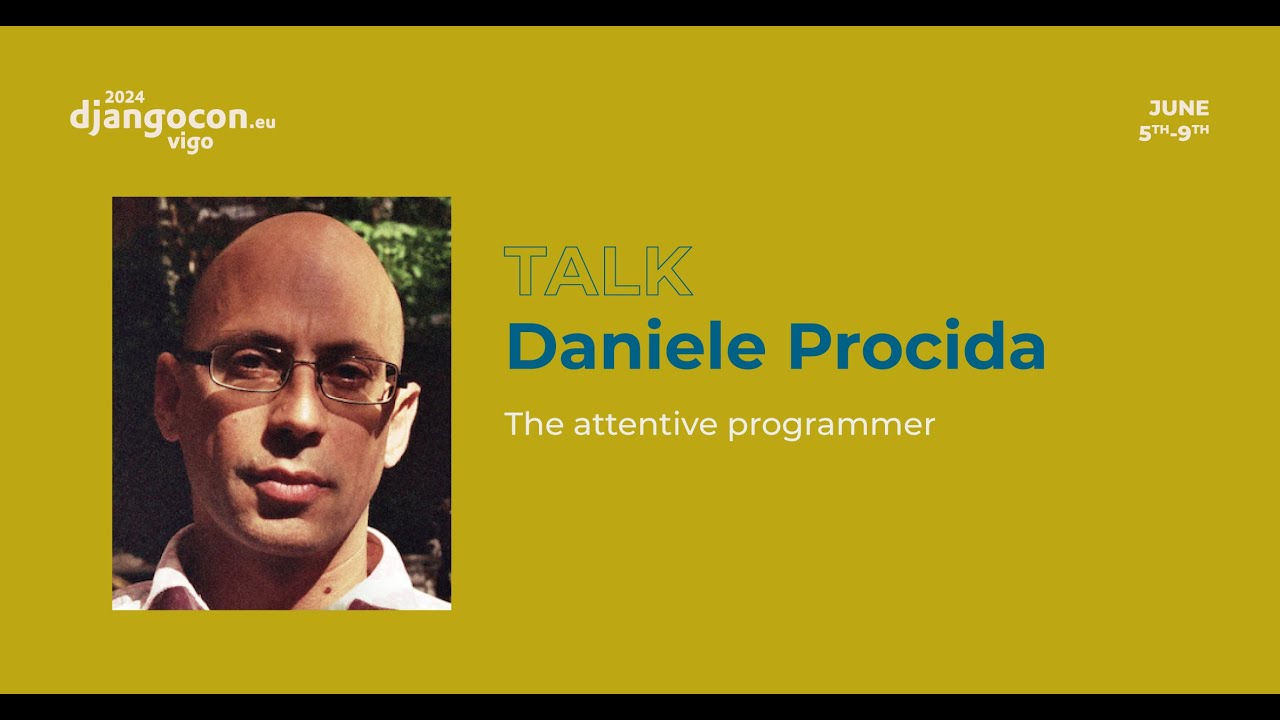
0:22:41
The attentive programmer
Published July 11, 2024
This video features Daniele Procida at DjangoCon US 2014 in Portland, Oregon, USA.

Daniele Procida argues that success is not earned by hard work alone: education, health, language, safety, confidence, resilience, social skills and supportive institutions are largely gifts of circumstance, or luck. Hard work remains necessary, but the ability to work hard and recover from setbacks is also shaped by what others have invested in us, while many people work harder without receiving comparable rewards. He applies this argument to software and Django, warning that meritocratic success narratives create exclusion, burnout and a false sense of individual responsibility; the community should share its advantages, lower barriers to participation, value different kinds of contribution and take collective responsibility for making success less dependent on luck.
Summarised automatically from the transcript.
Automatically transcribed, so expect mistakes in names and technical terms.
Speaker 1: Wonderful. Thanks for being here to listen to me. Thanks to Christoph Petos who invited me and to Stephen Nancy. and the organizers and uh volunteers who have set this all up. Um I should say before I go on that actually I'm pretty jet-lagged and uh at midnight last night I woke up in a terrible panic thinking that it was midday and I'd slept through my alarms. Also I can't see properly because I went swimming this morning at six o'clock and the chlorine reacted with my eyes. I'm also a bit deaf because I can't get the water out of my ears. And I gave myself a few nasty cuts while shaving this morning. So um I hope the cleaning staff don't feel the need to call the police
Speaker 1: feeling there's been a bloodbath in my hotel room. So I'm not entirely the perfect physical specimen I try to be. So with those came outside to the wing. I'm genuinely honored to be speaking here. It's really a pleasure for me. And Now it would make it a real shame if I upset anyone with anything I have to say, but I'm afraid that I might. And I'm going to use some words that polite people don't like to use, especially in this industry, and talk about some um unpalatable concepts and um
Speaker 1: say what I think are some hard to swallow truths. So Before spoiling everyone's morning with my talk, um let me introduce myself. Um I'm Daniele Pracida I live in Cardiff in Wales and I work at Divio. I work remotely for Divio of Zurich in Switzerland. Um and I am one of the core development team of uh Django. So um I work for Dio, it's a small uh Swiss company. They're extremely active in the world of Django, both as enthusiastic users and supporters of it.
Speaker 1: And I work on uh Django CMS, which many of you probably uh are familiar with, and on something called Aldrin, which is our cloud-based platform for uh Django CMS sites. And I honestly have to say that I couldn't ask for a better job. It's a super company to work for. And the work they want me to do is the work that I really love doing, which actually includes speaking at events like this, because part of my work is to liaise with the open source development community behind projects like Django CMS and of course Django itself. And if I may quickly say so. uh Divio is hiring have a look at our website
Speaker 1: divio. ch um remote and on-site Positions in um in Zurich. So please come and talk to me afterwards if you're at all interested about any of that. As I said, the other thing I am is one of the Django core develop developers and I still can't quite get over the fact that I was invited to join that team. And all in all, right now, I could hardly be happier with uh where I find myself in my work. So the question I ask myself quite a lot sometimes is how
Speaker 1: did I get here? I'm actually a slightly unusual uh programmer, I think, by most people's standards, because I didn't even start As a programmer until about five years ago, when I was already 39 years old and had had a couple of different careers, neither of which had anything whatsoever to do with programmer. And I'm not even a very good programmer or software developer. I'm slow, inefficient, inexperienced and fumbling, and I have to um work twice as hard doing mostly Poor work in order to do the same things that other people can do
Speaker 1: uh in a much better than I can So when I look back at what it took me to get here, what I see in my rearview mirror is hard work and a lot of it. It wasn't easy, but it's amazing to be here now. It's great that it paid off. It's wonderful that it all worked out. I'm delighted that the things I've worked on have turned out well, and I'm enjoying every bit of it And um the final reward for it is recognition uh in, for example, this uh fantastic job that I like so much. Uh my uh
Speaker 1: invitations to to speak, to participate, even the congratulations that people offer. So it's it's it's extremely nice to feel you deserve something and to be told that you do. So Can you just please raise your hand if you feel that your successes have been due to your hard work? Yeah, okay. And it's uh it is a very good feeling to feel that you deserve your success. And I think I have an extremely healthy capacity for recognizing merit where it's due, especially when when it's my own.
Speaker 1: But all the same, there's some small but that a small part of my consciousness is available to ask, and that is Do I do I really deserve um this And when I think about that in all honesty, Art, the answer is yes. Actually, I do. Because I have worked extremely hard And I've managed to do things that a few years ago I wouldn't even have imagined doing. And I honestly do think that I deserve the successes and rewards. And I think that the same goes for your
Speaker 1: successes and rewards and the successes and rewards of other people following their hard work. But there's still another button, and it's this, and it's the key. Even when we get what we deserve, it's not always because we deserve it. In other words, just because we've worked hard doesn't mean that it's actually the reason for our success. And I think that certainly applies in my case. So for the sake of argument, let's accept that hard work is at least a part of it. But what else do I have? What else do we have going
Speaker 1: for us? What actually is this recipe for success? Okay, well let's admit that hard work 's there. But also um education. I've been lucky enough to have a fantastic education. I've been to good schools, good universities, which I didn't even have to pay for because that's the kind of uh society I I I live in. good teachers and parents who care very deeply about my education. I have uh intelligence, or let's say at least well-functioning powers of analysis, synthesis, and comprehension. I have excellent social skills. I know how to get along with all kinds of people, make good impressions, behave appropriately in different situations.
Speaker 1: I'm comfortable in in most of them. I have the imagination required to be to function well at uh in creative and problem-solving uh work. I've had good I've had excellent employers actually who have been willing and able to support me. in my work, so I've I've hit the wrong one there, haven't I? Um my excellent employers. I've I've got self-confidence. Uh uh partly as well as a result of some of um these other things that I have. Here's one that might not occur to you. I have English as a first language.
Speaker 1: Now, most people here in this room have English as a first language, but that's not the case in our industry generally. I'd say that 90% of the people that I meet. in this sector are not native English speakers. So It takes me zero extra effort to read documentation or speak with colleagues or speak to you. I don't have to do any extra work. And the ironic thing is that my colleagues then. Praise or congratulate me for having a gift for communication. Well, uh that's quite easy when you're doing it in your native uh language. So I'm always at an advantage there. I have
Speaker 1: good health. It's hard to be successful when you're too ill to work. I have no disabilities. Daily life is never a struggle for me, nor do I have to deal with other people's prejudices or assumptions about it. Try being successful when you don't look normal. I have no excessive burdens. I don't have to look after other people. I have done and I know what that entails. And I know that the people who do have excessive burdens simply sink from view when it comes to success I have a safe place to live. No wars, no disease, no floods, violence, corruption, no danger that all my efforts in work
Speaker 1: could be swept away arbitrarily. In fact, where I live is so safe that if I did become ill, if I did, God forbid, lose my health, I live somewhere where there is free medical care to sustain me. So I won't have to, for example , start cooking illegal drugs and selling them to gangsters like on a documentary television I saw. Um so I probably share um most of these with most of you in some measure or another, you know, we we are all different, but I suspect that you too could uh
Speaker 1: tick those boxes. And I'm sure we can come with others, but I think you get the idea. So in other words, are we uh you are uh we we're well equipped for success. It would be more remarkable If I were not successful, because in a way I've been too well equipped to fail. Succeeding is the least I could do, and not succeeding would be like being rowed across a lake in a safe and comfortable boat with everything I needed and completely dedicated to my well-being and then drowning because I couldn't be bothered to swim the last 10 meters to shore. So if we accept that these things I've just talked about
Speaker 1: are the things that bring us success , Where do they come from? And to what are they owed? And I think the answer is that they are gifts, all of them. I was given those things. I did not work for them. I didn't earn them. I didn't struggle to attain them or achieve them against the odds. In fact, I didn't achieve them At all. In each case, they were given to me, they were provided to me by someone else, whether parents, teachers, schools, my society, so on. And so we come to that L word that nobody likes to hear.
Speaker 1: It's not a word that's used in polite company. And to avoid causing offense, I could just say that it begins with L and rhymes with fuck. But I'm gonna have to say this bad word a lot, so we might as well get used to it, that all you need is luck. And the truth is that I've had a lot of luck, and you have had a lot of luck, and I am here and you are here. because we are because we have been lucky. We are successful because we are lucky and we are rewarded for our luck. Okay, but I don't want to leave you with an argument that just sounds plausible when you hear it and then in the cold light of day
Speaker 1: starts to to fall apart when you reflect on it later. So I want to show that um I'm prepared to uh go into this a little bit more deeply. There are important nuances and qualifiers and all this, and I can't possibly go through all of them, but let's just briefly consider a few things that to show that uh it stands up to some scrutiny. So for example, setbacks. Of course, being lucky doesn't mean that everything is simply granted to you, that it's plain sailing, easy. Most of you, like me, I am sure, have had to overcome setbacks or even failures because success is not guaranteed even to the lucky. In my case, for example, a few years ago, I decided to become a high school teacher. And I gave up quite a lot to do that, and I was full of high hopes and determination.
Speaker 1: And it wasn't a very successful experience, so we can call it a severe disappointment. It did not last very long And that was a hard time, and my lucky gifts, however many of them I was able to enumerate for you, were simply not enough to make it a real success. And by definition definition, a real setback I think is one that you simply don't bounce back from. Recovering from a genuine setback like that was for me is a struggle and your lucky gifts won't make that easy. Similarly, whatever lucky gifts you have been given, everyone has limitations.
Speaker 1: And sometimes you have to work extra hard to get around your limitations or work around them, find different approaches to your problems or sometimes find ways to turn your limitations to your advantage. So in my case, I'm a rather poor programmer, as I said. I have a weak and hazy understanding of many key programming concepts. I have to spend much of my time reading and rereading documentation, asking people for explanations, and then having other people explain those explanations to me. By the time I've painfully made my way to comprehension, I'm actually in a position to write a better explanation of what I've just learned, one that even people like me
Speaker 1: can make sense of more quickly. So I'm certainly not a member of the Django core team because I'm a better developer than other people because God help us all if that were the case. But one of the reasons I am is that actually I can write better documentation, I can improve it, and that's because of the perspective That my limitations have given me. Or another example, when I approach a problem, the solutions, the programming solutions, are not obvious to me. I choose all the wrong ways at first. But that means that the problem that I need to solve for the person, for the user who needs a problem solved, always remains at the center of my perspective.
Speaker 1: It's not I'm not distracted by tools and methods and techniques. It's the problem itself that has to stay at the center of my thinking because the tools and methods and techniques don't come naturally to me. So and that has served me well. So again finding ways to turn your limitations to your advantages To your advantage is not easy, it requires work, and it's not a skill that everyone has. And of course, hard work. Please don't think that I am saying that hard work doesn't matter. Of course it does. Even if it's not sufficient for success, it's still almost always necessary. And if I had not worked hard I wouldn't be here, and you wouldn't be here if you hadn't.
Speaker 1: People do have to work hard, even the ones with all the free and lucky gifts. So let's take each of these points seriously, okay? The recovering from setbacks, dealing with limitations, and the necessity for hard work. respectively don't seem to involve luck. Well the resilience to recover from setbacks sorry the recovery from setbacks requires resilience But where does that come from? Is resilience of our own making? I think the fact is that if you're not already equipped to recover, you won't recover.
Speaker 1: If I wasn't equipped to recover to recover from serious setbacks, I simply would not. And my resilience was not. Conjured up out of nowhere by me, it was invested in me by other people in exactly the same way that, for example, my social skills were invested in me By other people, by my surroundings, by what I was given. So resilience to recover from setbacks is itself another lucky gift And the resourcefulness that makes it possible to turn a limitation to our advantage is also another lucky gift. It's only acquired because someone else
Speaker 1: or some education system or some social order made it their business to ensure that we had That resource resourcefulness. Our having it is not our undoing. And finally, do you think that working hard is simply a matter of having the will to work hard. I don't think it is. I think that working hard requires knowing how to work hard. Now, by nature, my inclination is to fool around and enjoy myself. I had to be taught to work hard. And I think it's deeper than that. I had Being able to work hard depends upon knowing how to work hard, just like being able to play chess depends on knowing how to play chess.
Speaker 1: It's something we have to learn, something that has to be taught, inculcated in us. I'm a hardworking person But I wasn't born knowing how to work hard and I don't think it's natural. I'm a hardworking person thanks to the painful efforts of other people Parents and teachers again, that I was lucky to have who could teach me and show me by example and by going all at me, as my children say, what it means. How to do it, how to work hard. So yes, it's us. It's up to us to work hard, but being able to work hard, knowing how to work hard, knowing what it means, is itself another lucky gift. No. So even
Speaker 1: hard work is not truly our own, I don't think. So his um our lucky gifts and we can add resilience and resourcefulness to them. And even hard work is not simply a matter of just working hard. Okay, what do other people think? This is typical. It's amazing how often people think there is a secret to success other than hard work. And I've got um three or four hundred pages of Twitter slides to show you on this subject. And so on. Okay There's more. Do an image search, if you like, for the word the terms hard work and success or a video search.
Speaker 1: You'll find all kinds of things that are exactly in this mold that success equals hard work. Success is the result of hard work. Hard work is the game guarantee your success. You'll find some dissent, sometimes a little nuance or qualification, but not that much. And people really do believe this, they really do take this sit seriously. So here's a good one I want to mention briefly. I found a a TED talk by somebody called Richard St. John. I've never heard of him, but it was one of the first things that the Top of a web search. So he's apparently very successful. He's an entrepreneur, a millionaire, he's won all kinds of rewards and he writes books about the eight things successful people have in common and that sort of thing. He has a black belt in judo
Speaker 1: and runs marathons and climbs mountains. He probably wrestles bears at the top of mountains with Vladimir Putin, you know so And here's a really popular TED video called Why It Pays to Work Hard. And really it is popular and people are lapping this stuff up. They love it. And he tells us, after interviewing 500, over 500 very successful people That hard work is a secret of success. Trust me, he says, I've interviewed over 500 successful people. Not one of them said it came easy. Well no shit. What did exactly did he expect them to say?
Speaker 1: Did he think they might say I have to admit the secret of my success that I was in the right place at the right time and made friends with the right people and had the right kind of education and the right kind of natural talents and the right kind of parents and the right kind of face and went to the right kind of school and had the right kind of health Because that wouldn't be a surprise. You know, if that's what they're saying, that would be worth a TED talk. Yeah. So I didn't want to be personal about this But this kind of layered fatuity of these six ghastly minutes in his uh TED talk was I find it rather hard to stomach. And it's in each case it's clear that he's talking about someone who alongside their admittedly Herculean uh hard work
Speaker 1: which by the way was only possible because they didn't have other burdens to attend to um We 're people who are being generously provided with lucky gifts in abundant quantities. So there's this Top independent Wall Street analyst who says he thinks about investments 24 hours a day, seven days a week. Well, guess who's not looking after a disabled child or sick parent Or Goss who doesn't have to worry about the health or fragility of his own body that much And he talks um Richard St. John about how enjoyable all this hard work is, how much fun, how amazing. How extraordinary but astoundingly well paid labor
Speaker 1: in the most comfortable possible surroundings, labor that's valued and recognized and congratulated and richly rewarded should be found enjoyable. What a surprise. And so on And I really don't want to be personal about this, but what I would love to ask him and the other five hundred smug-faced, facile, self-mythologizing, self-congratulating and complacent, very successful people, is if you're so hardworking, how is it that your thinking is so unbelievably noisy? So I don't know of and I don't know any successful person who has not had generous helpings of lucky gifts.
Speaker 1: And on the other hand, there are plenty of people who, despite vast quantities of hard work, will never attain success. There are people who work harder. for longer in nastier jobs than I could ever dream of doing and will never enjoy anything like success in that work. And no matter how many extra shifts you work for pittance doing unpleasant and unrewarding labor that will never be fun, you will never achieve Very much doing it. You will never be successful. If hard work were the secret of success, the most successful people on the planet would be Women living in sub-Saharan Africa, not
Speaker 1: top independent Wall Street analysts. And if you want to know the real secret of success, you won't gather useful evidence by interviewing 500 hugely successful people and swallowing whatever they have to say, because the evidence is in plain sight everywhere. In the lives not of 500 people and not thousands or millions, but billions of people. And it's pretty inescapable, I think, that hard work is not the secret of success. The secret of success is luck I'm gonna skip a few slides actually, just so that you don't have to listen to me too much. If I can find my uh right slide I'm just going to skip a little bit about failure you can probably work some of that out for yourselves
Speaker 1: um here we are so Briefly on the subject of failure. If you are lucky. It's quite hard to fail. Only really bad luck will dent your success. Only really bad work or behavior. We'll bring you down. If you've got time in the talks, ask me about that afterwards because uh in the questions, ask me about that afterwards because I've got an unpleasant anecdote to tell you And if you're lucky, then failure matters less in the end anyway, as it did for me when I I wouldn't necessarily call my teaching career failure, but it wasn't a success.
Speaker 1: And It certainly wasn't a permanent failure. Anyway, what does this mean for us? Because I've spoken for 25 minutes and Haven't really come on to us yet. So this applies especially to our software industry and also to us in the world of Django for these reasons. Our industry believes very deeply in this, in this mythology, this ideology rather of success and hard work. People in the industry The successful ones and also the ones who are not yet successful, the ones trying to be, really do believe that it's a meritocracy where their hard work
Speaker 1: grants success. And our industry is a very influential one. Its ideas, its values, its attitudes and practices are noticed and emulated by others and other industries Our industry determines how people live. We are building the world that the rest of the world has to live in. Increasingly so. What we build and the way it works is going to reflect our ideals and values. And our industry is not working very well for the many who have to live in it. It's exclusive and lacks diversity.
Speaker 1: It disadvantages the less lucky, compounding their ill luck while insisting to them that it's a meritocracy and what they need to do is work harder. Its infatuation with this notion of hard work harms even many of the lucky and the successful because working 80-hour weeks, however much you earn, is not good for you. And this is why burnout and exhaustion and depression are a real problem in this industry. So it's I think a dangerous lie In other words, our industry believes in a dangerous, harmful lie that obscures
Speaker 1: an important truth about success. And in failing to recognize the role that luck plays in our industry and our success in that industry, we risk allowing that industry to harm us. And to harm the rest of the world. And I think it's really a very effective layout. It's a brilliant one because it covers up its own tracks. It focuses attention on the individual And what they have to do away from the conditions that made the individual and under which the individual must work. It makes it easy for the successful to rewrite the history of their success and not
Speaker 1: worry about uh what gave them that success. It makes them makes it easy for them to fail to see what's holding back others. It makes it easy for people who are trying to succeed to believe that they have to do it entirely on their own And it makes success into an exclusive club, forcing people on the outside to sacrifice themselves doing useless things in the attempt to get into the club. Now, of course, um I quite like exclusive clubs, especially when I'm a member, when I can be a member of them anyway. Yeah. And being a member of an exclusive club, I have to admit, doesn't just make me feel good, it makes me feel better than other people.
Speaker 1: Which is great. I I I do know that. That's natural. But it's not very good. It's not right. It's unjust. And it's untrue. But it's really seductive. And this lie is really seductive, whether you're on the right side of it or the wrong side of it. Somebody said something very helpful to me. He said um uh well yeah when I was talking about this okay but um What happens to responsibility in in your picture of things? You know, doesn't that fall out of the picture? Uh in the
Speaker 1: um and Actually, I think that it doesn't fall out of the picture. I think that we have to find a different place, a proper place for individual responsibility. in this a place where it can make sense, not be fetishized, not be part of a dangerous lie. And it makes room for a new kind of responsibility, collective responsibility. There's actually we are more responsible. There is a more of a burden of responsibility on us, not less. This is not an abrogation of individual responsibility. It's an acknowledgement that we are actually responsible for others, responsible for uh responsible to the world we are a part of
Speaker 1: So what does this have to do with Django specifically? Well we, and I mean the Django community, want to be an inclusive club, one that anyone can join and participate in. We want it to be possible for more people to be successful. While being Djangoists. And this is built into Django 's ethos. So the problems that I've spoken about Our problems for the Django project. Django right now is being affected
Speaker 1: by these problems, by this ideology. you can trace them right back to this ideology of work and success. In order to be contributors to Django, to participate in the project, to um Be engaged, people need to have at least a little energy and time to spare. But we're losing valuable people in the project, even in the core team, through burnout and exhaustion, frustration, dismay. We're losing contributors who give up because they've tried to get into this club of participation and have their work acknowledged and so on and have
Speaker 1: failed and we're losing them We are failing to gain new contributors because some of the barriers are too high for people who are not already on the inside and we remain horribly undiverse And we fail to gain new contributors and new ideas and new approaches from people who are not like the people who are already in the club. So the exclusive General Club is not some hip new chess club in town. It's what we are in a danger of becoming.
Speaker 1: Now I'm a member of the Django Core team and Well, what do you think that we talk and and think about? You know, the the the carpets or the new lasers for our island hideaway, you know, the the bunker in the middle of the sea? Or or do you think we talk about finishly complex aspects of the ORM that no one else could possibly understand? Well Actually no, um what we talk about, what we're mostly preoccupied with is the Django uh community especially of late questions of inclusivity how can we gain more participation how can more people
Speaker 1: contribute feel that they're a part of it How can we make Django better by having a healthier community? And what we're most worried about is that commuting to Django, participating, being successful a successful part of this project is more difficult than it ought to be for many people. on the website for this conference. Now don't I'm not criticizing this because uh of course it was entirely well intentioned but it was unfortunate somebody referred to the core team as um the god y this is your chance to meet the god, the core team, the gods of Django. So uh we were a bit shock
Speaker 1: because that's not how we see ourselves and absolutely it's not how we want anyone to see us or or or what we're doing. That's not what we are. caretakers of the community. And that's the i that's the kind of idea that's out there. That's the kind of barrier that's being raised, even if people don't realize it. So in a way actually it's quite useful that that's that uh that was posted onto the website because there you are it highlights a problem for us that we need to deal with. So here's our friend Imeric Augustin. He's one of the core developers. And he's recently been trying to lead some
Speaker 1: changes. Now What's interesting that he has very different political ideas from me. He's probably quite sick of hearing me talk about ideology, although he's much too polite to say that. And but he agrees with me that we are we are hurting, or our project is being hurt by ideas about work and uh successful participation that aren't for many people who aren't already lucky enough to be part of it really true And one of the things he said when I was talking to him is that he wanted to expose the hidden power structure
Speaker 1: within Django so that we can do something about it. So that's interesting the hidden power structure. Maybe he doesn't think he's uh got an ideological analysis, but perhaps he does without realizing it. So if you um have a look, it's on the um the development documentation, so it's not yet gone into a uh a Django release, but he has done a lot of work in um the last months to rewrite some of that to s To reset the tone, to reset expectations, with the hope of bringing more people in and lowering some of these barriers to success
Speaker 1: and participation. And that is the kind of thing that we in the core team are really concerned about. So we're really grateful to Ayymerik for this hard work. He's put a Yes. And it it's really reassuring to me to know that even though, as I say, we are very politically different, that actually We are thinking on the same lines when it comes to this. But um well why should you care about any of this? You know, you're probably pretty lucky already. Otherwise you wouldn't be sitting downstairs in a nice hotel in a nice town with a nice computer in front of you and all this stuff. Why do you need to care about this?
Speaker 1: Well Django is not just a bit of software. It's also a community of software users. It has an ethos. And one of the main Principles of that ethos is that participation, engagement, and success with Django should not be reserved for a lucky few. And that ethos was built into it by its founders. It's expressed in, for example, Django's outstanding documentation that successfully achieves its aim of lowering a barrier to entry. The documented documentation, I think, expresses consideration and respect for even the most new novice newcomers. to Django. So that's quite an interesting way to think about our documentation as an act of respect to other people.
Speaker 1: It's expressed in the tenor of communication within the project, on our email lists, in our IRC channels, on our ticket tracker. Where communication is friendly, courteous, and helpful. It's expressed in the codes of conduct which govern uh that covers events like this one, and the actual conduct of people at these events, which is uh welcoming, inclusive, and friendly. And I've got one lucky gift that I didn't even mention on that slide, and that gift is I was lucky enough five years ago that I chose Django and not something else. Because the amount of extra brilliance I've been given by Django and its community can't be
Speaker 1: overstated. Just that was one of the luckiest choices I've made in my life. And I made it because I thought the website was a nice colour, basically. You know I wrote a 52-page document from a manager rationalizing it, but I think that was the real reason. We should care because I think nobody wants to live in communities for the privileged only, or in the burning towns of communities who's unlucky, in the burning towns of communities whose unlucky populations have lost. Patience. So it does matter for us. And what can we do about it? Well
Speaker 1: We want more people to be more successful. We want them to be active and engaged, satisfied, rewarded participants in our community, in our industry, in our world. What can we do about it? Well, it's a toilet. You know, it's not something let's not focus on the individual. This is none of these things are things that we as individuals can do. The responsibility is shared. Um what can we do to make more people lucky in the terms that to give them more lucky gifts? Well We can be the good employers and collaborators people need. We can share our skills. We can help people develop the self-confidence they need to participate effectively. We can be a part of this in small ways. But mostly this I think is a wider and deeper political aim.
Speaker 1: It can't be the responsibility of individuals. It requires a shift in our collective thinking about success and the role that luck plays in it. But we can all do our bit. Everyone who 's giving out a talk at an event like this, where they share something they know, is doing their bit. to pass on their luck to other people. I do my own bit, as uh Russell said, I I'll be running a a little tutorial at the start of the on the first day of the sprints called Don't Be Afraid to Commit. If you want to participate in contributing to Django but don't know how to get started, come along to that. We can make Luck matter less. We try to do this already. So for example, by closing the gaps that um the person with fewer lucky gifts has to leap.
Speaker 1: We write our documentation for the non-native English speaker. We lower the barriers to participation. We try to make different routes available into participation in Django. So you don't have to be a top-flight programmer to make a useful contribution. And we want people who are not top flight programmers to be making useful contributions. There's more than one way to be a successful part of this community. And we recognize that some people don't fit so neatly into our industry as others. And for example, our codes of conduct are intended to ensure that they're not made to feel too uncomfortable to be there. And another thing we can do is to change what success actually means. So for example, our friend Richard St.
Speaker 1: John of uh that uh TED Talk managed to interview over 500 very successful people But neither he nor they seem to have considered the possibility that, for example, thinking of finance 24 hours a day, seven days a week, is actually a pretty shit way to spend your time. And that when you're spending your life working 80 or more hours a week, that's not a life that's really worth aspiring to, however much it earns, because something else is missing from it. So when people talk like that, our reaction should be to laugh in a kind of embarrassed horror, not to applaud them for their
Speaker 1: crazy quantities of hard work. This is Alexei Stakanov. He was a minor in the uh Soviet Union. He was a hero of socialist labor. In 1935, he set an extraordinary record by mining 227 tons of coal in a single shift. It's an astounding quantity that no one could match. And it demonstrated the superiority of the communist production systems. So the stagov Stakhanovit movement was a huge propaganda tool for the Soviet Union.
Speaker 1: This is how the system works. This is how we work. This is communist labor. Those who opposed this movement were called wreckers. Now, he was upheld as the model for workers to follow. People were rewarded. all kinds of medals for huge amounts of production and so on. But in fact, all kinds of things made it possible for him to achieve this record, like being given the best teams to work with, the best tools, the best um seam of coal to work on And apparently having other miners production quantities counted in his own, which kind of helps
Speaker 1: And here again is an impossible ideal for other workers to measure their success against. And it's what we're seeing here in our industry. It's ideologically motivated propaganda. We are facing a modern-day Stachhanovite movement. in which the Soviet methods have been replaced by individual hard work. But the effects are similar though of creating exclusive clubs, making it hard for people to succeed, making it easy for people to drive themselves in the ground in the attempt to do so. So I would say don't be beguiled by
Speaker 1: this lie and don't worship propaganda heroes where they're there. Soviet miners or Wall Street analysts. Be aware that success depends on lucky gifts, whether it's your own or other people's. And share your lucky gifts. And don't be afraid to demand that other people share theirs too. So thank you very much for listening to me. I'm Daniela Pracida. You can email me if you want to get in touch. I'm organizing DjangoCon Europe next year in June 2015, which will be held in Cardiff, Wales, you are all cordially invited to come. You can come and talk to me about that
Speaker 1: In fact, if you'd like to talk to me about uh anything, if you'd like to talk to me about Divya or the jobs, or about the core team, or about don't be afraid to commit or the sprints. or Soviet miners, or if you want to talk to me because you're new at JagoCon and you don't have anyone else to talk to, please come and talk to me. I'll be really pleased to talk to you. Thanks very much for listening to me.
Speaker 2: Well thank you very much Daniela. Um we've only got time for a couple of questions if anybody's uh keen on a on a question or two. I'll I'll throw one out here just to get the ball rolling because No, if anyone knows me, no one ever gets out of a room that I'm in without a question, and there's a backstory. So come and talk to me if you want to talk to about talk about that. that success is measured in this way is because it's easy to measure. Now, for example, people uh historically people have become members of the core team because they have contributed a lot of tickets. or they have posted a lot of messages to Django Django developers. And that is something that they're only able to do because of the luck they've had to have the free time, to have the expertise, to have all the other factors that you've
Speaker 2: positive there. But it's effectively the reason that it's become the thing that we we use to judge whether someone becomes a member of the core team is fundamentally because it is something that can be measured. It is a quantifiable that number is larger than someone other 's number. What do we replace that with? What other metrics can we use that aren't based upon sheer quantity of contribution that take into account some of the luck factors that other people may not have?
Speaker 1: I mean that's just thank you for asking me such an easy question to answer, Russell, you know. Yeah. Because uh really I think if I if I had a very good answer for that, I I would have spent some of the last forty-five minutes giving you that answer and I don't really know I think that we have to keep talking and or no, I think that w we the core team have to keep listening and you the community have to keep talking. And we have to hear your complaints and frustrations. And sometimes people get um frustrate and express their frustration, for example, on on the Django developers
Speaker 1: list about their work and how it's been ignored and this is a closed shop and so on. I'll tell you what my natural instinct is, it's fuck off asshole. You know, because that's how exclusive clubs work. And these reactions are really dangerous. We must be aware that they are natural reactions and we have to look at what's happening and and you know think with humility, you know, Imeric. Imeric has the gifts that Could uh he'd be forgiven if he were supremely arrogant with those gifts.
Speaker 1: But he's not actually. He's um undertaken a very humble piece of work and he's really to be applauded for that. And I think that's the kind of thing we're doing. I think there's no single thing, there's no one single answer. We don't there's no heroes gonna come and solve this. That's the whole point. There are no heroes. It's a little patchwork of effort that everyone has to take part in. That's the best I can do. Thanks, Roscoe. Thanks again.
Speaker 2: I'm sorry we're up against the break.
Speaker 1: Okay. So
Speaker 2: thanks again.
Hard work is usually necessary, but it is not sufficient or the main explanation for success. Education, health, safety, social skills, support, language, and other advantages are largely gifts of circumstance—luck—that make success possible.
Discussed at 13:28No. People still need to work hard, recover from setbacks, and deal with their limitations. But resilience, resourcefulness, and even the ability to work hard are themselves things people often learn or receive from other people and circumstances.
Discussed at 17:28It hides the advantages that successful people received, blames less-lucky people for their lack of success, and encourages unhealthy overwork. In Django and the wider software industry, it can reinforce exclusion, burnout, and a lack of diversity.
Discussed at 29:47Individual responsibility still matters, but it belongs within a larger collective responsibility: people are responsible for one another and for the world their communities create. Making success more accessible requires shared action rather than asking each person to overcome structural barriers alone.
Discussed at 33:08Participation in Django requires time, energy, confidence, skills, and a sense that the project is approachable—resources that not everyone has equally. The project risks losing contributors through burnout and high barriers, while remaining less diverse than it could be.
Discussed at 34:40People can share skills, provide supportive employment and collaboration, build others’ confidence, improve documentation, lower entry barriers, offer multiple ways to contribute, and enforce welcoming codes of conduct. More broadly, the community should share its advantages and redefine success beyond sheer quantity of work.
Discussed at 43:07Note: We understand that names change, people change, and bodies change. We respect each individual's journey and privacy. If you have any concerns about a video or need us to remove content, please don't hesitate to contact us. We will handle your request with care and promptly address any issues.

Published July 15, 2026

Published July 15, 2026

Published July 15, 2026
Published July 15, 2026
Published July 15, 2026
Published July 14, 2026

