
0:32:10
Orientation with Kojo Idrissa
Published October 26, 2026
DjangoCon US 2026
This video features Andrew Selzer at DjangoCon US 2026 in Chicago, Illinois, USA.
Taking that first step into open source can feel overwhelming, but it doesn't have to be. This talk is a friendly, practical guide for developers who are curious about contributing to projects in the Django ecosystem but haven't made that first contribution yet.
We'll start by asking yourself why you want to contribute in the first place. Having a clear goal will keep you motivated when you hit those inevitable roadblocks. From there, we'll walk through how to find a project that aligns with your interests, skills, and availability, how to take the time to understand a project's contribution process, and how to find the right first issue, whether that's a code change, a documentation update, a bug report, or a code review.
We'll also cover what happens after you submit your work, how to receive feedback with an open mind, iterate, and celebrate getting that first pull request or change merged. We'll also touch on how to use AI tools responsibly as part of your workflow.
You'll leave with a clear, actionable path to your first contribution and a curated list of resources to help you keep the momentum going.
This talk was presented by Andrew Selzer at DjangoCon US 2026 in Chicago, Illinois, USA
https://2026.djangocon.us/talks/enter-the-ecosystem-contributing-to-django-open-source-projects/
LINKS:
Follow Andrew Selzer 👇
Website: https://www.linkedin.com/in/andrew-selzer/
Automatically transcribed, so expect mistakes in names and technical terms.
Speaker 1: As Marlo Sellers said, I'm Andrew Sellser and this is the talk Enter the Ecosystem, Contributing the Django Open Source Software. Before we get started, also hello to everyone who is attending online. Oh, skipped several slides. So start off a bit about me. I'm from Somerville, Massachusetts. It's near Boston. The picture on the right is my local neighborhood, the Prospect Hill neighborhood. I've been a software developer for 10 plus years, working primarily with Python and Django. I'm an engineer at Natural Gas Intelligence. Actually my entire team is here. If your company doesn't sponsor you to go to DjangoCon Highly recommend talking to your manager about that opportunity. It's a great way to invest your career in the upscale. I'm also a maintainer of Django Dance School. It's an open source dance registration software project.
Speaker 1: To make you be able to sign up for classes for free instead of using something like MindBody that takes a cut of every registration. Outside of coding. I have a partner named Andrea. It gets really confusing at times. We have two cats, pepper and pumpkin. They often join me for coding. I run a dance school and I've been teaching dance for about 20 years. I also enjoy jazz music and play clarinet and two jazz bands. A lot of you probably know this, but if you don't, Django was named after the musician Django Reinhardt. Yeah. So who is this talk for? If you have little or no experience contributing to Django open source projects, this talk is for you. If you have some experience, I hope to have some useful tidbits for you, but this is mainly like a beginner new to contributing to Django
Speaker 1: Open Source Projects talk. Maybe this sounds familiar. I don't even know where to start. I don't know enough about programming yet What if I ask an obvious question when I'm typing an issue or messaging someone on a project's Discord or Slack? I'm here to tell you that contributing to open source projects is for everybody. It's not for somebody who's an intermediate or expert programmer or even if you have little to no call like knowledge about coding. So what is an open source contribution? I really want to emphasize it is not just a merge pull request. I know a lot of people think about that, but there's many other ways to contribute. And actually a few other talks this past weekend have talked about. or this week have talked about this as well. It can be reporting a bug.
Speaker 1: A a clear and reproducible bug report or ticket is very useful. Triaging a ticket. Checking whether an issue is still existing and reproducible. Testing. Checking out a branch and confirming it works. I think there was a talk earlier that talked about how we needed more test reviewed for Django itself. Improving documentation. Fixing a guide that you ran into an issue. If you just ran into an issue, you're probably the one of the most qualified people to address it. Translations. Many projects want to reach a wider wider audience. If you speak a second language that's not featured by the primary language of a project, it's a great way to contribute. And then lastly, answering questions. Um
Speaker 1: I believe actually as part of sprints on 1-3 p. m. I think tomorrow Frank Wiles is running a Django New Features review where they want to review new features. If you want to answer some questions and contribute that way, that's a great opportunity. So we're first going to start off with you our roadmap for today. And where we're going is we're going to start off with knowing your why. It helps you survive roadblocks in a project or working on an open source contribution. Picking a project, learning the process of how that project works, like how does the ecosystem work? What culture does it have? Finding your first issue, and then lastly, submitting and iterating So we want to start with your why.
Speaker 1: It is important because for any goal, whether it's an open source contribution or just like anything you want to work on in general It helps you get past when you run into friction. I rarely recommend starting this before you write a single line of code or before you type a sentence at all into an issue or to a or anywhere you like would start. So, why do you want to contr contribute? There are a lot of different reasons. I don't judge anyone for any one of them. I think they're all valid. Here's our few examples. First off, you want to learn. You want to learn maybe more about the project, or you want to learn how the code works in a project? Grow your career. You want public work that you can point to in an interview. You want to give back. You really enjoyed a project.
Speaker 1: It's really benefited you like your workflow and your life, and you just want to give back to it. Belong to a community. I mean I think a lot of people go to DjangoCon because they really enjoy the community of this event and they want to invest in it and feel part of it and contribute to somebody who helped them feel like they belonged. And then lastly, oh, sorry, hit my own HDMI cable. Fix something at the source. I've I've run into this one myself. You run into an issue with the project. You fix it in your own code base and you want to ship it out to the actual project. That way you're not just having the fix live locally. And also maybe many other people have complained about an ticket and will like your fix as well. As I said early, earlier your why is your fuel to keep going. You'll hit a roadblock.
Speaker 1: You're not special. Everyone does. Some examples of this. You're following the dev docs and the project will not successfully build or tests will not run. Nobody replies to what you wrote in an issue for days or perhaps week weeks. The first review on your pull request asks for changes you didn't expect. So when you run into this, remember your why. I actually recommend For like any goal setting, writing it down. That way it's not an abstract thing you forget. It's fresh in your mind and you can go back to it You also want to have a plan for when a setback happens. Like starting a workout program or learning a language. Have this plan so when you're stuck, you don't have to think about it. Like what is your plan? What do you do? Make this plan before you start
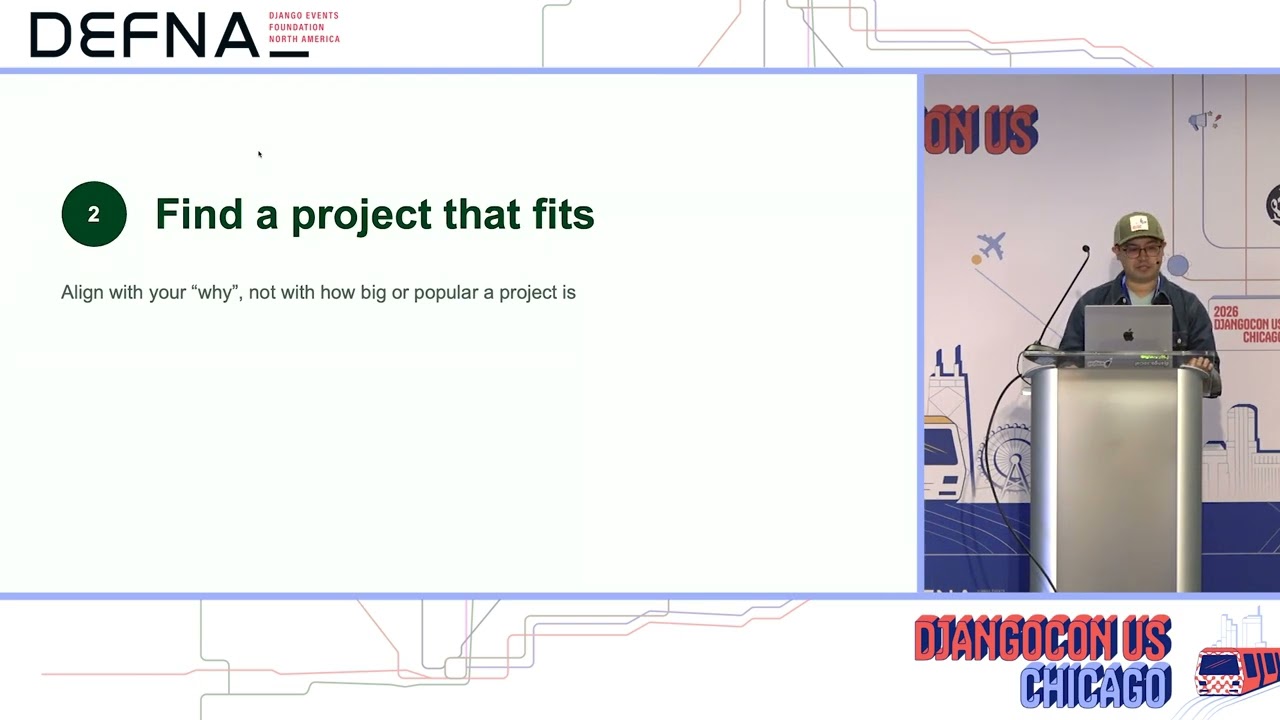
Speaker 1: And it doesn't have to be a complicated plan. It can be as simple as joining the Slack or Discord for a project and your plan is when I run into an issue, I'm gonna go into the help channel and ask a question. So, second place we want to go is find a project that fits. You want this to align with your why, not how big or popular a project is Oops. So three different filters you can try on to figure out a project that fits. Interests, do you actually use the project? I find personally it's a lot easier to stay motivated and I'm not starting from ground zero if I actively use something and know something about it. Use that advantage of familiarity
Speaker 1: Skills, do you have relevant skills for the project? You don't need to be an expert, but having relevant skills for a project Or the time to learn those skills is important. If you don't if you don't know anything about the project, it's okay, but do you actually have the time to invest to learn those skills to contribute to it? And then actually speaking of having the time, availability. Do you have time for what you want to work on? Contributions can be short as literally minutes or as long as like days or weeks. And something to keep in mind for selecting a project to work on is projects with a larger code base and more users can have a more thorough review process. So if you know like your part of your why is I want to make a small contribution and I want to have it and like I want to do it quickly, then maybe choosing a project that has like a lot of
Speaker 1: red tape or extremely long review process isn't the best fit for you. Also for contributing to like for a larger contribution you want to make sure to check in on your time. Because I've definitely started projects or contributions where I had all the time in the world, real life happened, and I had that just my investment. And actually something nice to do in those cases is if you're collaborating with other people, give them a heads up. You don't you don't want to be the person that the maintainer or someone else's uh working on the project with you has to like chase via email or slack to find out what's going on. Cool. So where to look in the Django ecosystem. One step is you can check packages you already use. If you're like Andrew, where can I find those? You probably have a requirements file where somewhere they're stored.
Speaker 1: Check there. Local Python and Django groups likely has people who can answer your questions and help you out. The very obvious one, DjangoCon Sprints. They're literally in this room. If you show up Thursday and Friday, there are people who have projects that are excited to talk about them and want your help. Um Django Not Space, it's a structured mentorship program for for Django contributions and it's not just a Django project, it's Jang other things as well. I believe that their application um Uh applications are open until September 6th, so if you're interested in that, get into it like check in on that sooner than later And then last not least, first issue. First issue or similar tags.
Speaker 1: It's a good signal that the project has an ecosystem that's supportive of new or first-time contributors. At the very bottom I have an example from the good first issue from Wagtail. So if you type in like Django first issue in whatever search um or whatever browser or search engine you use, that's a good way to find a place to start. Cool. So next in the roadmap, learn the contribution projects process. Every project has one. It's part of the culture of the project, and they are all not the same. Some are small projects where you're literally talking with like one person who's the maintainer and they do everything. And other projects have entire like multiple teams that you have to find the right people to talk to and coordinate with them. An example of this is I have German and Filipino ancestry.
Speaker 1: For the German side of my family, if you're 15 or 30 minutes, if you're not there 15 or 30 minutes early, you're late. Whereas for the Philippine side of my family, if you're like two to three hours past the starting time, that's probably a decent time to show up. And a lot of projects like this. So like take the time to learn how it works. You can find information about this like in whatever issue tracker they use, if they use a chat program like Discord or Slack, I don't think anyone's on IRC anymore. You can you can find you can just observe and figure out, oh, this is how they communicate. This is how the process works. So good places to actually learn about this. Contributing. md as kind of standard operating procedures for most projects.
Speaker 1: Recommend reading through this and other related documentation thoroughly. Code of Conduct, how people are expected to treat each other within the project's ecosystem. Read that and follow it. Recent merge pull request. It's a great way to find a signal of what looks like good or reasonable for a project. And then last but not least, the dev setup docs. Get the project working before you change anything and that's just that's something I recommend is before you start contributing to a project if you haven't run it that's a really good place to start. Ideally you use it already, but If you're looking to contribute something new, get it working and then move on from there. Um next is finding the right first issue.
Speaker 1: A code contribution is only one of the many options. So, again four ways to contribute. And you'll notice I'm repeating a lot of things in these slides. It's because something I learned from boarding a marketing team for several years. You want to just I really want to emphasize these ideas. Um you can do the the known code change. This is a contribution many people think of. I recommend starting with a small change such as a simple bug fix. Like some of my first open source contributions were I fixed typos in documentation. It's a great place to start and it's often very low effort. And it's a good foothold to like start to like build uh your open source contribution journey.
Speaker 1: Um actually speaking of that, a documentation update. Um often when you're building a project or you're trying to read through documentation, understand what's going on, you'll flag if something's unclear. Also you can flag if something maybe can be improved. Like for example, my mom speaks English as a third language, so I can often chant like sense in documentation when they're using like Colloquialisms are something that's not intuitive to somebody unless if they speak English as a first language. So it's always nice to change stuff like that as well. A bug report. A clear reproducible bug report is very valuable work And that's a great way to get in as well. And last but not least, a code review. If you're one of your whys is you want to get better at learning, reading code is extremely valuable to do it
Speaker 1: As I mentioned earlier, I think Django is looking for people to help out with code reviews. So what does a good first issue look like? Here are some good signs. It's small and clearly scoped. I have found very few, if any, maintainers appreciate it if you try to refactor their entire project. Nobody else is already on it. Again, maintainers generally don't like it when you start on a ticket that someone already has worked on and is and they have a conversation going about it You can describe the fix in a sentence. If it's it's more complicated than that, maybe that's not a good place to start. The desired outcome is written down. That's a very obvious place to start. You already know what to do, you just have to implement it.
Speaker 1: It has the hashtag or like an issue tag first time first time contributor or something similar. And again, this talk doesn't at beginners. If you have a lot of experience at coding and you're going for like a pull request, maybe this might not apply to you. Um issues you want to double check first. Open for years without no with no decision. I don't recommend trying to revive a thread that's been dead for years unless if you have a very good reason for it A long unresol resolved design debate. And then lastly, touch as many files at once. Again, like unless of you have the experience doing that and you're very familiar with the project, that's probably not a good place to start. And then fifth step, submit, respond, and iterate.
Speaker 1: Um something I want to emphasize is I think Thank you, Marcelo. Uh a lot of people have the misconception when they start contributing that opening a pull request or commenting an issue is like you're you're about to cross this line like the the little ribbon at the end of a line for a race. And that's often actually the start. Like sometimes you can start control you can start um contributing and realize, oh, there's more to this issue than it appeared on surface. I've I've definitely had things where I thought this was going to be a quick fix and it ended up taking much longer, but it was a better fix in the end. So just set your expectations accordingly. An important part of contributing is receiving feedback.
Speaker 1: There was actually a very good keynote about this. Reviewing is about the contribution. It's not about you. I try I try to always assume good intent and remember if someone is giving me feedback, it's because they want me to be better and do better. And if I want that as well, I have to be able to hear that So the start, as I said, assume good intent. Direct review comments can maybe mean a busy reviewer, a maintainer, not one who is personally unhappy with you. Um ask when unclear Can you say more about that? Can you say more about what you like here? Or can you give me examples of what it would look like to move forward? Those are reasonable replies. Again, if you're contributing to an open source project,
Speaker 1: most of the time people want to help you because you're you're con you're helping them out. Um also lastly pushing back kindly. You're allowed to disagree as long as you explain your reasoning reasoning and have an open mind. I've had issues I've had situations where Our reviewer said this fix doesn't look like it's working. I've talked to them or or talked in the issues and it discovered that they had a different branch checked out. We're humans, we make mistakes. It's okay. Just be willing to talk through it Next, using AI tools responsibly, which is not a controversial topic at all. From my point of view, I think they're helpful for explaining unfamiliar code to you. getting the local dev environment on stuck, drafting a clear issue description, but not writing it for you
Speaker 1: Um I would say check the project's policy. Many projects now have an AI contribution policy and if you just use an LLM to do the full contribution, some projects straight up don't allow it or some of them ask you to acknowledge how you use an LLM. Never open a PR, a pull request that you can't explain or answer questions about. or even answer an issue that you can't explain your answer at all. And also , just to mention this, like unreviewed AI output costs maintainers and reviewers time. Also, I think it probably doesn't help out with GitHub's recent outages. Lastly, your contribution is accepted. It's always nice to thank your reviewer or anyone else who helped you out in the process.
Speaker 1: You can tell a friend, a colleague, the internet, or do something to celebrate your contribution. If one of your goals was for career development, this is maybe a nice place to put like a Macedon or a LinkedIn post Write down what you or log what you learned while it's fresh. If one of your goals is learning, you want to make sure you maintain those lessons and use them for future projects you work on. And then next, pick your next contribution. So, whoop, I keep handing my M2HDMI cable. Where to go next? As I mentioned earlier, DjangoCon Sprints. They are literally right here. in the next two days. Um local Python and Django meetups, uh Django Notch Space, again a mentor-based program. If you want to contribute the Django itself, there are a lot of documentation about this.
Speaker 1: There's a Django contributing guide. Many people at this conference who can probably talk to you about it. I believe there's also as part of the sprints a little section for people who want to contribute to Django to meet up to do that. And I'm trying to think of anything else. Also local groups. If you have a Django Girls group, highly recommend that as well And then lastly, I want to end this talk with a call to action. Pick one thing this week. It can be even as simple as I will show up to this room tomorrow for DjangoCon Sprints and see what projects are available. Or it can be, I've been interested in working on this project, but I've just never taken the time to do it, and putting some time in your calendar to work on a project. I think one small link change after another leads to
Speaker 1: bigger and bigger contributions. Thank you so much, everybody, and I think I'll take any questions now if you have any. Yeah. Oh god , I don't think that's a good idea.
Speaker 2: Thank you for the talk. Um one thing which always happen is imposter syndrome. How do you think we can deal with that?
Speaker 1: Oh, I have that's a really good question and I have a lot of thoughts on that. The startup flip, I think almost if not everybody runs into it and just remember that everyone started in the same place Like I think in nearly every endeavor I've done, whether it's open source contributions, learning how to dance, learning how to play music I had stages where I was just trying to start at the beginning and doing small things. So I think remembering that everyone started in the same place and starting small and stacking up wins is the way to go. Like having for me what works but good for me is I have small goals. And then once I accomplish them, I start building more and more. Also, I would say there are several good talks about imposter syndrome. I think a few of them have been like PyCon and DjangoCon, so I'd recommend anyone who's feeling that
Speaker 1: Realize you're not alone and look into those resources.
Speaker 3: That was a a really good overview of how to get started contributing to open source. Um definitely gonna be linking to that a lot. Uh I was curious what types of contributors are you looking for for your own project and are you gonna be at Sprints?
Speaker 1: Oh, that's a good question. To be honest, I have not been that good of a maintainer. I think I've run into the project the problem that many maintainers have had is I've gone busy. So like my project, we actually support three dance schools, one in Boston, one in DC, and then one all the way in Australia. But it's working good well enough for us that we really haven't done anything. I would say the project is online if you want to contribute to it. I'm not going to be personally running a sprint on it, but if you want to contribute to the project, please talk to me either in the hallway or at the sprints. I'll be there on Thursday and I'm happy to help you out. Yeah, thank you. Well
Speaker 4: Andrew, thank you for the talk.
August 24 - 28, 2026
Chicago, Illinois, USA
Note: We understand that names change, people change, and bodies change. We respect each individual's journey and privacy. If you have any concerns about a video or need us to remove content, please don't hesitate to contact us. We will handle your request with care and promptly address any issues.
Published October 26, 2026

Published October 26, 2026

Published October 26, 2026

Published October 26, 2026

Published October 26, 2026

Published October 26, 2026