
0:35:30
Reliable Django Signals
Published October 26, 2026
This episode of DjangoChat features Haki Benita.
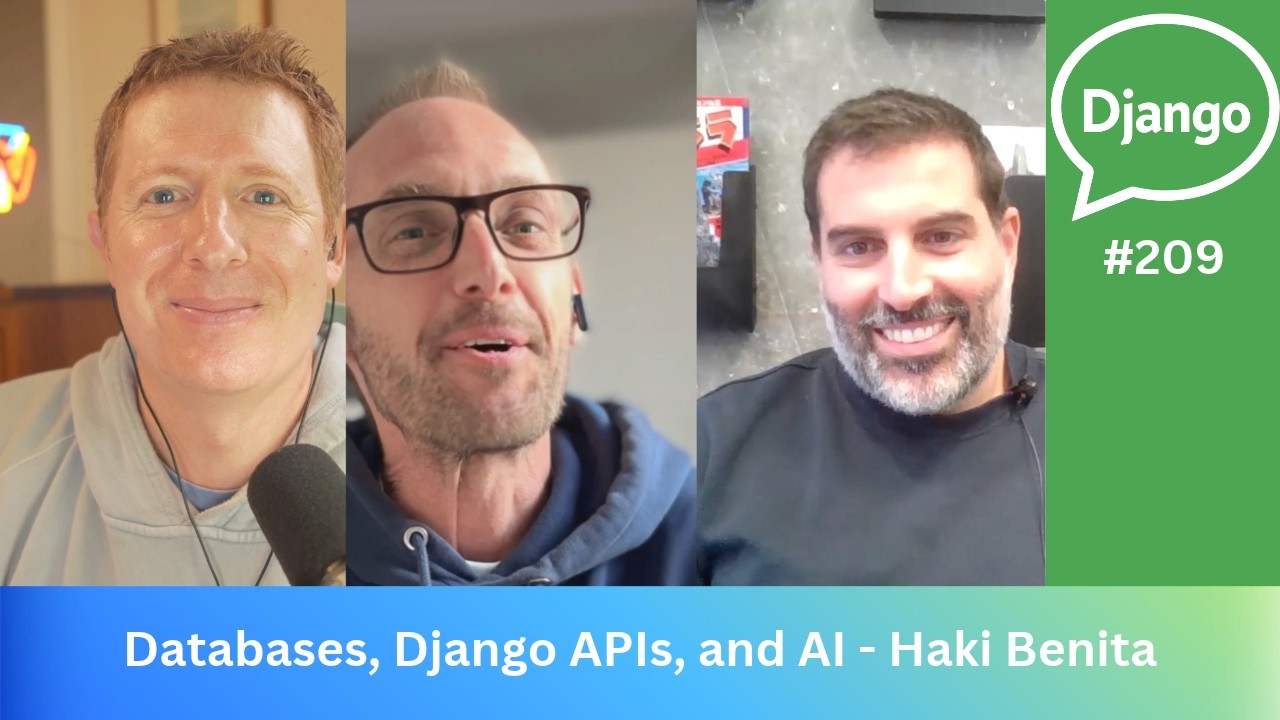
Haki Benita joins us to discuss mastering Django's ORM, optimizing database queries, and building applications that stand the test of time. We debate Django's future, including typing support, modern APIs, and why Django Ninja is so appealing. Plus, how AI is changing software development, open source, and the way developers learn and share knowledge.
🔗 Links
📚 Books
📦 Projects
🤝 Sponsor
Thanks again to Laravel Cloud (https://laravel.com/cloud) for sponsoring this episode. The team behind Laravel’s managed hosting platform has something big in the works, and we’ll share more here on the show in the coming weeks.
Automatically transcribed, so expect mistakes in names and technical terms.
Speaker 1: Welcome to another episode of Django Chats podcast on the Django Web Primeworks. com. Carlson Gibson joined us every by Will Vincent. Hello, Will.
Speaker 2: Hey Carlton
Speaker 1: Hello everyone. Today I'm very excited to have with us Haki Benito, who's longtime hero of mine, Haki. Thank you for coming on the show. I was
Speaker 2: Thank you for having me.
Speaker 1: Oh no no it's it's uh it's really is an honor. I was gonna just gonna introduce you as that database guy and be done with it, right? So
Speaker 2: Yeah, that would that sounds about right. Yeah, the database guy. Well
Speaker 3: craft as well, but you know, database guy is fine.
Speaker 1: Yeah, no, that's fine. For people who don't know, gone, well, you can see that.
Speaker 2: Carlton and I were I think that I think that's the first time we met you in person. Carlton and I both at the after party, we both went up to each other and were like, that's hockey, Benita. Like 'cause we've read your stuff for years. You were like this mysterious figure. And so we're like, wow, he's he's here. Uh so m many people don't but you know, you've you've written these deep in-depth articles and teaching. Um and we'd never seen you before. Now of course you're on the circuit at uh multiple conferences, but
Speaker 3: Yeah, I know. Dublin was my debut when it comes to the Django world I had some appearances mostly online, but this is the first time I came in person and uh yeah. I wanted to enjoy the the full experience. I liked it very much, Dublin.
Speaker 1: And you came back the next year so you must you know, that must have stayed. I
Speaker 3: know. And the food was uh significantly better. I mean, you know Dublin. Nice beer, but that's it. So Athens, that was that was great. Great food, great beer, great everything
Speaker 1: Yeah yeah yeah. I s uh I I was uh I came home raving about Athens to my wife. I'm like, we must go back there and uh, you know
Speaker 3: Yeah.
Speaker 1: So let me just um tee you up for people who don't know you. I mean like I came across your blog many years ago uh where you write these Just and for me, f amazing articles about using the O ORM and going into some of the more deeper things. So we can all, you know, write a model, we can all filter on it basically, but Um, you know, the more advanced things, I think the ORM is is hard. And even if you know SQL, it could be hard to map what you do know from SQL to how the ORM wants to do it. And you you write these lovely pieces. So I guess I you know my big question that I would just start with right in at the deep end is how do you view the the mismatch or the impedance between SQL SQL and and using the ORM? Because When I speak to people who are analysts, they quite often go,
Speaker 1: I hate Django, I hate Django because I just wanna write my sequel. But
Speaker 3: Honestly, I I I hear people say that as well, but I I can say that I really understand why. I mean uh I wouldn't want to write and maintain SQL for trivial stuff like, you know, fetching a transaction doing a simple join. And I think that it boils down to really knowing the RM, knowing the tool that you're using, making the best use of it. And if you often layer with the ORM and you know how to use it, then it's a great tool. If you don't know how to use it Just like any other tool, you're going to shoot yourself in the foot. And this is why I write so much about DRM because it's so easy to get it wrong, right? And I should say, just to be honest, you know, when there are situations where I can find an elegant solution with the RM, then yeah, I I write SQL and it's fine.
Speaker 3: It's completely okay. I mean, I have my wish list from the RM, you know that. And uh it's fine. I mean there are situations, if you'll search my code bases, you'll find SQL.
Speaker 1: Okay.
Speaker 3: It's fine.
Speaker 1: And and the the Jago 's devi design philosophies have this thing about making the the escape hatch to raw raw SQL deliberately easy and deliberately welcoming and not not inhibiting that.
Speaker 3: Yes. I can honestly say that uh you know with expressions and the ability to create functions and window functions and aggregates and everything, 99% of what I usually want to do is covered Uh there are a few uh situations where I struggle, especially when you need to make custom joins between models that don't necessarily have uh foreign key between them. And this is uh This is uh sometimes happening when you have complicated generic relations or when you're working with uh slowly changed dimensions when you want to do a join but you can create a foreign key. I mean it would be nice if I was able to explicitly say join this model with just this model and use this um this expression.
Speaker 3: Um but I don't know, I guess this is the only thing that comes to mind when I'm thinking about situations where I'm limited by the RM. It's usually very, very good. Boring and good. Right? Boring is good.
Speaker 1: Yeah. Yeah, no, I mean boring is what we're after, right?
Speaker 3: Yeah, we this is exactly what we're after
Speaker 1: Okay, so let me let me give you the flip side question then, because your talks are often teaching about um what's going on in the database b underneath the ORMEI indexes and you know how to optimize queries and and these kind of more advanced topics. As Django Nauts, do you think we have we need to know that the low the layer below
Speaker 3: Well, first of all, my background is uh databases. I have formal CS education. I have uh the green CS and I uh spent a lot of time training on traditional programming languages but My first actual job was being an Oracle DBA and this is what I've done most of my uh in the first years of my career. I talk about this from time to time, I know, and uh and this is what I've done And um so I I I know a lot about databases and when I transitioned into a more uh developer position as being like a back-end developer Uh I think that I found that a lot of people are trading the database like a black box.
Speaker 3: They send queries, they don't know what's going on, and something comes out, and as long as it's fast, they don't really care. And you know what? That's that's a good thing. I mean that's the ideal. This is what you want. You want to be a black box. But Django Django is all about managing data, right? It's for managing crude applications. This is what you do. You're building dashboards. This is where Django excels. So naturally you need to process some data. So at some point you reach this threshold when your system is big enough that you need to care about what's happening in the database. And I think that uh I I found a very good niche because everyone has database problems.
Speaker 3: And as it turns out, a lot of people have the exact same database problems. Everyone wants things to be faster. So I try to share some of my I call them aha moments, you know, when you you realize something and then you everything starts making sense to you. So I have several aha moments like this in Django as well. And uh this is what I try to uh write about. I rarely write uh like tutorials. I know you really like this uh article I wrote comparing SQL to RM and doing group bys and stuff. This is not my normal style. This is very documentation like Um but you know this was my exploration of DRM.
Speaker 3: I wanted to have some kind of reference and I was missing that So I just decided to write it and I also come back to this article from time to time when I need to do some of the more complicated stuff and I don't remember the syntax.
Speaker 1: Yeah, I find myself on that regularly as I oh what was the one where you have to do you know, 'cause you get the group the values give to the group.
Speaker 3: Start starting selling merchandise like posters you can hang on the wall.
Speaker 1: I'd wear a hat too much.
Speaker 3: Yeah, yeah. This is uh CSS Trix playbook, you know they have this uh Flexbox poster, you know that? Man
Speaker 2: Yeah, we should Well
Speaker 1: okay, so let me ask you one more question, 'cause th the um the the th the I guess the question is, does Django d um Does Django set you up for success as your application grows, do you think? Or does it lead you into bad patterns which you're then gonna struggle with? Because I think the beginning story for Django is perfect. You know, but a million, a million and two millions of crowd applications say so. But as your application grows and you hit those growing points, you're always going to hit them with any framework, with any pattern. But are we leading down to paths where you have to dig a long way out to make progress forward or do you think it generally steers you in the right direction?
Speaker 3: Well speaking from uh a position where I manage several large database applications running for a fairly long time. I mean I have one system running for more than eleven years at this point. And we started with Django. We went through all the versions, releases, Python, typing, ORM changes, you name it, we've been through it. And I think that uh Django definitely stood the test of time. And I think that we are able to maintain a f uh very uh let's say it it's a busy system And it's working very well. And we've managed to uh do large migrations and you know work around
Speaker 3: uh performance problems and we've done all of that within the context of Django. So I think that if you uh take the time to learn the framework and use it correctly Then you can definitely have a successful application using Django. And I think that most of Django's defaults are for the most part Uh right and correct. I also talk a lot about the defaults. So yeah, I think I think that Django definitely sets you up for success. And you know, I I'm I I see myself as a living proof because I went through the process West Django several times and um Yeah. I really like Django.
Speaker 3: I mean the fact that it's boring, it's stable, it's it's not changing very often. We are upgrading Django versions uh not long after they are released. We rarely have big problems. And uh I can say the same for other frameworks or you know third parties that we use. So I think that Django in this sense is is very, very good. Exemplary, I would say
Speaker 1: Okay, so we can't ask for more of a recommendation than that. You know, it does everything you want it to, it's uh, you know, super powerful, and it it makes all the right choices for you to begin with
Speaker 3: Yes, yes, yes. You know, you interviewed someone, one of the people who wrote Django initially a few weeks ago, right? And he said And you asked him why aren't you not engaged with Django as much as you used to be? And he gave you actually a very good answer. He said, Django is already doing everything I needed to do.
Speaker 1: Yeah, right.
Speaker 3: So I don't have to tinker with it as much. And I think that that's a very, very uh good way of looking at Django. It's just already is very mature and it's doing everything that you need it to do. And if you need to extend it, you can. There's a very uh vibrant ecosystem around it. I mean, seriously, doing everything that I wanted to do
Speaker 1: Yeah. I mean
Speaker 3: this is like uh one of the great things about Jenko and I think that this is uh um this is part of the things that You know, maybe uh is less appealing to younger developers at this point. It's not changing as often.
Speaker 1: Yeah.
Speaker 3: It's not uh let's say quote sexy
Speaker 1: Well, no, I mean well it kind of is.
Speaker 2: I mean look at Carlton come on
Speaker 3: Look at Carlton, come on.
Speaker 2: Sweatshirt. Come on.
Speaker 3: Yeah. We'll poster type for Django.
Speaker 2: Yeah.
Speaker 1: Oh, I lost my headphone now
Speaker 2: What's up?
Speaker 3: Yeah, he gets excited. We got him excited.
Speaker 2: Let's just say whatever we want. He doesn't listen to I know he doesn't. I have to produce him. He doesn't.
Speaker 1: Never put the hood up during the recording. Here's my other one.
Speaker 2: Right. Oh.
Speaker 1: Never put your hood up during recording. There you are.
Speaker 2: Now I feel slightly bad. Okay. The
Speaker 1: the web problem is kind of right solved, right? Yes, they've added a new query method, new query verb to HTTP, and we can add that in the new version. And oh won't that be exciting that, you know
Speaker 3: Yeah.
Speaker 1: Well, kind of. But one thing I think is nice and increasingly in, you know, our current our current moment, is that it gives you a solid foundation within which to explore upon. It's it does the fundamentals right. And then the exciting thing isn't the framework, the exciting thing is the application you're working on. That or
Speaker 3: Yeah. Yes, but having said all of that, if if I I had to uh Pick two beefs I have with Django. And I think you know about them. The first one would be typing.
Speaker 1: Yeah.
Speaker 3: I really, really want typing. Um and the second one would be uh APIs. I think that was a bit of a missed opportunity. The fact that we are now starting projects and we need to use uh a package that is not maintained for a very long time. I mean that's a problem. And I don't know if you had a chance to use it, but if I had to say what I really, really want, I would really want uh Django API views to look like Django Ninja. I think uh this is exactly how I want them to work. I want to be able to uh have a function uh and with this very simple decorator to register the URL and I want to be able to say
Speaker 3: this is what I expect the payload to be using uh some kind of type. And maybe it's a Piedenic base model that already handles serialization, deserialization. I want to be able to define properly my query using a proper type. I don't want to have to handle all of the uh, you know, this uh serialized, deserialize, and I want it to be function-based. I don't want it to be class-based. Okay. And uh
Speaker 1: three things now have. I really want to have like this built-in
Speaker 3: documentation that they have. I think it's very elegant. I used it. It was it was very it was so simple, so refreshing I've done a project with Django Ninja. I think that the main problem with Django Ninja at this point is that, well, it's a it's a small project. and it's maintained by this one very talented guy, but I mean, I wouldn't I wouldn't say I wouldn't, but I would be a bit hesitant to base a big project on something which is not uh that doesn't have the backing like DSF, for example. You know? So uh I really would have been happy if Django as an organization would lean to something more like Django Ninja because I think it really gives you
Speaker 3: I I think that FEST API really showed us a new type of way of writing views. And I think that it's very appealing, the ability to provide types. and inject services directly into the view and everything is kind of baked into that. And Django Ninja showed us that it can also work with Django. But I would really like to see endorsement from Django on this project. I think that we can all benefit from that because it hits Two very very big pain points that I think me at least and a lot of other people that I talked to have with Django, which is APIs and typing and everything that comes from When you join these two together, like documentation, you know. And um I think that uh
Speaker 3: now with a Gentec coding, right? AI And we all realize that typing acts like a layer of documentation on the code. I mean, when I prompt, I basically just write the typing and leave the implementation to the agent. This is how I usually work now. I just define the typing. This is what the signature looks like. Go ahead and implement it. Usually it's very trivial. And if you have your typing right, Then everything just falls into place. I mean a development at the end of the day, it's all about abstractions and abstractions are types So let me just write the types and everything will work itself out. Um so you know I would say that it bothers me a little Valjango Just a little
Speaker 1: Yeah, no, I mean it's worth mentioning in this um in this context. Uh there's a another um uh rest um solution out there called uh Django Modern Rest, which is uh I think that's what it's called, which is by uh the folks who are into uh Django startups and they've be behind all of that. And that's fully typed. It's using um it can use uh Pydanic serializers, it can use Addis class, it can use message spec. It's does the d dependency injection thing as well. So it's worth you know, mentioning that while while you've got it on it on the table. But I think yeah, there are s there are s some exciting um changes that have happened in the ecosystem in the i in in the wider Python ecosystem in the last five to ten
Speaker 1: years, which Django needs to bring in. It it's
Speaker 3: Yeah, I I I I agree. I agree. Because right now usually when you uh start a new project Usually you need an API, especially if you are doing something related to mobile or SPAs. And the fact that Django is perceived just as primarily a you know, as a servers uh server rendered engine. Well, I think that it's uh unfortunate. I mean I I hate fighting APIs. I really like yeah doing everything in the server, rendering templates That's great. But uh when once you go into places where you can't actually render HTML anymore, uh just for example, mobile apps. then you need an API and this is where it starts to get a bit hairy.
Speaker 1: Yeah. Um what I like about the dependency injection isn't just about injecting services. It's about saying, I want um this particular thing from the request object. And it's going to come from the query string and it's going to be named this and it's going to be that type. And your your view gets given the value. And if it doesn't get the value, the framework handles the the 404 or the you know the four hundred bad bad request error or whatever. And you don't even have to see that. Whereas Kind of the old the the way you do it is you get it in, you create a form, you instantiate the form, check the form is valid, get the value from the form, and then okay, you've got your val your value. But there's no reason why the framework can't wrap all of that for you and you say, Ley, just give me this from the request, will you please?
Speaker 3: Yes. That's right. This is all just boilerplate and and I want to focus on the actual you know, the processes, the the business logic, this is the interesting part, all the nitty-gritty stuff about serialization, this is just distractions. I want to be able to read a view and understand exactly what it's doing. And this is also my beef with uh class-based views. Um I want to be able to uh understand the flow. Uh yeah. Yeah. Well
Speaker 1: , so surely that's not class-based views, that's the particular implementation of the generic class-based fuse that ship with Django, right? With their mix-ins and multiple files.
Speaker 3: You need a guide, you need a poster just to uh you know understand where everything goes. Too much for me. I just do function-based and if I need to inject stuff to customize behavior, I just do it. I want the entire logic in just one place.
Speaker 1: Yeah.
Speaker 3: But you know this is just a personal preference. I know a bunch of people who would be more than happy to argue with me about this for a very very long time. It's like politics at this point.
Speaker 2: Yeah, yeah.
Speaker 1: What would a Django conference be without an argument about class-based features?
Speaker 3: Yeah, I know. It's like it it's it's basically religion, right? You can't I can convert anyone.
Speaker 2: Well, I I take your point. I mean, function and class base, to me that's I'll put that to the side. But I was thinking like so let's let's think about it like openly. How would we be proactive, Carlton, right? So On APIs, we know from the Django Developer Survey, most people come to Django through an API. It's Django REST framework, but at conferences, most people are using Django Ninja or these modern things. You know. I'd like Carlton, I don't think we can just complain 'cause like you're on the steering council, Jeff Triplett's the president. Like, you know, like what would be a path forward? Is it Is it a depth? Is it like a breakout session at DjangoCon Europe? You know, because these two things that Haki mentioned, types and a built-in API, they're not new. Um, but I do feel
Speaker 2: if not the time has come, like we shouldn't just like be like you know, we should do something proactive about it. Like maybe we say, okay, we're gonna wait a year. Okay, but like What is the process to like steering council, board, you know, because I would love to see the API in Django. I completely agree. I mean, hockey, you teach, I teach beginners. It's like now there's a third-party ecosystem and what is that and who are the people? Like it's honestly it's crazy Django is as big as it is without a built-in API. Like there's no other web framework at scale I can think of that doesn't have a built-in one. Sorry, sorry, I'm throwing that to you, Carlton, but like what would be like should we have a session at DjangoCon Europe in February? Can we do something before then? Like what what is the path?
Speaker 1: Okay, so the the path is um there's a a long-standing uh d uh depth that's been stalled for years about introducing content negotiation into the request object and modernizing the request object. It was stalled because of you know, whatever Django pushback regions that that happen that are totally legitimate, right? Django's got a massive install base and those edge cases which break someone's sink, actually they're important. Right. So but that depth has been stalled for years now and that needs picking up, that needs someone to come back and think through the difficult cases and work that so that's the hard bit of the request level. Then Um serialization is is the big issue. The view layer in the RES R Rest framework is nothing. We can all write one in ten minutes. We can have our our clanker write one in f in
Speaker 1: Five maybe. But the the view layer is not the problem. It's the zer serialization story. So is it you know, do we just jump on PyDantic? Well PyDantic uh y yeah, it's great.
Speaker 3: two serialization formats, one for fixtures and you know, forms, they are basically serializers.
Speaker 1: Right. Yes. No, they're entirely serializers, but they're they're the same problem with DRF serializers. It's they're they're from the last generation. So how do they work? They work by um f taking the model, fetching a field off the model, getting the value for the field, and they do this in a loop, and it's it's pretty slow. And it's it was fine. ten years ago, it was fine, fifteen years ago. But compared to the speed of pa uh Pydantic or Attors or Attors and Katters or Message Spec It it's a lot lot lot lot slower. Uh I
Speaker 3: really think the average Dango developer would care about serialization speed?
Speaker 1: I was helping to men maintain Rest Framework for years and years and years. And even years ago, the the the people that would complain on the issue tracker were complaining about how slow the serializers were. No. Most users wouldn't. And so um Emma uh Dallas Dallas Cole, who's on the um steering council, she's got a uh Django REST uh package which uses forms as the serialization layer and just shows how you could do it. And it's perfect. And it it works really well, but it's not going to be performant for high traffic APIs and it's gonna be like, oh no, why are we using forms? They're slow, why aren't we using this, that, and the other? So it's this
Speaker 3: Well let me tell you a secret because DRF serializers are also not very fast. on uh you know high traffic use cases and then you also need to get it down to the database level, Python level, whatever level. So I mean once you introduced an API that works and is endorsed, then making it fast is an engineering problem that you can solve separately. The problem is that there's no official API to use with Django. I mean first Show me how it should look like and then let's talk about how to make it fast. Separate problems. In my point ,
Speaker 1: Okay, fair enough. But so Adrian Horavati he also said why have why isn't there an inbuilt rest stories? Because there's no there there. He's like there's nothing to it. And what he's talking about is a view lab. So yeah, we could come up with some simple view functions and be like, look, there's the official Django endorsement. view layer. But until unless we make it the serialization story pluggable, we're not going to satisfy anybody. And until we get the request object modernized, we're not going to It's not gonna look modern. It's just gonna be exactly the same as Rest Framer, but in Django rather than next to it. So Yes, I'm totally with you. But just use you know, half of people are still using Rest Framework, but a few people are using Ninja Some are using Django Modern Rest and I'm fairly sure there will be half a dozen more stories out there before we get a a final solution.
Speaker 3: By the way, I can tell you that in in some of my projects when we uh add new uh endpoints. We are now using DRF views and the serializers are already Piedenic.
Speaker 1: Yeah. Yeah. And why not? Why not? Because they view that we find
Speaker 3: Yeah, I mean I mean yeah we we stitched it together. I mean I guess that at some point we'll ditch DRF as well and just maybe uh use uh you know raw Django with some decorators I think this is what we're going to end up with eventually because we are slowly starting to strip away uh DRF parts. It started with serialization and I'm guessing that at some point we'll strip the resources as well. And, you know, there's not a lot of motivation at this point because it's kind of working and it's stable, but for new stuff, we are looking at doing it maybe differently. You know, just to keep up with all the changes. I mean Pidanic brings a lot of very uh convenient uh things that you don't necessarily get
Speaker 3: uh elsewhere. And it's as you said, it's fast And uh when you design for scale, you want it to be fast.
Speaker 1: Yeah, I mean it was always
Speaker 3: but it's definitely faster than DRF serializers. No,
Speaker 1: it was always the complaint. People would turn up a de a f pff t uh ten years ago and they'd be like it's not fast enough. So marshmallow serializers were the big thing and then by danger you know, there's this long history of people wanting faster solutions than this loop through the bottle fields, fetch the the field
Speaker 3: Yeah.
Speaker 1: Solution.
Speaker 3: Let me ask you a question, Carlton. How did you start using Django? How did you end up picking Django?
Speaker 1: Ugh. I'm gonna lean back like
Speaker 2: that.
Speaker 1: I guess it was I went to a conference called uh Future of Web Apps back in the day and um it must have been around I don't know the one point oh and uh there was Lots of talk about oh django jjango jjango So I went home and I googled it and it said the web framework for perfectionists with deadlines and I was like that's me. Um and that so that was all uh quite a while back Uh and then I was um doing mobile applications and I was building the back end to go with them. So I was using uh DRF for that and then Tom Christie came on the mailing list one day and said I needed a bit of help maintaining it. So I started answering questions and doing that kind of thing. And you know, that was That was a while back now. But yeah.
Speaker 3: Basically you uh you got excited about Django after you saw it presented in the conference.
Speaker 1: Well, g uh I yeah, I mean maybe maybe Yeah, no, I mean I had like so why did I start using it? I started using it because I needed I needed a back-end solution for mobile applications. I was u using PHP and MySQL and I was like, okay, that's fine. But then I found Python and I was like No, this is the like that proverbial glass of water to the, you know, the person in the hot boiler room. I was like, this is lovely.
Speaker 3: Yeah. By the way, it's a very similar story for me. I mean, the only difference is I also needed to develop a back end for uh a a mobile app and I went and asked my younger brother which is uh Python developer as well he's also the maintainer of PyTest now and a bunch of other stuff And that was like maybe fifteen years ago and I asked him, I need to do this back and what should I use? And he's like, Get off me man, get off me, you and your crap and I'm like, No, no, seriously, I need to do this thing. What what what should I do? And he says Well use just use Django like get off me use Django. He saw that this way he would have to uh you know help me the least
Speaker 1: So this is how I got this is how I got fun with Django. Experts recommend Django because it's got the less y user support it needs.
Speaker 3: If you only knew how how how how much hand holding you would have to do, but yeah. So this is how I got started with Django. And now the next question would be, how do you think new people get started with Django?
Speaker 1: I have no idea. I'm so far removed from how people get like I guess they don't because what do new people get started with? They they um uh they're talking to their clanker or you know my son's just gone to university he's doing a programming course maybe they introduced that maybe there's a web module for that and
Speaker 3: you know that's not true
Speaker 1: I don't know if it's a good idea.
Speaker 3: You know exactly how people get started with web frameworks these days. They have some idea, they go to the AI of choice and they say I need this and that And then the AI would vibecode something and you just pick it up from there. So the question becomes, what do I have to write in my prompt for the AI to actually suggest Django? Right? I mean if I write I want an API backend for a mobile app, am I going to get Django Probably not, right?
Speaker 1: No, you can't. If I write
Speaker 3: I need to develop a backend for a crude app with lots of forms in an admin panel, I might get Django
Speaker 1: Yeah.
Speaker 3: Right?
Speaker 1: Yeah.
Speaker 3: So I think the question now becomes understanding where Django shines Because this is eventually what's getting picked up by these AI tools and this is I think how a lot of people get started these days with new projects. This is how I get started when I need to develop something in a language or environment that I'm not familiar with. I let this thing uh suggest tools for me based on uh things I think I need. And then I just accept the recommendation because honestly I just don't know. And AI is usually very confident in his in his answers, you know.
Speaker 1: It's like a mediocre one, but
Speaker 2: I wanna talk about AI, but I just wanna loop back to so Carlton, the request object. I think Like
Speaker 1: because
Speaker 2: this frustr this frustrated me for years is we'd say, like, Django can't do something. Why doesn't someone do something? Like, we are in positions to do something now, Carlton. So what is the next step? Do we need to have a a Django on the Med on the request object? Do we need to have a breakout session at DjangoCon Europe? Like would we we should or should we just close the depth You know, like that seems like you're saying and I like that's the blocking function to these other things about, you know, an official thing and putting things in the docs.
Speaker 1: Firmly believe that the way progress is made in the Django ecosystem, because of the way Django is and because of its install mass and because of its slow inert , slow release cycle and all the rest, the way that progress is made is by third-party apps. building the r building the thing and then, you know, it there being a case made for it being to merged into court. So I've given my presentation of the take on the serialization layer. Um The only reason why I haven't built the view layer and the and and a and a request object replacement is because I haven't needed it for my project. I'm four years into my work project and we've We I thought I was going to add an API layer this summer and I did. I added one MCP endpoint like to it. And I haven't got to the rest of the the API stuff. I'm I'm not gonna build it yet. I will eventually, if the next time I need an API, I will
Speaker 1: I will say, look, here's what I think an API framework can look like in 2027 or 2028, whenever that happens to be. But It's for somebody who's interested to write that thing and present it. And there are a couple of case things in the in the ecosystem. There's Django Ninja, there's Django Modern Rest, there's a couple of others I think that they're out there, but present these things. And then when there's a h a head of steam up, then it's possible to say, oh well, let's pull that in, let's pull that in, let's pull that in. But the idea that we're gonna sit down in a sprint and add a f a full featured API framework into Django l in a one shot, that's Unrealistic. That's not how Django will be.
Speaker 2: Well no, but we uh there's history for this. This is what the migrations framework happened, right? There was people realized we need migrations. There were three migration options out there. One was decided But I mean I guess I'm just saying like I don't want to just complain about stuff and not fix it. Like so is it do we ask people to like DjangoCon Europe, DjangoCon US, like let's put a call up, bring us your ideas, maybe there's a Django on the med Like 'cause to h to Haki 's point, I do worry that Django is left behind and that agents don't think it can do APIs. And it used you know, I have my whole story of how I think beginners would come to Django usually after trying a JavaScript framework and being frustrated. But they're just going straight to agents. And you know, again, not that we're I don't want to optimize just for agents, but I don't want us to to be having this discussion in five years about the context object.
Speaker 1: I'm scopcal that the situation is equivalent to back in the days of 1. 7 when migrations were added. Bef that was in the Wild West days when nobody upgraded Django. Half of the ecosystem was still on like 0. 96 when 1. 7 was released, right? Whereas Now we have the very and since 1. 8 and the the uh periodic the the scheduled release cycle, Django has matured into a very stable, very easy to update, very reliable foundation on w upon which you build And it's not the case that we're just gonna add, I believe. We that we're just gonna add a an API framework that doesn't yet exist, that we're gonna write from scratch
Speaker 1: And add it in and be like, oh, there's the new API framework. It will have to be better. It took me a whole LTS release cycle to get template partials into Django, right? We 're talking about one a pair of template tags. It took a whole LTS cycle to go from third-party package to inter Django. And that's two template tags. How on earth are we going to merge an entire API framework whilst maintaining the API stability pol um policy whilst you know doing all of these things? It's It's not feasible.
Speaker 2: I don't like your negativity, Carlton.
Speaker 1: No, it's not negative. I think it's massively positive. I think Django is in a
Speaker 3: Carlton in trouble here.
Speaker 2: No, no, no.
Speaker 1: I'm as excited I'm as excited for the framework as I've been in years. I think we're we're in a really fertile and and exciting exploratory time, but That hap the way that expiration happens is in third party packages and and whatnot. It doesn't happen in trying to merge essentially untested solutions into Django itself because people don't use Django because for untestedness. They use Django for reliability and knowing that their application is still going to be running in a dozen years.
Speaker 2: No, I got I j and just not not to go on forever about this, I just maybe if a plan was like this is what the plan would look like for success Um, you know, we could have some some you know some people come on the podcast. I know that's unfair because it assumes they can speak, you know, comfortably in English. Um I don't know. I just don't I just wish the steering council, the board, I mean We know these people, Carlton, like could say, if
Speaker 1: you know, just build the thing.
Speaker 2: But what does Django Ninja need to do? Like, for example.
Speaker 1: No, but Jiang and Ninden needs to be maintained, right? Is the pro like Jang Jang and So
Speaker 2: the DSF has money. Like we could, you know, it could We can do things, right? Like the Postgres features, you know, w like we can f I guess that's what I'm saying is we have more resources than we did before, even as the complexity is more and and the, you know, messing it up is higher. We could there's more possibilities. I know we could go on about this. And I'm not I'm not attacking you, Carl.
Speaker 1: Talk to hacky. But I I don't I don't want to upset the the the me the hard word that goes on on Django Ninja, but Django Ninja is a nice proof of concept, a nice demonstration that, you know, things like dependency injection in Django are possible and and all those things. But merge it as is, no way. No way. Like it's there's all sorts of things that aren't right about it.
Speaker 2: Carlton, let me this is a question to hockey. So as our transition, what if I just ask Opus 5. 5 to do it? Problem solved, eh?
Speaker 3: Well, I would just tell him uh, you know,
Speaker 2: pivas
Speaker 3: to Django Ninja, honestly at this point. I told you what my problem with Django Ninja. It's not even a problem. It's just like uh more like a management point of view. I I just You know, we do a lot of scrutiny on the dependencies to make sure that they are uh okay and reliable, especially these days when you get CVEs left and right. And uh we we we wanna make th sure that things are legit. So we have trusted the DSF. We know they run tight shop and we know that everything that goes into Django is uh is uh is is good. I mean see what's happening with Postgres right now. I mean it's crazy, right? Are you following the new
Speaker 2: Well wait, okay, let's talk about Postgres because I've had this discussion. Like what
Speaker 3: 's
Speaker 2: well given
Speaker 3: starting stopping nineteen and then not getting out.
Speaker 2: All right, I'll give you my one sentence and then you're much more of a domain expert than I am. So one argument is LLMs are introducing a whole bunch of bugs, but what I've seen is that LLMs are uncovering Lots of bugs that were there for a long time. And that's why it's taking so long. So in a sense, that's a positive, not a negative. But what do you think?
Speaker 3: It is a positive. Yeah, yeah, yeah. I mean I think that we all understand that LLM's made a huge leap at the end of last year, which was right after the uh uh last version, previous version of Postgres, because they usually release in October and the big model was released in November. So I mean this is basically the first version that we have that you had actual resources pointed at the source. And and and checking for, you know, old bugs and stuff. So I think what we're seeing is uh um Let's say it otherwise. I think that this is the first release that we're going to see this and I I hope that most of these things are going to get fixed and that the next release would be uh on
Speaker 3: time And I think that I I read a lot of uh Postgres uh contributors saying that it's it's uh a lot thanks to LLM uncovering a lot of very, very old things And we should also say that this was a very ambitious release from the get-go. There's a lot of very big stuff that was supposed to get in. This is what made this release so exciting. And uh You know. Uh hopefully the next one would be released in time and and I think that at the end of this release we're going to get uh a much more reliable Postgres. So I think that from this Uh sense it's it's a good thing. It's a very good thing.
Speaker 2: Well I'll just say and I hate to name drop, but last week uh we were talking about this before we went on the air, I was at an AI conference um in California and Peter Norvig I was texting Carlton during it gave up and gave a talk. And you know, I think he knows mostly what he's talking about. And he made the case that all these things LLMs are uncovering are nothing new. We've known about them for decades. And so he was actually optimistic that LLMs will help us address these long-standing security issues that, again, are not new, but we can use the LLMs to plug the holes. Um so I appreciated some optimism in a sea of pessimism, right? Because a lot of time you know, they're it's not necessarily something brand new. It's just like, yeah, well no one took the time to do these things. And if you
Speaker 2: Again, he said, look, I studied these, well, I forget the vulnerability, but he's like, this was done, you know, I studied this in the 80s in grad school, and the LM found it. Like it's not a new thing. So yeah, an optimistic take potentially.
Speaker 3: So you say the cost of fixing these things became so cheap that we just go ahead and do that.
Speaker 2: Well that's what he was saying. He s he was You know, he was optimistic about cybersecurity 'cause he said we know what the problems are. It just was hard to track down the long tra l the long tail of them. And now like we know the list of here's what we should do. There's no reason not to do it on every project. So he was, you know, as opposed to like LM's discovering zero days everywhere, like, okay, occasionally, but that's usually not what it is. It's You know, something lurking in the code base.
Speaker 3: So we all agree we are going to get a better Postgres when uh nineteen is going to be released. Yeah. I hope
Speaker 2: that's a good idea.
Speaker 3: Yeah. Exciting stuff in Postgres 19, by the way. Uh I really uh I was really looking for the um graph queries.
Speaker 1: Yeah, I wanted to
Speaker 3: already know are not going to make it. Uh but I don't know, maybe uh maybe next year Maybe next year.
Speaker 2: Is there anything Django specific that you think once Postgres 19 is out or you know the ideas that are in it come out that Django should should look at?
Speaker 3: Yeah. Well I can think I can think of a Postgres uh 19 feature that would be relevant to Django. Um no No.
Speaker 2: Not Django as we know it. No.
Speaker 3: It's hard to keep track of what made it and what didn't, you know, at this point.
Speaker 2: All right. What Carlton, where did w where where should we touch I mean we have some AI questions, we have Or I don't know, hockey to you. I mean you're an educator. Like what what should what do you want us to ask you about? What do you want to talk about while you have a couple thousand people listening? Surely there's some things you want to get off your chest. About Django.
Speaker 3: Well first of all, thank you for calling me an educator. I don't uh I just write my blogs, you know, and I 'm not sure. No no, you teach
Speaker 2: you teach an O'Reilly, right?
Speaker 1: You do, you've got the O'Reilly
Speaker 3: O'Reilly. Yeah. You know I I started writing uh ten years ago. I think that my first post was exactly October uh twenty sixteen and I had the very good fortune of having a very popular first blog.
Speaker 2: Oh, that's the problem.
Speaker 3: And I got a lot of uh responses, which was great and very unexpected, and this motivated me to keep writing So I set myself on a schedule and I said that I want to publish every month. And I actually published every month. I started writing and writing and writing. Obviously the second article was a bust. The third one was a bust. The fourth one started to pick up. You know, I I learned that people really appreciate uh you publishing on a schedule. They knew that they are going to get something new every month. And I actually was able to maintain that for like three years. And then my first born, my first child was born.
Speaker 1: Ruins everything.
Speaker 3: From once a month, it became once every three or four months, you know. But still good good pace. I was able to uh produce some very uh uh good po posts. Also uh a lot of engagement, people were starting to reach out. I went out of medium and into my own website, started publishing for myself. At this point, I also uh uh started to write for other publications like Froid Python and Twilio and stuff like that. got to work with editors, which was new to me because I wasn't a writer, I was a developer, and they started commenting me about the grammar and how I structure my articles and how should you uh never end a paragraph with their code block and stuff like that. And I
Speaker 3: think that it it made me a better writer and I write wrote more and more. And then I had twins. And then I had like a blackout period of like a year where I was basically sleepless completely. I I was completely sleep deprived. I was not thinking straight But I started getting back into it and I now try to publish around once or twice a year and And I think that this is probably one of the best things that I've done because a lot of the people that I know, a lot of the interactions that I get and all of the very interesting individuals that I get to meet, uh, and the opportunities that
Speaker 3: I had were thanks to people reaching out to me uh after reading my
Speaker 1: what you re
Speaker 3: uh posts. I mean if you think about it when you write you basically put yourself out there and then people with similar interests feel comfortable reaching out to you And I think that this is amazing. And uh um O'Reilly by the way, uh they reached out to me after reading one of my blogs, the editor of there, and he said, That's let's turn that into a live training. And um I just talked with my editor and and I'm with O'Reilly I think for f seven years.
Speaker 2: Wow.
Speaker 3: Which is uh A long time. Yeah, it was a very emotional moment because I just changed editors and he brought me in so I realized it's like seven years, yeah. Um, yeah, so around COVID I think I started uh uh submitted CFPs for conferences. And the funny thing is that the first uh CFP I submitted, actually two CFPs were were for uh Foss Dem. You know Foss Dem?
Speaker 1: Yeah. Yeah. Belgium. Yeah.
Speaker 3: Yeah, that's a pretty big deal. I mean, that's a pretty big conference. And I wasn't really into the conference scene, so I I like I didn't know what I was submitting to. So I submitted two CFPs. I got two talks accepted, one for Python and one for Postgres. And I went to my brother and I said, I just submitted the CFP to this thing called Foostam. And he told me and he told me, You mean Fosdem? And yeah yeah, foos them Foster something, I don't know. Really? Seriously? You're not joking? That's huge. And then he explained to me what it is. Uh I stayed cool though and I gave my talk. It was a very good experience. And I started pitching to more and more conferences. I realized that I can take a lot of my posts and I can turn them into uh
Speaker 3: uh talks. I usually uh try to talk about non unconventional things. As I said, these aha moments that I have, I think uh I think uh people find this very useful. I try not to talk to ride and talk about uh trivial stuff.
Speaker 1: Yeah.
Speaker 3: You know, I mean like the main advantage Sorry, what what?
Speaker 1: Your talk in Athens was amazing about reliable signals. I think you know there were there were some very sharp people in the room listening very closely to your your approach.
Speaker 3: Yeah, I know, I know. I know. I I think that the most interesting thing about reliable signals is that all of the people came to me afterwards and they actually made some good points Which uh made me think about my own uh solution. I also heard a bunch of uh very interesting stuff um in the conference which I took back with me and wrote about them and and integrated them into uh my uh my own systems, especially around partitioning and stuff like that.
Speaker 1: Yeah.
Speaker 3: I think that it uh yeah, it's very interesting. And you know, one of the things that I I think it's a bit unfortunate recently is that I I don't know if you sensed this as well. But I have this uh feeling that people are writing less and reading less because we're not interacting as much as we used to, and uh I think that uh one of the one of the only remaining ways of actually interacting with people is if you attend these conferences. Uh because I I I see it for myself as well. I do a lot of my research these days with uh AI. So I used to uh read lots of blogs I have my RSS feed.
Speaker 3: I don't see as much blogs as I used to. People don't write as much. I don't know if uh there's nothing left. to discover anymore, no new patterns anymore, or people just interact with with uh machines?
Speaker 2: I think it's discover I think it's discovery. I mean I think a lot of it is discovery. I mean so Jeff Triplett and I do the Django newsletter and There's less stuff than before, but I think the problem is if you write a s a something on Django Postgres, you know, you would you would get Google traffic. You know, it would rank really highly. Like tra search traffic is gone. So Unless somebody already knows you, it's hard for them to find you, or an LLM pulls it in and appropriates it. I mean, really the only discovery mechanism is video, but video is its own thing. But like I I can look up traffic to my personal site. You know, like you, I wrote some stuff and it got traffic and people commented and you know and I still got the initial uptick and then some downtick. But I got engagement right off the bat
Speaker 2: My traffic was ten times higher, you know, ten years ago. And uh for me and for l most people I know, right around twenty twenty two, twenty three Traffic just falls off a cliff.
Speaker 3: And so
Speaker 2: why so I think it's I think it's discovery as much as anything. Like even if you go to Google, it's gonna give you a Gemini result, right? And so it makes it less Again, you don't have those add-on effects of people commenting and engaging and I mean, at this California conference, it was everyone was making the joke of I can't wait to get off stage to wasting time talking to you humans to see what my agents have done. like many sp keynote speakers, right? They're like, I've got a hundred agents running, you know, this is great, but like I'm really more interested in what they're doing. Um
Speaker 3: yeah.
Speaker 2: So something yeah, something is something is lost.
Speaker 3: I can tell you that I have a similar experience. My own website, I have uh uh my fair share of popular blogs. from Hacker News and Reddit and and other websites that link to me. And I used to have very high traffic and you can just see it plummeted in recent years. And you know there's a lot of media outlets that suffer because of ad revenue. I don't sell ads. I don't care about the revenues. I do care about the interactions. And uh if less people visit my site, less people are uh presented with the opportunity of reaching out talking to me and as a result you know I do I do have one uh experiment that I do whenever I publish something new yeah For example, I I go, I recently published something about um
Speaker 3: partition pruning, right? So I went to um I went to uh some LLM, Gemini, for example, and I asked the question. And what I was very, very specific about the question. And I wanted to know if it can figure this out. Right? If it can actually replace me and I I presented it a very contrived example and I said, can you suggest any solution to that? He couldn't find anything. Then I published my article and I asked the exact same question. And he actually replied with my solution, right? So I figured at this point I'm basically feeding the machine, you know?
Speaker 2: Yeah.
Speaker 1: Yeah. I think a lot of people are feeling that, right?
Speaker 3: Yeah.
Speaker 2: I mean that's in DjangoCon Europe, uh or Dublin, I loved your talk and you know I know you've written about this, this is why I tee it up. At the time you said, let's see an LLM do that. after going through this complicated example. But I think you know, you even wrote L LMs now can do that, you know, back Back two years ago they couldn't, but now I I mean I where I'm at is they st you know, everyone was talking about living on the exponential out in San Francisco. And At some point, maybe it comes down, but as it's just going up and to the right, you know, everyone there was v deeply uneasy, right? People with PhDs, 20 years experience saying the models surpassed me in the spring. So kind of what do I have left to give, right?
Speaker 2: So I know customer service reps are, you know, in danger, but people with 20 years experience are also going , Like what am I here for? Um and I
Speaker 3: I don't sh I don't share this feeling. I I I'm not feeling like my becoming obsolete. I think that uh well I always tell my my team that I don't think actual development happens on the computer. I think actual development happens on the whiteboard and I don't think this changed. I think that uh, you know, the same way Django makes things faster because I don't have to implement everything. Uh LLMs make, you know, the rest of it become very, very quick, but I still need to uh be able to uh explain to the computer what I want. You know, I actually had a very interesting conversation the other day. I went to uh this uh event for a friend and I was sitting next to this uh guy
Speaker 3: which I haven't seen in a while And I was talking with him. He's a police detective, right? So we were talking, you know, we were drinking and he asks me, um What do you do for a living now? And I told him I'm a developer. And he looks at me and he says, oh man, you guys are screwed, right? And I asked him, why why are we screwed? And he said You c I mean, I just downloaded this app, right? And I can just vibecode my own computer game with drones and everything. Dude, it's amazing. I mean, what do you do what do they need developers for anymore? You're dude, man And I asked them, let me ask you a question, right? You're a police detective, right? If I take all the evidences, the videos and everything and I send them to uh the LLM and I say ask the LM
Speaker 3: who's the killer And he just gives me a response. Does this make you obsolete? And he says, oh no, no, no, no. You don't understand. You need to draft it in a certain way. You need to ask it in a certain way. And I told him what it's the same exact thing, you know, you really think that two of us doing the exact same task, you doing the exact same LLM are going to produce the exact same outcome. Obviously mine is probably going to be better, scalable, you know, something that you can actually use in production, not some vibe-coated toy that you whipped up in five minutes. using some LLN. So I think uh there's still something left to say for developers and I don't think we're doomed yet. I do think that, you know, we we are in a level where we are going to the next higher level of programming
Speaker 3: where you don't actually need to know the syntax. You can just talk in English Or not even English, I don't know. Whatever you talk.
Speaker 1: Yeah, yeah. Whatever you want. But you've still ri you've still read written let's call it probes, output written text from these things. And ev every one of us can agree that LLM text is deeply flawed in any number of ways. It's verbose and vacuous and probably incorrect and it and really easy to spot. But so it is for code, right? The code that comes out of these things is fine for a lot, but actually at the design of the em application that's going to be sustainable in in production, they cannot be left to implement a long chain of tasks and expected it to work at the end They don't spot their own mistake.
Speaker 3: First of all, I think that I think that you we should be honest and I should say that I'm a avid user of LLMs. I enjoy them very much. I use them for coding. I use them for research I use them to proofread my articles. I don't use them to for prose because uh for me writing is understanding and thinking. So this I leave for myself, but I do delegate a lot of my coding these days to LLMs and I think it's it's fine. I do go over everything because when you write something, you need to own this thing uh for better or worse, right? So you need to at least understand what it says. Um and I think that it's going to get better.
Speaker 3: But at the same time, I also think that it can uh well I would say differently. I see a lot of people producing very good, let's call them MVPs or stuff that work like 80% of the time. But I've I've deployed AI generated code to production. I actually integrated AI into the product in meaningful ways. Not just bullshit ways, actual meaningful ways, right? And I experienced some of the challenges involved with working with AI and production in user-facing applications. And I think that it takes some expertise to get it production ready, really
Speaker 3: production ready. There's a lot of things that people uh When they just do the MVP, they don't experience with AI. For example, uh, it's slow, can be very, very slow. which makes it extremely difficult to use in user-facing applications. I mean not everything can be async. Something you want the process to be sync There's a very high error rate. I mean, I can tell you that right now, when I use inference in production, I get like six percent timeouts and failures. And it can be timeouts and it can be uh situations where the response doesn't match match the the the template that I give it. So I mean This is very high airway that I don't have to deal with with any other API that I'm using.
Speaker 3: And of course, hallucinations. and injections. These are actually getting better. I see less and less of these. But I mean as I said, uh LLM can lie to you in very convincing ways. And it's uh It's uh it can be tricky trying to spot that. But I think it's an amazing thing. I think AI is unlocking a lot of capabilities that were previously very uh inaccessible, especially around understanding natural language, working with documents, images. um voice. I've done some of these stuff and it's truly amazing. I I I'm just trying to imagine what would it take to do this stuff that I do now with LLMs if I had to do it with traditional
Speaker 3: tools Uh
Speaker 1: I think that's
Speaker 3: that's the most interesting part.
Speaker 1: I was speaking to someone at uh Django on the Med about this. They work in a a similar um domain and I was asking them about the comparison with traditional NLP. um tools and they were like basically those libraries are no longer of use. Like two decades of work has gone into producing those and the LLM's beat them hands down. Even though
Speaker 3: it's also very accessible these days because you can just describe what you want and you want API call away from getting a response. Things like, you know, sentiment analysis. summaries. These were pretty difficult tasks just a year ago and they are now very, very simple. I do a lot of work with documents, for example, and traditional OCR tools are very very difficult expensive and not as reliable and and now if you do it correctly you can actually get very good results working with documents using off-the-shelf API a uh inferences. I'm not even talking about fine-tuned stuff. I'm just off-the-shelf LLMs that you can use and um And I think that it this opens up a whole new world of stuff that we couldn't do before.
Speaker 3: And I think that this is uh what I'm mostly interested in. How can I integrate LLM into my product in meaningful ways. And when I say meaningful ways, I mean things that I couldn't do a year ago with you know a certain amount of effort
Speaker 2: Yeah.
Speaker 1: Yeah.
Speaker 2: Okay. Well, we're at an hour, so let's Yeah. Let's quickly do are you okay with doing the book and project recommendations?
Speaker 3: What do you mean book and
Speaker 2: at the end uh we've we've started r uh mentioning what we're reading uh to the audience. It's it's optional. So is there anything I mean I see you have a Godzilla comic behind you, I think. Is there something you wanna Carlton and I will go first and you can think about it, but I'll just say quickly, I've been reading In the Distance by Hernan Diaz, a novel. Just started it. Really good so far. The author won the Pulitzer Prize for a book Trust a couple years ago. Um, I find I'm liking fiction more and more given that all I do is read AI-generated text all day. And so maybe I'll find my way to pure poetry soon, but I'm enjoying that. Um Carlton, anything you're reading?
Speaker 1: Yes, so uh this week I've been focused on um the sixth edition of Django for Beginners. Let's go of William S. Vincent. Um this is like This is the c absolute um canonical or essential learning reference for Django, um, you know uh and it's up newly updated, so it's updated for the six point X series. It's uh pulls in chapters on deployments and on APIs that you should perhaps take a look at, hacky. And it's they can
Speaker 3: learn something.
Speaker 1: Yeah, yeah. It's like You know, everything we've been talking about, like the Django is the foundation upon which you explore, right? It's the foundation upon which you you go on and build. And whether we're talking about training juniors or um telling our LLMs the stars, we want them to to um generate code in so that we can understand them ourselves, that solid foundation doesn't the need for that solid foundation doesn't go away. And entirely human ridden Um yeah, absolutely canonical.
Speaker 2: Yeah, thank you. And I just
Speaker 1: you should go and check that out, folks, at learnjango. com.
Speaker 2: Thank you, Carlton. I so I've I've maintained three books for a long time. I now have just one book. I pulled in things from the APIs and and uh professionals book into one. Partly because sales are down, but I also still sell copies every day, so I'm still happy to work on it while people still read it.
Speaker 3: Umgratulations on that.
Speaker 2: Yeah, I mean right. I mean it's like well sales are down, but I still have sales, so that's something
Speaker 3: Yeah.
Speaker 2: Yes.
Speaker 1: Go on.
Speaker 3: I was recently on a very long flight and I I I s I read a book cover to cover. It's uh it's very random. It's called Storyworthy. It's by a poetry slam uh actor. It it it talks about storytelling and how you should structure a story in a compelling way. And uh yeah, it's completely random, I know, but I actually enjoyed some of his uh insight. It's called uh Story Worthy by Matthew Dix
Speaker 2: Okay, we'll put it in the show notes. Cool.
Speaker 3: Yeah.
Speaker 2: And then quickly, projects. Um so I'm gonna call usually we call out a new project. I'm gonna call out the Django admin just because I increasingly hear people saying that they don't use the admin anymore because they just use MCP and agents and I I still think the admin is great. Um, our previous guest is using the admin to help put satellites into space. And I think Django without the admin wouldn't be Django. So I don't know if it's around in ten years, but I appreciate admin and all the people who w do a lot of work continually on it. So that's my shutout.
Speaker 3: Yeah, yeah, definitely.
Speaker 2: Carlson or hacky, is there one that comes to mind? Anything?
Speaker 1: This week I've been using um package called Rosetta, which uh enables you to tr um has gives you a a nice UI that you plug into your Django app to trans to do your translation. um your translation files, which is um pretty um pretty nice how you had a requirement to, you know, whip up a translated page quickly and um it needed Such a uh UI and that was remarkably smooth and remarkably polished. I was like, okay, I'll give that a go.
Speaker 2: This is j Django Rosetta, right? Django-Rosetta?
Speaker 1: Yeah, yeah. I'll find the link. I'll put it in.
Speaker 2: Okay, I I got it. I'll put it in. Yep.
Speaker 3: Yeah. Well I don't actually have a project specific that I focused on the past uh few weeks, but I can tell you that I am enjoying following there's a new repo where they can uh post uh suggestions for Django, right? Ideas? Yeah, so I like whenever I have some time I like to go over the suggestions and the PRs and the issues that they open, sometimes they have some very creative ideas of what to add to Django. Sometimes it's things that I say, wow, that's a great idea. Sometimes I say no, that's a terrible idea. That should definitely be a package or why would you even want to do that? But there's some very good and interesting ideas there So uh I recommend everyone using Django if you have some time, go over the issues
Speaker 3: and see some of the things that people are actually struggling with and want to add to Django. I think it's uh it's a very good idea and I hope that we'll be able to keep this up.
Speaker 1: Yeah.
Speaker 2: Fantastic.
Speaker 1: I think that um That that's so uh that was introduced when we started the steering council term nearly two years ago. And I think as we're coming to the end of that term, we're we're gonna mark it as like it was marked as an experiment. We're gonna mark it as a permanent thing because it's It's been really nice. And what used to happen with people would turn up for track at track, which is Django's o very old school uh issue tracker, they'd open something and it'd be closed as won't fix, go and discuss it somewhere else. And pe it was quite You know, it just wasn't very welcoming and friendly. Was the new um ideas the new features board gives people a chance to um discuss it, it gives time ideas time to bubble away and You know, we can see over time which are getting the tractions and those ones can be taken forward for more consideration. So I think it's been a a real success. It's not perfect by any
Speaker 1: measure, but it's Yeah. It's b it's it's much better than it was and that's that's good progress and then people can move it forward, you know, over time.
Speaker 2: Okay. Well, I would love to s keep talking, but I I think you have things to do we've already gone over, but Haki, thank you for coming on. We'll have to have you on again. You this is It took two hundred and something episodes to have you on, so we'll get you on before four hundred. My God.
Speaker 3: I put it on the schedule.
Speaker 2: Yeah, put it in the schedule. Lock it down. Lock it down. Uh but th thank you.
Speaker 3: Thank you for having me.
Speaker 2: Yeah, thank you for all the stuff you've done.
Speaker 1: Global.
Speaker 2: Absolutely. We'll have links to everything in the show notes and DjangoChat dot com. We'll see everyone next time. Bye bye. Bye bye
Note: We understand that names change, people change, and bodies change. We respect each individual's journey and privacy. If you have any concerns about a video or need us to remove content, please don't hesitate to contact us. We will handle your request with care and promptly address any issues.

Published November 20, 2026

Published October 21, 2026
Published October 14, 2026

Published September 30, 2026

Published August 24, 2026
Published May 20, 2026

