
0:05:40
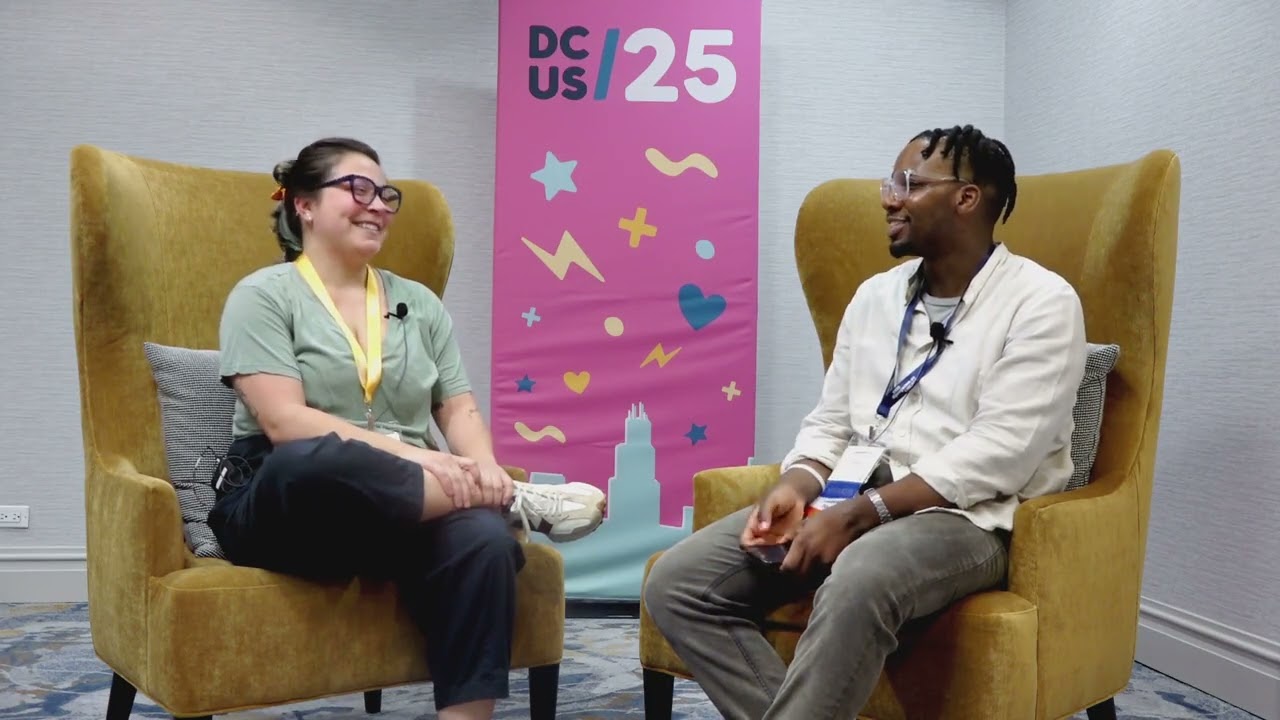
Creating an Inclusive Django Community with Kenya Phelps
Published July 15, 2026
DjangoCon US 2026
This video features Sharon Steed at DjangoCon US 2015 in Austin, Texas, USA.

How to talk to humans: a different approach to soft skills by Sharon Steed
Developers are trained to communicate to things with a goal in mind. When you're talking to something like, say a computer, you type in your code and it responds by giving you back what you want. Nine times out of ten, it works perfectly. Why, then, is it so difficult to do this same thing when talking to a client about a project, updating a superior on your progress, or pitching an investor your million-dollar idea? Because talking to people requires a special set of skills - namely, empathy and a little bit of storytelling. In an industry filled with brilliant minds, great ideas and mass disruption, so few of the best and brightest know how to tell their compelling story. The takeaways from this workshop will be learning how to value the listener and use vulnerability to improve your social connection.
This talk will take you through the difficulty of broken communication - I, myself, stutter and have great difficulty in saying the simplest things - to discovering how to reframe your perceived weaknesses. None of us are perfect, but sometimes those things that we feel are our weak points are the exact things that we can use to our advantage.
Help us caption & translate this video!
Sharon Steed argues that effective communication is less about managing how you sound and more about focusing on the person you are speaking with. Drawing on her experience of stuttering, she explains how asking genuine, open-ended questions and listening actively can make others feel heard, build empathy, and create stronger connections. She also describes how sharing vulnerability encourages other people to share their own fears and struggles, and advises readers to notice cues such as body language, openness, and engagement in professional conversations.
Summarised automatically from the transcript.
Automatically transcribed, so expect mistakes in names and technical terms.
Speaker 1: Hi everyone, should be crying.
Speaker 2: Freak now alike, everybody.
Speaker 1: I suck at communication. That's the first thing that people tell me when I tell them that I work in the communications field and I've done everything from PR to content to social media kind of the whole thing. And uh that's a thing that people tell me, you know, that they're just and not good at communicating with other people. And I find that kind of odd because there isn't anything more important than communication. Being able to concisely express
Speaker 1: y your ideas while empowering people to uh look look look look listen and inspiring them is is one of the most valuable commodities that we have to sell as people, both personally and professionally. However, so many people just resign themselves to being like, hey, I'm just not very good at this and fast me in the bat. Well, how do we get people to change? their minds about their communications skills. And uh what are the steps
Speaker 1: that they have to take in order to improve them? Okay, so before I go any further, uh I'm going to address the elephant in the room and tell you that I And stuttering is awesome because you can't say the things that you want to say when, you know, everybody else can just talk and you're like, my name is sh And it's very embarrassing. It's very hard to deal with. However, it has taught me a lot of lessons. But even all of the lessons I've learned, it doesn't take away from the fact that I have trouble
Speaker 1: sh you know saying my name l let alone you know talking to the people about something I'm passionate about or something that I'm just interested in. And it uh it has affected pretty much every area of uh my life, both my personal life as well as my professional one. And even though it is Awful at times, I feel like I've learned a lot of valuable lessons. So this talk is called How to Talk to Humans.
Speaker 1: And um I think a basis of just talking to the people is a conversation, right? And so we can all agree that a conversation is The uh sh sh the the exchange of ideas, right? So person A has an opinion about something and they want to tell person B and then person B you know responds to it and then they go back and forth until uh they come to a resolution and then the conversation is is over, right And so how we approach conversations is probably about the same way
Speaker 1: every time, you know. We uh think of the words that we um would like to use, right? And we think about how we would like to feel um how we want to sound and how we want the other person to feel and preact and uh what we want them to say, right? It's all about us. Me, me, me, I, I, I. And that is the exact wrong way to approach a conversation.
Speaker 1: You have to be thinking about the other person, you know? How do they feel? What do they want to say? The focus has to be on men, right? So how do you make the focus on them? The first thing that you have to do is look Listen ma more when you talk. So this is me. I was around uh three years old, I know, and adorable, dumb stayed all at once. And uh This is um around the age that my um parents told me that I began to stutter. But it's actually pretty normal. Um a lot of kids who are around, you know, three years old
Speaker 1: four years old. They develop some sort of speech pediment. Uh generally it's stuttering. Occasionally it's um a little bit of a lisp But um after, you know, two or three years, uh it just goes away. And um Also, uh stuttering actually runs in my family and um pretty much everybody else's uh in a way between the ages of about ten and twenty. And so, you know, um we didn't really think anything of it because it was, you know, obviously it was going to go away. Not quite, clearly. S
Speaker 1: So um as I got older and uh as I went through life and I hit uh all of the major milestones, it became extremely clear that I was gonna have to deal with this for as longs that wanted to hook around. And so um like a lot of other cutterers, I developed coping m m m m m m mm mechanisms in order to kind of deal with aka avoids tottering. Something that I did was I used a lot of filler words like um and ah and like and with those things. Um I would also uh ch ch ch ch ch ch ch chch ch ch ch chch ch change words Because if I was about to come to a
Speaker 1: word that I thought I was going to stutter on, I was like, no, no, no, I don't want to embarrass myself. So I would think of another word. Um I actually know a person who who was very um you know uh just higher um level thinking and so he uh read the dictionary So he could always have another word on hand. He's very impressive and clearly had a lot of time on his friends. He's also my boyfriend, so he's very good. Um so eventually I came to a place of like, hey, if I just don't talk
Speaker 1: a whole lot, I'm probably not going to stutter because I'm not talking. This is a great idea, except it's an awful idea because um it either came off as I was either you know un interesting or I was not interested in the other person. And oftentimes it looked a lot like hello, goodbye, please don't talk to me. And it came off like this. And so, you know, I had to figure out a way to be an active part of the conversations I was in. And And nun and
Speaker 1: not talk a whole lot. And so I began to ask people a lot of questions, right? Um I would just ask them things until we hit on a topic that they just you know, love to be talking about, right? And so I would do this time and time again And um a pattern develops. I realize that these people actually like enjoy talking to me, right? And I think it's because I was choosing to, you know, actively listen to them and be, you know, interested in
Speaker 1: the things that they have to say. So um all of us here, um I would say um uh like all of the m mm mm mm millennials and jin jin gin y um I believe now there's a gin z apparently um We all live in a sh sh sh sh sh sh sh sh sharing society, okay? As people, our brains are wired to connect and we just have a need to be exceptive, right? And so
Speaker 1: all of the Facebook 's and Twitter and all of that stuff, it allows us to be able to sh share ourselves. with other people with pretty um mm minimal judgment, right? So as I was talking to people and you know hearing all of what they had to say, I was basically just taking the shhing society offline and I was allowing them to feel like I was giving them you know a
Speaker 1: thumbs up on themselves or you know a V sweep or alike if that's even relevant but yeah it was so How does that look for you? It's asking a lot of questions and being actually interested in the answers. And um This does two things. It um it sh shows the other person that you are both Interested in them and it also shows that you are empathetic towards them. And empathy is a pretty important
Speaker 1: key in communication. So um like a lot of other cutterers, I have had my fair share of therapy experiences. Um I was in uh s speech therapy um when I was around eight or nine years old and then I Took some time off. I went to high school, I went to college, you know, I got a job and all that stuff. And then I uh returned to therapy again in my late twenties. Um I was a freelancer and so I had to go out there and and um find my own
Speaker 1: clients And um I was just having a very difficult time talking to people. Um I was verified to even, you know, uh have coffee with people and coda and then and then the networking events because I was afraid that um I would sound you know bad and that I would be judged And so I uh sought out therapy as a way to kind of overcome cuttering And so I found a therapist who was
Speaker 1: around my age, I think she was only two years older than me, and she uh was also a stutterer. And I went to her and I was expecting to be able to just learn some uh techniques. That would make it a lot easier for me to avoid cuttering. Again, clearly that's not what happened. But um what I did l learn from her is how to be a lot more sympathetic I had been around other cutterers before and every time I was, I was so uncomfortable
Speaker 1: that I would just leave the room. And I couldn't do that here. I had to sit here and I had to listen to her talk. And in the beginning it was pretty awful. But as time went on, it did get easier. And it also helped me to be a lot more empathetic towards her and as a result um I was able to open up a lot more to her about the emotional side of of stuttering and how it made me feel just on a day-to-day basis I do
Speaker 1: not believe that there is enough empathy in everyday communication. And that's a shame because empathy is the cornerstone of connecting with other people. Empathy creates the environment for other people to share meaningful details about themselves. with you. And the therapy experience that I have is have is a perfect sample of that. Empathy also helps Yi you to be able to
Speaker 1: open up to the other person who uh yee you were talking to So I began to speak um about a year and a half ago, just to hit myself out of my shell. Um I know that I've said this before, but I was truly just terrified to just talk to people and so I'm the kind of person where you know if I'm scared of something I'm just gonna I'm just gonna do it. Um I don't know how to swim, so I'm gonna jump in the deep end with the sharks. Why not? What could go wrong? And so um I was pretty nervous
Speaker 1: The first time I spoke. Because I thought that the awful things I thought about myself, I thought that other people would think those things about me and then I would have to face that Well, it turns out that people didn't judge me. They didn't even uh sh sh sh-sh sh shun me. They truly embraced me and they wanted to sh share their stories of you know fear and vulnerability and uh weakness with me
Speaker 1: and I think that's because I was willing to tell my whole story. You know, I would give these talks, and these talks are pretty Austin for me. And so after the talk was over, I'm obviously like emotionally drained because I'm showing all of these people like the the very painful parts of myself and um again I was ready to just right out of the room because I'm done talking now so leave me alone But um I couldn't do that. You know, people would come up, I mean, after talks and and and uh tell me the ways
Speaker 1: um um um that they were flawed, or the things that they were afraid to say, or ashamed of, or the things that they hid from. You know, I showed my vulnerabilities, and as a result of that, they were empowered to sh shh sh show me theirs. And um that's an important point. You know, a lot of people uh in this uh sh sh sh sharing s society, they only talk about the good things. They only talk about like, you know, I got a promotion, I got a raise, and
Speaker 1: I'm starting a new business They don't talk about how it's, you know, it's terrifying to do those things. Um You don't talk about how hard it is to be an entrepreneur and how incredibly lonely it is, right? People don't identify with the perfect. They identify with being flawed. Right? So your struggles and your your insecurities Those are the things that make you incredibly interesting. And that 's what people are going to take with them
Speaker 1: And so how do you talk to humans? Um the key is this. It's being empathetic. Being empathetic enough to listen to other people 's stories and courageous enough to sh sh share your own. Thank you.
Speaker 3: Does anyone have any questions and if they would come to the mic and ask
Speaker 4: Thank you for that talk. Um I'm curious how in a basically in a business environment how you would translate some of these points that you're making. Because I can see a lot of what you're saying in a in an overall context, but if you're with your co workers or something like that maybe in meetings or with other clients do you feel like these same things translate or would you how would you ship it
Speaker 1: Right. Okay, so um the thing I like to tell people about this is that other people are constantly telling you how to talk to them, right? And so the main thing that you want to do is just pay attention to to accuse that um other people are Hiving you right so um an example that I have is this um the easiest thing to do is to um uh Check out like body language, right? And so um um and there are you know um
Speaker 1: endless um Endless head talks on this. Um the Party language cues that um um that I kind of go by is um I really don't want to use this phrase, but uh anytime people are uh leaning in and uh there I know, right? I'm up here, it's never happy. Um and uh their um um arms are um a little bit more um uh open and to the sides. They are just uh a lot more open and
Speaker 1: interested in things they have to say say. I know that um um eye contact is uh um another thing even though it can be um a little bit ch chch ch chch ch chchch chch ch Tricky. Um people can get um a little bit nervous and then they uh look away. from you and sometimes it can be taken as like well I'm not interested or I don't want to talk to you and actually it's just So those are those two
Speaker 1: things. In terms of just um empathy, the easiest way is to just keep on um asking people open-ended questions, right? Um You truly do just have to listen a lot more than you talk and then kind of allow them to take the conversation to a place where they are just incredibly like open and comfortable and and and are having a A pretty easy time just talking to you. So
Speaker 1: those are my tips.
Speaker 5: Thank you. Um you mentioned that the best way to show with someone you're interested is by being genuinely interested.
Speaker 1: Yes.
Speaker 5: What if you want to be interested but you actually aren't?
Speaker 1: It depends on the situation. You're in a personal situation. Then, like I tail it out of there. But um, if you're in a more professional setting, then as hard as this is to believe, and as hard as that is to practice, like every single person has something that is extremely fascinating about them right and it's just about allowing uh you know the person adjust it to a place of being comfortable enough to just keep talking to And if you allow them to talk um enough about things that they are interested in,
Speaker 1: then you can kind of control And the conversation from there. Um, it's a lot easier to get people to do the things that you want them to do when they feel like you are actually interested um in them and to be actually interested in them you have to allow them to talk first Okay.
Speaker 5: I have seen on reality shows like
Speaker 6: people uh like in America sure uh the people who have strut problems uh they if they sing or they speak like in the way of lyrics they can speak better so does it work for you or
Speaker 1: I mean I I am like Beyoncé when it comes to sitting in the car. Discovered. Ever. I'm in the wrong career. Too bad I can't say it. But
Speaker 6: in reality, like uh can't you speak like uh you know in the normal talk you can say like just I'm singing some lyrics and you can
Speaker 1: Yeah, that's that's not quite how it works. But uh um but they do like teach you things like how to um speak in a way that makes you more uh sissy s sing songy. The problem that the problem is that it kind of takes all the like inflection and personality out
Speaker 3: That's all I'll give her a round of applause.
Stop centering the conversation on yourself and focus on the other person: listen more, ask questions, and show genuine interest in what they say. This demonstrates empathy and makes people more comfortable opening up.
Discussed at 5:01Be empathetic enough to listen to other people’s stories, and courageous enough to share your own. Showing vulnerability can encourage others to share honestly as well.
Discussed at 19:43Pay attention to cues such as body language, eye contact, and whether someone is leaning in or keeping an open posture. Ask open-ended questions, listen more than you talk, and let the other person guide the conversation toward a place where they feel comfortable.
Discussed at 21:08In a professional setting, assume that everyone has something fascinating about them and give them room to talk about it. Once they feel you are genuinely interested, it becomes easier to guide the conversation.
Discussed at 24:30Note: We understand that names change, people change, and bodies change. We respect each individual's journey and privacy. If you have any concerns about a video or need us to remove content, please don't hesitate to contact us. We will handle your request with care and promptly address any issues.
Published July 15, 2026

Published July 15, 2026

Published July 15, 2026
Published July 15, 2026
Published July 15, 2026
Published July 14, 2026