
0:58:24
Keynote: DjangoGirls: It takes a Village
Published June 7, 2023
This video features Aisha Bello and Ibrahim Diop at DjangoCon US 2016 in Philadelphia, Pennsylvania, USA.
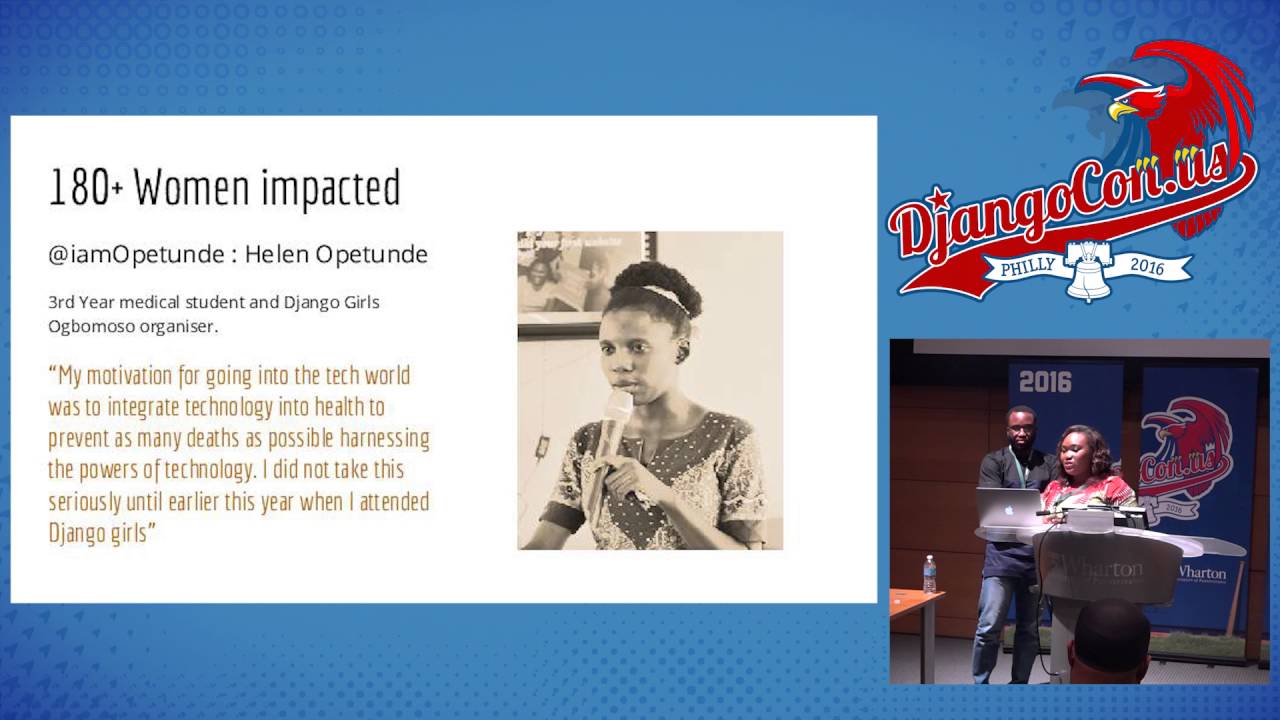
The Impact of Women Learning to Code in Developing Countries: Benefits and Challenges by Aisha Bello and Ibrahim Diop
In a continent where more than 75% of the world’s poorest countries are located all with common problems of Economic hardship, electricity issues, lack of water e.t.c and there is a global need to change the narrative not just as individual countries but as a continent. Our leaders try as it may have failed us, nothing seems to be working. The next point of action is to use Technology in whatever form to change our narrative, change our story and enhance our lives.
What better way to go than to go the open source route. Already many initiatives have sprung up recently with PyCon Namibia and DjangoGirls spreading through different African countries. In this talk we highlight how Python education has gradually changed the lives of many women and hope to make suggestions on how such initiatives hope to bridge the technology gender gap in Africa and ultimately how it is being used to change our narrative.
Anywhere in the world, achieving development means going through serious technological changes and innovation. That implies having qualified people to drive those changes. These qualified people exists in most of the developing countries but it’s not enough. It is indeed a sheer case of demand outweighing supply. It is no secret that in Africa there are so many untapped resources with a whooping 60% of the entire population between the ages of 15-25. At this point there is so much potential laying fallow.
Globally there is a talent gap in technology with not enough people with the right skill set to fill in the role with Africa with no exemption. Furthermore, by looking closely, it’s easily noticeable that the majority of technological workforce is the men. There is therefore a considerable opportunity: WOMEN. Unfortunately, because of different reasons especially in Africa where women rights are not given due consideration, and due to unfair treatments, very few women are involved in technology. By consciously making extra efforts to enlighten and bring in more women, we can nearly double the amount of qualified people in technology, create more innovations and progress. This is in fact a no brainer solution
In this talk we would talk about how workshops like Django Girls are helping increase the number of skilled people in technology and also stress the need for to create a lot more similar events and make them more “3rd world friendly” by tackling challenges such as lack of electricity, internet, proper equipment etc. In this talk we would curate information from all DjangoGirls organizers in different African countries to highlight the general challenges faced in organizing python workshops and events in various countries in Africa and also profer solutions and suggestions in tackling these issues To conclude we leave with this quote from Karen Spärck Jones, Professor of Computers and Information at Cambridge Computer Laboratory "I think it's very important to get more women into computing. My slogan is: Computing is too important to be left to men."
This talk was presented at: https://2016.djangocon.us/schedule/presentation/21/
LINKS:
Follow DjangCon US 👇
https://twitter.com/djangocon
Follow DEFNA 👇
https://twitter.com/defnado
https://www.defna.org/
Aisha Bello and Ibrahim Diop argue that teaching women to program can strengthen communities and national development by bringing roughly half of the population into technology, innovation, and problem-solving. They describe Django Girls workshops in Nigeria and elsewhere, showing how participants used their skills in health, software testing, entrepreneurship, and organizing further training. They also explain practical barriers—including unreliable internet and electricity, limited access to computers, social expectations, and gendered education—and suggest community events, local-language documentation, mentorship, donated equipment, and more welcoming outreach as ways to address them.
Summarised automatically from the transcript.
Automatically transcribed, so expect mistakes in names and technical terms.
Speaker 1: Come on, no, yeah, yeah, yeah. Hi everyone. Uh we're really happy to be here and we'll be talking about the impact of involving women in technology in developing countries. Any woman in the house?
Speaker 2: Hey guys, give it up.
Speaker 3: Give it up for all the women in the house. Hi, so I'm Aisha and it's a real pleasure to be here to share the stage with Ibrahim and to talk about the impact learning to have on women and their communities as a whole.
Speaker 1: So I'm Ibrahim, currently living in Montreal, but I'm also originally from Senegal, Niger, not Nigeria And Mauritania. So if you guys have any goal to achieve regarding diversity in the conference, you just call me and it'll be said
Speaker 3: So we last year I attended a Django Girls event in Bilbao and I spoke about this journey at PyCon Namibia, which happened earlier this year, which is by the way the second official Python conference in Africa, the first one being PyCon ZD, South Africa. During that event, I helped organize Django Girls Wind Duke and I also doubled as a coach and went ahead to organize Dango Girls Lagos events in Nigeria.
Speaker 1: Uh so I must say that during that conference in Windok we had awesome talks and presentation, but The highlight for me was that Django Girl workshop. So just feeling that I was there helping and teaching somebody to code was worth the two-day trip from Montreal to Windows.
Speaker 3: The highlight for me though is um how during my first encounter with Python and Django, um the enthusiasm, the awesomeness, the feeling that I'd finally discovered myself And I was going ahead to help many more women experience this life-changing, all-encompassing event of teaching a girl like me how to code. According to statistics, women are a little bit more than 50% of the entire African population. Because of historic and social reasons, women are excluded from many sector sectors including technology. In a society where we have more women than the men, how come women are often underrepresented in the workforce?
Speaker 3: even more so technology. Let's face it, third world countries are the part of the world with the highest growth rate. But in order to maintain that group rate, there is a need for more innovation and more creation. That means involving more people and increasing the number of women in the workforce Not involving women would mean keeping us from nearly half of the population's potential. So involving more women will contribute to the growth and the development of a country. Just imagine in Africa the potential this has. This means that in communities women can actually go ahead to solve their immediate problem, which are not limited to poverty, lack of electricity or clean water.
Speaker 1: So she she said actually more than fifty percent of the population is not considered. Now I don't know about you, but I find it to be a very catastrophic Especially for developing countries where now is the time that actually they need as many qualified people as they can have.
Speaker 3: So how can we get from where we used to be to where we want to be? Um I'm gonna start by addressing some current challenges In most developing countries, um this is a known fact that access to reliable internet is a luxury for many. And even when it's not a luxury, you find out that you're an area that You can afford it but you're in an area where you don't have network coverage. Also, um we also know that in some traditions we still have cases where boys are actually given more priority than ladies when it comes to um going to even basic elementary education. There is also uh a common uh misconception that um comes with Most people feeling like if you want to get good software, if you want to get the best of it
Speaker 3: means you actually you should be willing to pay quite a good amount of money for it For we know that or I know that some of the best things in life actually come free. Yeah, so This is no disrespect to any company, but you know, instead of a Windows OS, you know, you you have awesome things like the line-up distribution or You know, instead of um Microsoft office there is the open office, there is an alternative which is free. And this is a great this is great news for you know developing countries where the money or the funds are not readily available in the first place Having said that, um we as a people need to be more creators than users of technology. Um in Africa we have a lot of early adopters of technology
Speaker 3: and This for some reason doesn't you know encourage people to necessarily go under the hood and find out you know how this technology works. So for example, if I knew how things work, if I knew how things worked under the hood, I would be better equipped to teach more people um how to use this technology and how to become creators instead of users
Speaker 1: So uh actually some people from a Python group in Cameroon reached out to us and they mentioned a few problems which are Some ladies, ladies that are between 18 and 22 are actually more interested in learning Python or programming because they have their parents that are backing them And that don't have any like financial charge or something like that. And ladies that are over 22 would hardly ever even go through the course because we would actually go through the course because most of them are already having children and taking care of a family. And they go to that course to actually um
Speaker 1: Another reason also is that Some ladies are running away from classes that they don't like. So university are offering default classes and formation that they don't necessarily like and they're just running away from that and go to those groups and learn programming
Speaker 3: So how can we now change the narrative?
Speaker 1: We could change the narrative by organizing more and more events like this. Event like Django Cons or PyCons contribute significantly to uh in creating communities and making them more diverse. Uh thanks to the Django diversity statements, more people are involved. So but we still need to consider that there are a lot of people that we don't know actually about and we need to be aware of that that there's there's a lot of people that we we actually don't know so Uh particularly in developing countries and this message goes specially to people living in these countries, uh we need to encourage people by creating stuff and letting them know that they can create stuff by their own also.
Speaker 1: Involving women implies uh well brain growth. Involving more women Means increasing the number of tech actors by 50%. So we'll always say that number, 50%. This is quite a valuable number considering the technological need in developing countries. This obviously implies more and better innovation. Diversity, or we can say now inclusion, brings a lot more point of views and more creativity So here's a phrase from the Django Diversity Statement. We believe that amazing things happen when people from different words and worldviews approach each other and create a conversation. Uh technology innovation creates development
Speaker 1: and growth.
Speaker 3: Education is the key. Just to emphasize how much of an impact um we're both trying to talk about, I would like to give a brief about the Jago Girl story in Nigeria I might begin first by saying you know that little green pin there is Lagos, the first one. In organizing Django Girls Lagos, it brought about the first uh the official Python users group Nigeria. It was the first gathering of the Python users group in Nigeria, which didn't exist before. So um Django Girls event brought about that. And also we had 38 women attend the Django Girls workshop. This number initially was supposed to be 30.
Speaker 3: But there was just so many amazing applications. We had to make space for more women to come and take advantage of the opportunity. And after this workshop There's been six other workshops. Um some are gonna happen soon, some have already happened. Um I just want us to take a minute and look at the numbers, yeah So if we have 38 women in Lagos and we have an average of 25 women in the six other um locations where um other upcoming Django events are coming up That would give us a hundred and eighty, a hundred and eighty women from all over the country who have been directly impacted by this Django girls movement Meet Helen.
Speaker 3: Um Helen attended Dangle Girls Lagos in February and she's a third-year medical student and she went ahead to organize Django Girls in the Boomershow. Um in her own words My motivation for going into the tech world was to integrate technology into health, to prevent as many deaths as possible and nursing the powers of technology. I did not take this seriously until earlier this year when I attended Django Girls. Helen now has just applied for an internship in a software development company to improve her skills so that she can achieve this dream. More impact. Meet Mercy, aka Mama Django. That she's probably called in our school. She's a second-year computer science
Speaker 3: student and organizer of Django Girls A Career. And after our workshop, this was what she had to say. The workshop was successful. The girls wanted more of it. They were inspired to code. People kept asking me what next. My lecturers were impressed and they kept telling me to continue. That was what prompted me to organize a three days code camp which will be coming up in August. I want to say thank you to Django Girls for allowing me be a part of something wonderful. There's a different kind of impact. Meet Tomiwa. She's a software quality and assurance analyst and now Django Girls Lagos organizer and PyLadies Nigeria organizer. She's also looking to switch into
Speaker 3: the software development field. So after the event, this was what she had to say. After the event, I started to walk through the Django tutorials and I got a better understanding of the model view controller. This made me understand the internals of the application I was testing that worked better. I also started to check out how Python and Django can make my test more efficient and I discovered Selenium and Robot Framework. And voila, my testing had become much more efficient. Now these three examples goes to highlight the different ways or the different areas um the impact of a single workshop can have in the lives of that many women. It doesn't just propel them forward, but it gives them the confidence um to take advantage of any opportunity as it presents.
Speaker 3: itself. So um like I mentioned earlier, we have we have there are some peculiar problems in Africa, but most of these problems actually come on when you're even trying to organize these events So like the almighty internet that is just like the basic of basic without it you can't even go and stop overflow or you know Google that answer, you know, I ask you a question and you're like go and ask Google, things like that So it's it's a basic and it's a problem because during these workshops we have these women trying to, you know, pull or push the GitHub, try to configure on Python anywhere And you know, without internet there is there's only so much they can do. But we've um also had problems where we've had electricity issues, where the power just goes out in the middle of um
Speaker 3: a training and And just so you guys know, um some of the laptops we have back home are usually like really old and the batteries are not so amazing. We call them glorified TV sets because the moment power goes out they just go off, right? So there's no battery power or any sort. So yeah, so imagine how frustrating that can be when you're trying to work and you know how it just goes up. Um and so in trying not to have um to let many people access the internet at the same time and you know try to reduce the load. Um we have the we have we preload these tutorials, we preload the applications on the USB drive and we try to share it to everyone. So for example, there is a flash drive. I take it from Ibrahim, I take it on my computer.
Speaker 3: And yeah, just so you know, we have more Windows users than maybe Mark or Linus users. in this part of the world. So you know, I'm taking his flash drive, I'm getting his viruses on my own computer, and when I'm trying to give it to someone else, I'm giving them both our viruses on their own computer. So it's it's It's not sharing of love, honestly, it's it's just chaotic. It's not healthy. Um Another impending problem is that many times these women cannot even afford computers. They don't have computers, so they always have to go to a friend, borrow a laptop, just to attend this workshop I don't know about you but if I have to borrow a laptop to attend the workshop, I go back home and I give this laptop back. Yeah, I you there are people that you know you're resilient and you're going to go back and borrow the laptop as many times as possible to, you know, get cracky.
Speaker 3: But Still at the same time it's it's still a problem. It's still not, you know, these are basic necessities that shouldn't even be in the first place.
Speaker 1: Um I actually experienced the same problem in uh The Django Girl workshop we had in Winduk. One of the ladies didn't have a laptop, so I had to lend her mind so she can actually continue or term to uh finish the workshop But after that I don't know if actually she would continue on her uh programming journey, right? So that's another small pro uh major problem that we have But other than negative stuff, uh we have positive stuff also, we have a lot of growing communities, so We're witnessing growing African Python groups. After events like Python Namibia communities like Python Zimbabwe and Python Zambia were born. And that's without counting all the Django Girl summit that were held in different cities.
Speaker 1: A lot in Nigeria, some in Kampala. There is also a Python community in South Africa which can be considered as the most established one in Africa right now. Uh they organize yearly a Python conference and this year is gonna be in October 6 and 7 in Cape Town. So you guys are all invited And now if you want to know uh stuff about like Python communities in Africa, there is now a mailing list, Python Africa. Uh you can register, it's open to anyone. We are actually doing our best. It's been here for six months now, and we're doing our best to gather all African Python communities together so actually we can work together and do better stuff
Speaker 1: But you also can help, all of us can help, right? Because as tech actors we have to adapt our products for all, whether it's uh an event, hardware or software. There is also a need for more Django girls or PyLadies-like events. Now, another interesting fact is that programming needs to be promoted differently. When we think about programming It is a f as if it has been tailored for men with glasses in front of computer or video games. So that's pretty much how it looked like, right? But that's not all An example in the University of Berkeley clearly shows that appearance is important. So by actually renaming one of their class titles from Introduction to Symbolic Programming to Beauty and the Joy of Computing
Speaker 1: They increased female attendance by 50%.
Speaker 3: Oh I have one. What if we name rename the iPython Ubuntu a pink Python or book?
Speaker 1: I don't know about that, but yeah. Yeah, so also this um I actually this is a Google image search for the word programmer. You see actually what we see it's just men 's glasses screens computers and we
Speaker 3: try that in it. ng the T UK it's just the same same
Speaker 1: So yeah. But you know what?
Speaker 3: A programmer can also look like this. And it's not boring, is it? Beautiful. Thank you. Thank you very much.
Speaker 2: Thanks for a wonderful talk. When we're writing documentation or contributing to open source projects in the Django community, uh you mentioned an example of like just changing the title of something make it more welcoming. Um are there any resources or advice you have for us when we're writing documentation and making contributions that uh Or maybe particular to communities in Africa and communities featured in your talk.
Speaker 1: Yes, I've been thinking about that particularly because a lot of people are not aware that you can actually now write in traditional like local language like Hausa or Swahili or Yoruba. So when we know that we can actually contact people and ask them to contribute to documentation. So If for example the Django documentation was written in Hausa, it would maybe bring more Hausa ladies or people in general. So that's one of the ways to help. And also the other way to help is actually to learn about people. So it's actually when you know about people that you can customize something so that it will be uh more attractive to those kind of people. So yeah. That's kind of the advice I have for that.
Speaker 4: From your experience to the students that you teach, are they trying to augment like their education in computer science or are they trying to start new businesses um with their skills that they learn? Um how are they using like what they learn in your classes?
Speaker 3: Yeah, so we have a little bit of both like everyone different kinds of women. So we have yeah, we know most times in universities even where you go learn computer science You actually learn how to code on a blackboard and a marker. Like there is no computer sometimes and you know you're printing and debugging on the blackboard. Yeah. So I mean workshops like this comes to comes to play in helping them augment you know that competence um education that they cannot get in school and you also have women in I mean I don't know if you know this but most African women have very entrepreneurial. So most of them are trying to see how this technology can help them in their businesses. You know, oh I've been thinking of trying to do a website for my my fashion business or my makeup or my beauty business.
Speaker 3: Uh yeah, so we have a lot a lot of work actually.
Speaker 4: So I guess the follow-up question. From entrepreneurship versus like how involved are local businesses in these workshops? Um are they like helping fund or are they helping like send students um to these workshops at all or is it more so just word of mouth? Um
Speaker 3: do you mean like local entrepreneurial businesses or like businesses like companies
Speaker 4: Businesses like companies that are already existing as um
Speaker 3: yeah.
Speaker 4: Just uh women that want to, you know, like start their own businesses.
Speaker 3: Um funny enough, um most of the people currently that I'm gonna use my experience that we've had like really come to support are majorly startup companies, the big names and big organizations, they're not really that maybe maybe it's because it's the part of the world we're in, you know. But but yeah, they're not really really responsive to
Speaker 5: that's a nice talk. Thank you so much. My question is when you have approached all these women when they want to learn, you talk about all this problem that they're facing when they want to learn. Have you ever encountered an attitude problem from the side of the people who are who are actually trying to focus on? Because even before Django Girls initiative started and even before I was actually exposed to this for programming community and the problems over there. I used to do workshops at college for students, all of them. And um this is funny and I didn't understand any of this at that point, but when I actually encourage all of these students to come and attend a workshop. They used to be just like two or three women students, like girl students at my workshops. And one day I actually took the time to go and ask each of them like I sent you a personal invite I told you this is what we are learning.
Speaker 5: I told you this is how it will be useful. Why didn't you attend? And they sort of said unanimously as I they gave me the reply that we are just here so that we can get a degree and sort of get a better husband And that sort of that was my impression before I was exposed to all of these things which has considerably changed. So have you ever encountered that sort of an attitude problem or how you know women are tall that what they are learning will help them
Speaker 1: Yeah, actually like I said before, um this guy from Cameroon said that most of the ladies they come there, uh well some of them are eager to learn, but most of them they come to earn another degree or find a better job, but they don't actually understand the value of programming. So for me the the real value of it is that you can create stuff you can help people with that. And This is a challenge. You have to let them know that you can use programming to create stuff and to help their own selves. Instead of actually learning programming to find a better job, they can learn programming to Find solution to local problem. Water, electricity, and so on. So
Speaker 5: from attitude level you need to have that change from that point on. Yeah.
Speaker 3: Yeah, and even at that, you you could there is a way you can actually turn this attitude level. So it 's still about understanding them and what appeals to them So it's it could be like uh for example the cookbook um you know that she has. Uh so you y that is what appeals to them. So you're gonna use what they love and they better understand when you're speaking their language. Um the same way they have businesses and some of them do run do their businesses on Instagram, they use Instagram, they use Facebook. They still use technology but they don't know that they can actually, you know, just learn how to build their own website. and do it themselves, right? So you there's still um yes the attitude problem is there but you can still use that to understand them and tailor you know how you approach them Yeah, so instead of saying oh come and learn how to code I could just say
Speaker 3: oh um want to grow your business want to get as many internet customers as you can sign up and learn how to build your own website yeah so that could be a way you know
Speaker 5: all right thank you
Speaker 6: Hey, um so I know you mentioned in your talk that one of the big uh I guess roadblocks for um I guess teaching Django girls um uh workshop is the lack of computers. Um a lot of us work at companies and then after a while like our old workstations they they either get recycled or sent some away. Is there a way for like companies uh I guess to donate their old workstations or laptops to Django Gir Girls or your specific branch?
Speaker 3: Oh yes, there is. Uh there is. We should we should talk after this. We should talk after this. Okay, so um even during the last doctor Brown Girls Legos, I did an appeal that 'cause then some girls emailed me and said that they had lost their laptops or they they were gonna borrow. I think there were like three different ladies that emailed me and I said a Twitter campaign like just a week to the workshop And surprisingly someone from the Python Nigeria community had two laptops from their company and just brought it and gave gave it to the I actually wrote about it in a blog post as in It w it brought tears to these lady's eyes. Like you don't know what it means to have a laptop. It's a big deal. Many of us can't take it for granted, but it's a big deal and it'll really go a long way So yes, if you can't use got laptops, please. There are lots and loads of people who need them back in developing countries like Nigeria.
Speaker 3: So
Speaker 6: thank you. Okay.
Speaker 7: All right. Thanks for your talk. Uh for those of us who are who who have Python and Django communities near us, it's easy to be involved, but for those of us who aren't aren't physically on the African continent, what are some ways uh that we can contribute to helping enhance uh uh women and people in general in Africa learn to program and enhance their programming skills? What what are things that we can do to contribute even if we're not physically in Africa?
Speaker 1: Actually that's my case. I'm living in Montreal, so for me one of the good things to do is participate in local events or to encoura encourage local Django girls or PyCon events locally and Also to talk about these things so making people aware that there are other programmers elsewhere in on the planet.
Speaker 3: Yeah and you could also um Support us. Like, you know, you could you could want to for example we're trying to do this mentorship thing where girls have mentors but you know they can also connect with mentors that are not within Nigeria. So If you'd like to mentor like it's awesome you should. If you your company has got laptops they're no longer using T send it over. It's a different way actually. Yeah.
Speaker 7: Thank you
Speaker 3: Okay.
Women make up more than half of Africa’s population, so excluding them leaves nearly half of the available talent unused. Including more women increases innovation, workforce capacity, and the ability of communities to solve problems such as poverty, unreliable electricity, and limited clean water.
Discussed at 2:36Common barriers include unreliable or unaffordable internet, limited access to basic education for girls, electricity outages, old computers, and not being able to afford a laptop. Social expectations and family responsibilities can also make it harder for older women to attend courses.
Discussed at 3:41Workshops and conferences create supportive communities, make technology more diverse, and show people that they can become creators rather than merely users. Organizers should also actively reach people who are not already visible in technology communities.
Discussed at 6:49The event helped establish Nigeria’s first official Python user-group gathering and introduced 38 women to programming. It was followed by six other workshops, potentially reaching about 180 women across the country.
Discussed at 8:24Participants went on to organize new workshops, pursue software internships, improve their testing work with Python tools, and consider software-development careers. The workshop gave them both practical skills and confidence to act on new opportunities.
Discussed at 11:55Programming should be presented in ways that challenge the stereotype of the male programmer and connect with learners’ interests. A Berkeley course that was renamed from “Introduction to Symbolic Programming” to “Beauty and the Joy of Computing” increased female attendance by 50%.
Discussed at 16:20Documentation can be translated into local languages such as Hausa, Swahili, or Yoruba, and contributors should learn about the communities they want to reach. That understanding makes it possible to tailor content so it is more relevant and attractive.
Discussed at 18:25Some use workshops to supplement computer-science education that is too theoretical or lacks computers, while others apply the skills to entrepreneurship—for example, building websites for fashion, beauty, or other businesses.
Discussed at 19:28They can explain programming in terms of creating solutions to local problems, rather than presenting it only as a route to a job or degree. They should also connect the invitation to interests women already have, such as growing a business or building a website for customers.
Discussed at 22:24Yes. Companies and individuals can donate computers that are no longer needed; even a small number of working laptops can make a major difference to women who otherwise must borrow one to attend a workshop.
Discussed at 24:34They can support local Django Girls or PyCon events, raise awareness, provide mentorship remotely, and donate unused company laptops. Mentors do not need to be located in the same country as the learners.
Discussed at 25:27Note: We understand that names change, people change, and bodies change. We respect each individual's journey and privacy. If you have any concerns about a video or need us to remove content, please don't hesitate to contact us. We will handle your request with care and promptly address any issues.

Published July 15, 2026

Published July 15, 2026

Published July 15, 2026
Published July 15, 2026
Published July 15, 2026
Published July 14, 2026