
0:24:41
Becoming a Polyglot: Lessons from Natural Language Learning by Rebekah E. Post
Published September 7, 2017
This video features Caroline Taylor and Rebekah E. Post at DjangoCon US 2018 in San Diego, California, USA.
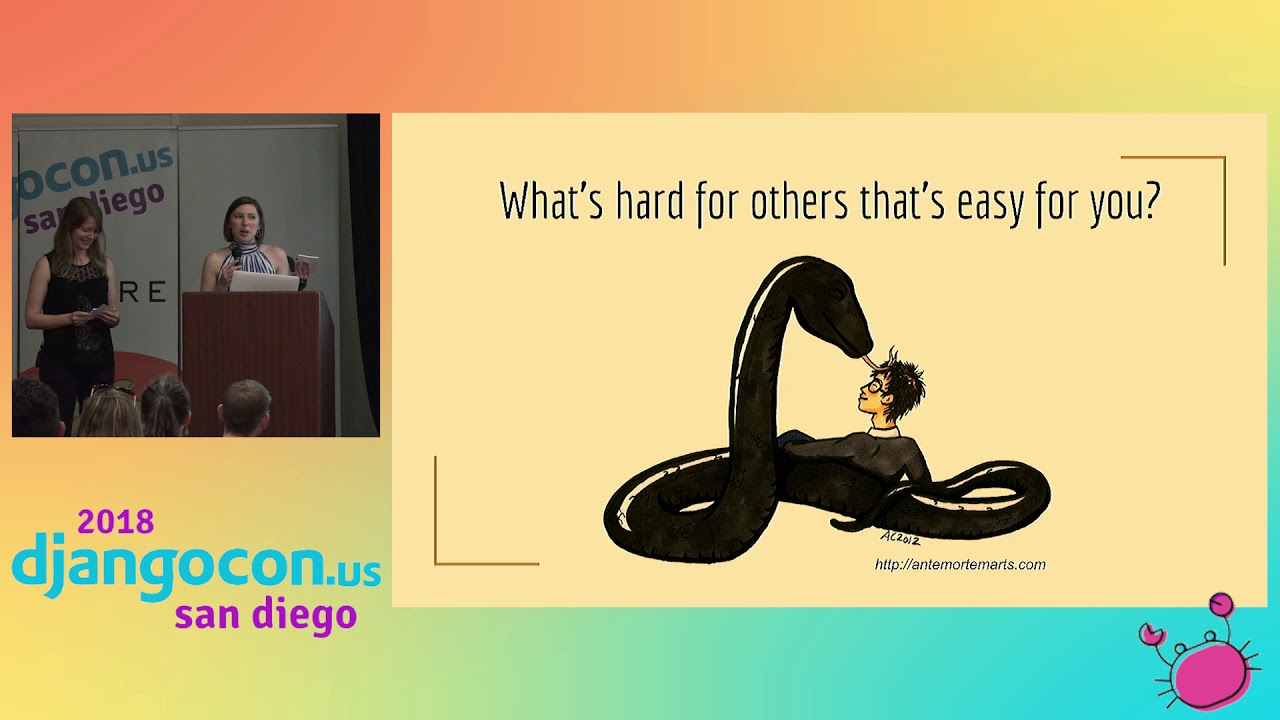
DjangoCon US 2018 - Transfer those Skills! How to Identify, Communicate, and Sell your Transferable Skills when Switching Careers by Caroline Taylor and Rebekah Post
Tech industry giants are acknowledging that diversity in employee backgrounds is valuable for their organizations’ bottom lines. However, it’s still tough for job seekers to land a tech job without prior experience closely aligned with the job they’re applying for. This talk will focus on helping people who are looking for their next tech role: (1) understand themes of what hiring committees look for, (2) identify transferable skills from nontraditional experience they already have, (3) communicate the power of their unique set of past experiences, and (4) learn tools to demonstrate these skills in their resume and job interviews.
Attendees who are looking for their next role will leave with actionable ideas for improving job application materials, conveying transferable skills from non-technology-related jobs in interviews, and generally rocking any job interview with basic tips that many people miss.
The presenters, both of whom came to tech without a traditional CS background, will give a short introduction of their experience and expertise. They will discuss the aspects of their experience that they expected to be valuable from the start, and those (sometimes surprising!) skills whose value became apparent only after they got to technical positions. Both presenters have participated in hiring panels, one as a hiring manager.
They will share tips and tricks based on industry best practices and their experience reviewing resumes, cover letters, speaking with references, and interviewing job candidates. They will highlight common mistakes and things to consider when applying for, and then interviewing for, attendees’ next tech job.
This talk was presented at: https://2018.djangocon.us/talk/transfer-those-skills-how-to-identify/
LINKS:
Follow Rebekah Post👇
On Twitter: https://twitter.com/Chocotiere
Follow DjangCon US 👇
https://twitter.com/djangocon
Follow DEFNA 👇
https://twitter.com/defnado
https://www.defna.org/
Caroline Taylor and Rebekah Post explain how people can move into software development and related roles without a computer science degree. They argue that transferable abilities—especially communication, writing, organisation, planning, project management, research, customer service and problem-solving—can be as valuable as technical skills, and show how to identify these strengths from previous work. They recommend building relevant experience through networking, open source, personal projects, hackathons and volunteering, then presenting a clear, concise career story in applications, seeking feedback, applying despite frequent rejection, and approaching interviews with preparation, confidence and humility.
Summarised automatically from the transcript.
Automatically transcribed, so expect mistakes in names and technical terms.
Speaker 1: So thank you all for being here today and thank you for the introduction. As Carlton mentioned, we're going to be talking about how to transfer your skills from a variety of different fields potentially potentially. My name is Rebecca Post and
Speaker 2: My name is Caroline Taylor.
Speaker 1: So before we get started, we want to have a better idea of who you all are. Can I see from a show of hands who here has a computer science degree? Oh wow, a lot of you. Okay. Not me, not her. So all right. Um and who here is involved in hiring? A few of you. Okay.
Speaker 2: About 20%.
Speaker 1: Now you might want to pay attention for the next couple questions. Who is looking to get into tech for the first time, maybe? A few people, okay. And um who is already in tech but thinking about a different role or not sure they want to stay where they are forever? I mean me, right?
Speaker 2: Yeah.
Speaker 1: Yeah. Cool. Great. All right.
Speaker 2: And who here is a Harry Potter fan? All right. All right. About ninety percent participation in that one.
Speaker 1: I think that we are in a in a good place right now.
Speaker 2: All right, so imagine with me, you find the perfect job, you find an organization. that you can support that you can enjoy working at. You know you've got the skills to get that dream job and you know exactly how to communicate that.
Speaker 1: Maybe
Speaker 2: movie in the back. No Can you hear me now? It is not on.
Speaker 1: Success.
Speaker 2: Winner. Thank you. Alright, oh. Beautiful. Beautiful. Is that why raising your hand? I was like, it's not time for questions, bud. What are you doing? Thank you. Thank you.
Speaker 1: All right, let's imagine it yet.
Speaker 2: Okay, back up, back up. Okay.
Speaker 1: We got this.
Speaker 2: Imagine with me. You find your dream job and you find it exists at an organization that you can support, you can work at and you can love and you know exactly how your skills fit into that role and not only that but you know how to communicate that and so you craft your resume your cover letter if applicable you get you apply you get an interview you rock the interview You get an offer and you negotiate for a better one.
Speaker 1: Yeah.
Speaker 2: And you walk in on day one knowing that you have something unique and powerful and different to offer What if that was your next job search experience? Right? Our job today is to get you there. And we're gonna use the very helpful magical world of Harry Potter and friends. to um to find relevant you know stories to to make this content come alive. So I I will say I feel obligated to tell you there may be spoilers in here. So like if you haven't read or seen anything Harry Potter related, sorry in advance We figured it's been out for a while, so it won't be too disappointing. A little while. So our alternate title here is all about how to harness your magical powers. So when we talk about transferable skills, we'll be using magical powers interchangeably when talking about those skills.
Speaker 1: And today we're really going to focus on jobs related to software development, whether that's actually a developer or engineer position or the related positions like testers, QA. uh product owners, product managers, these are all important things. But a lot of this vice advice honestly can be used for any type of field that you are interested in going into.
Speaker 2: Absolutely.
Speaker 1: So, before we get into it, let's have some introductions. Who are we? As I mentioned, Carol and I do not have computer science degrees. Before I became a developer, I did a lot of data analysis. Um, and in my first developer job I did a lot of data analysis as well. But now my position is a lot more of a traditional coding position
Speaker 2: Right. And after I joined software development, I went on to be a manager to a manager position, and I most recently transitioned to the product team. I've had a little over two years of hiring experience both as a hiring manager and as someone on a hiring committee.
Speaker 1: Yeah, and I've been able to get a little bit of experience hiring as well, reviewing resumes and helping with interviews. Which has been a really cool way to see how it works from both sides.
Speaker 2: Right. And so we want to share what we've learned in transitioning from career or maybe just different kinds of jobs in the same field to help you guys make that transition yourself. And in order to give you guys the best advice possible, we did a lot of research and we also interviewed 10 people with various roles in tech So we interview people who are software developers, project managers, dev managers, even a CEO, an HR professional, organizational change management analysts. We really tried to get a breadth of different experiences so we can share something useful to everyone here.
Speaker 1: Yeah. We also went to the library to do some research, right? That we waded through some journal articles as well as a ton of internet articles, good and bad, to bring you hopefully what's helpful. Yeah. Because we don't have a sorting hat to tell us what our future should be, we had to go through all of this different process. And the first thing we're gonna talk about then
Speaker 2: is
Speaker 1: what does it take?
Speaker 2: What does it take? So here is just a brief outline of what we're talking about today to help you know where we're going. So we're going to talk about prioritizing networking. We're going to talk about focusing on the skills that you bring to your next role and the skills that you need for that role. We're going to talk about how to craft your materials so they really tell the story. We're gonna show you how to hustle for feedback to make sure you're improving all along the way. We're gonna encourage you to get out there and apply. That's an important step. We'll have some tips for rocking the interview and then we'll want you to keep on proving over and over. It may not be that you get your dream job the first time you apply, right? So we're gonna talk about it. About how to iterate and improve. Now I will say that these are not necessarily order-bound. So if we talk about something today that uh really inspires you to take action tomorrow, do it. You don't have to go in this order.
Speaker 2: This is just how we'll be leading you through the content today.
Speaker 1: Yeah. So as she mentioned, let's talk first about networking. To be honest, when I thought about networking before preparing for this talk. I it made me a little bit uncomfortable. I didn't like the idea of it. I didn't know what to think about it. Does anybody here really like networking? A few people, two or three? Who avoids networking? A lot more willing to admit that, and that everybody else is somewhere in the middle or just too shy to say. All right. So what I found in learning about different ways of networking is that there are so many different ways that I already was networking, but in a way that I found comfortable and that fit my personality. So we would encourage all of you to do the same, to find a way that you can network, that you can connect with others
Speaker 1: within whatever technical area that you're in.
Speaker 2: Right. And I think a lot of people approach networking as kind of a a way to get something out of somebody. It's very transactional in my experience. And what I found to actually be really helpful for me, um, you know, I find those transactional interactions really awkward and uncomfortable is I find that if I approach it as I'm here to make friends, it turns out people want to help their friends, right? And so if you volunteered with somebody or worked with someone that you enjoyed working with, you're more likely to recommend them for a job. or find an opportunity and pass it along to them. So I encourage you to make some friends here at DjangoCon, because you're really you're 90% of the way there by showing up today. Um and that like it's gonna help you out.
Speaker 1: Yeah.
Speaker 2: Ooh, one thing we also um found out sorry, I just remembered. Um one of the people that we interviewed um for uh for this talk, we asked her um how she liked to do networking because she's really good at it. She meets a lot of different different people. And what she recommended, even though it sounds extra scary, is to go to networking events alone. Um which maybe makes your skin crawl a little bit, but she said what she found is that if she went with friends, she was way more likely to talk to her friend and not Make any new friends. And so we encourage you to go to those events alone. You're much more approachable and you're much more motivated to talk to somebody that way.
Speaker 1: Yeah, what a great idea. So there are the traditional networking events, but you can network at places where you're trying to do other things as well. For example, while practicing a skill. perhaps at a meetup, maybe while you're volunteering, or even at a hackathon. And those are all ways to gain experience, but also get out in the community and network and meet people who live in your area who are working with the same sorts of things. Sort of like Dumbledore's army where students from different houses, right? They all were practicing their skills together and making a different group of friends than they had before.
Speaker 2: And we encourage you guys after today's talk to say hello to your neighbor if you don't know them and make a new friend. You'll be step one down.
Speaker 1: Awesome.
Speaker 2: All right, so the next step we'll talk about is focusing on the skills. And this is a two-parter because really you want to focus on what skills you bring to this next dream role and also what skills are really necessary. So you may not think that you have the perfect resume. Um, Hagrid certainly didn't. He ended up getting his dream job somewhere at near the end of the the books of care of magical creatures instructor. But as a Hogwarts student dropout and the groundskeeper on campus for several decades, which we know is not a very prestigious job, he was really surprised to find that he actually had a lot of the experience that was Necessary for being a great magical creatures instructor. His background led him to his passion for magical creatures, and in this case gave him that perfect opportunity with the help of Dumbledore, the headmaster of Hogwarts.
Speaker 1: Yeah. We also have a real life example. One of the people that we interviewed was recruited out of college that there were recruiters contacting him saying, hey, we want to hire you now. And he's like, well I don't I need my degree? Don't I need that for a to get a good salary? Um but in high school he had been making Geo Cities and Angel Fire websites. if you weren't on the internet at that time. Those are like the great granddaddy of Squarespace and WordPress, things like that. Um but what he found was that no, he didn't need the degree in order to be hired. So he decided to quit college. went and took a job and ended up with a bunch of different jobs and now owns a company where he also does not care so much about what degree you have as much as the skills that you can bring.
Speaker 2: So when you're trying to figure out what unique skills or magical powers you have, uh you can think of Harry Potter's uh ability to speak to snakes. favorite examples because he didn't even know what it was. He didn't know what was happening when he spoke to the snake at the zoo one time. But this is something that was really, really hard, if not impossible, for others around him that for him came very naturally, was very easy. So there may be something that's really hard for other people around you that's really easy for you. That might be writing a very readable and accessible email. It might be designing really beautiful architectures. It might be be always catching the details. We encourage you to look for things that other people come to you for help with because chances are that means you're really good at that
Speaker 1: Yeah. I was shocked in my first developer role that people complimented me on my emails and like It's an email. What's wrong with you? But then they started asking me for help editing other things and also in my documentation, like, oh, you laid those steps out very clearly. Like Well, I would hope so. Isn't that the point? But but it was something that was easy for me that I just didn't realize how much diff like difficulty others might find in that area.
Speaker 2: Right. And as a product team member, a big part of my job is figuring out what a user is struggling with and how can our developer team really meet that need in a unique way or in a In a straightforward way. And so a lot of my job is asking questions and trying to figure out what the right question to ask is. And in my former career as an environmental educator, I had to ask a lot of questions of the seven to nine. year olds that I worked with and I got really good at reading between the lines when they weren't telling me that they were scared of spiders, right? And so you never know what job experience that you already have may be really valuable in your next career or your current one
Speaker 1: Yeah. So when you go looking for your magical powers, the first thing to trust is your brain. You know yourself and your experiences most Most of all. Your friends can be a good source, maybe your favorite colleagues, the experiences that you've had in life, your favorite things to do, because maybe you're not the best at it yet, but if you like doing something, you're more likely to be willing to put in the time to get better. And if none of those are working for you, you might also think about free skills assessments. Like they have a lot of these online where you can get an idea of what you might be good at.
Speaker 2: Right. One of the people that we interviewed found her passion for organizational change management because she kept getting invited to these meetings where nothing about her job title indicated that she needed to be there. But a lot of the developers were looking for help translating their lingo to members of the business and she was really good at that. And so if you remember that you know important workflows to those who are competent, getting that feedback from her colleagues And peers was really valuable and now she is in a totally different job than she started with and she loves it.
Speaker 1: Yeah. Another example we have from our interviews is someone who was a project manager and realized that her favorite part of her job was writing macros and stuff. scripts in order to analyze different things. And so she started taking on more coding like responsibilities and was able to transition to a developer role, which was a really neat opportunity for her.
Speaker 2: Right. Um now you don't have to listen to every piece of advice out there. You may get feedback, solicited or unsolicited, from people you work with that you're not big fans of. of and you know what you don't have to take their advice
Speaker 1: just ignore them it's okay
Speaker 2: uh people if you you know really want to get some feedback on what you're really good at we encourage you to talk To nice, friendly people who know your skills. If you have that one friend that's really unnecessarily judgmental, like you don't have to ask them. And if they give you advice, you don't have to listen to them. In fact, if you have any expert, including us, you know, who gives you advice that doesn't really work for your situation. You don't have to do it. Because really you know your situation better. So don't feel pigeonholed into doing this one thing and only this thing, or else you can't get ahead. Right? Like The world is a wide, vast place. Absolutely.
Speaker 1: And when we were looking at those internet articles, there were tons of self-proclaimed experts contradicting each other. So one expert might tell you one thing that's not going to work for you, but you can just find another expert that will tell you something that might work for you.
Speaker 2: Right. Right. Okay, so now we've talked about how to identify what magical powers or trans inspirable skills you have, but what powers are actually really in demand for your dream role or industry? It's time to look at some research.
Speaker 1: Yeah. So luckily there is an organization that actually went and studied job ads across tons of different fields to figure out which skills are common across different different areas and different Different well, just general fields. And what they found was that there were twenty-five skills that stood out across the board. And we have brought today the top 10 that they found in what they considered IT roles. So that might go from customer service all the way up to manager, but it's still generally related. These are in order of their findings. The first most important is communication, then writing, organizational skills.
Speaker 1: Problem solving, planning, project management, research, Microsoft Word in Office, Customer Service, and Microsoft Excel. And when you see them up there, you might be like, yeah, I guess I use those, but how would I transfer that from somewhere else? Well, I wrote a dissertation that's over 200 pages of writing, so that checks that one off. But also that was at the end of a three-year um project that was a research project that covered two different countries organizing with 40 different participants, two translators, five professors, and if anybody's worked with faculty. you will know how impossible it is to get them to do anything. So there's a lot of project management planning and problem solving that went into that.
Speaker 2: Yeah. And in my prior uh career as environmental educator, um, there was a about a year-long period where we were giving different curriculum every two weeks to different groups of kids. And we had a team of seven. And so that required a lot of close-knit direct communication, a lot of project management, and a lot of planning, and honestly a lot of very last-minute creative problem solving. So you probably have a lot of these skills already. And I think what's really important in this study is that it shows that these skills are ones that are very well represented in job postings. So it means that a lot of people don't necessarily have these skills, but employers really want them. And so if you do have these skills, these are you know baseline or transferable skills, it's really important to highlight those in your next job search because you may have that leg up that someone doesn't.
Speaker 2: And honestly, if you've been a part of hiring, you know that you can teach technical skills to someone with that kind of brain and aptitude, but it's really a lot harder to teach someone communication skills. skills that struggles with that. So keep in mind that these are really valuable in IT.
Speaker 1: And these were found, these were one in four of the skills found in the even the IT job ads. So 25%, that's pretty good.
Speaker 2: That's a lot.
Speaker 1: Yeah We will have a link to the actual study if you're interested in learning more in our GitHub resource page that's interest listed at the end.
Speaker 2: Okay, so you know what skills are needed in IT in general. But your dream job may not be necessarily made up of just transferable skills. There may be some skills that are really unique to that kind of role that you need to make sure that you brush up on. One way to find those out is a great uh piece of advice that someone told me at a networking event a couple years ago. This woman said she was looking to get into a new industry. She didn't know a lot about what kind of job she wanted, but she knew where she wanted to go, like the industry. industry itself. And so she looked at several job postings across the industry and she cut and paste those into her dream role. And then she went to networking events for that industry and said, does this job exist? I think it's called this, is that right? And people with that industry knowledge are able to say, actually no, you don't want to go for this job, you actually want to go this direction.
Speaker 2: And she's able to get that feedback and really hone her job search very appropriately.
Speaker 1: Yeah, and that sounds pretty amazing. If you don't want to go up to real people, you can also start out by looking at existing resumes on LinkedIn and Indeed. The Indeed resume search is like typically for employers looking for employees, but you don't have to have an account to to go and look at the re existing resumes. You can type in a couple of skills and say I would like to be a project manager. And you can see people who have that listed as one of their past jobs and you can see that the skills that they've listed or you can see people who are now a project manager and see what jobs they've had in the past and what sort of skills they show on their resumes. that may have helped them to get that project manager position. So that's a way that you can ease into it.
Speaker 2: And that's indeed, is that right?
Speaker 1: Yeah.
Speaker 2: Yeah. Use it. It's out there.
Speaker 1: After putting together all of these different things, you may realize that you need some more experience before you can get that dream job. If that happens to be the case for you, we do have some ideas. These are more for developer type jobs, but there are some others that could use them as well. But the first would be to contribute to open source projects For example, the sprints at the end of this week, right? Thursday and Friday, you can work together with people who are really excited to have others work on them. work on their open source projects. Last year I helped with one. I had never used GitHub before. I had done a tutorial, but they helped me to be able to figure out how to fork the repo, how to make changes, how to commit the changes, how to fix when I screwed it up. Um
Speaker 1: and they were super welcoming and helpful and I was I was actually able to commit something useful to an open source project by the end of Thursday. It was really exciting
Speaker 2: And we also heard from the uh the organizers that if you want to participate in those sprints, sign up by the end of Tuesday or by Wednesday morning or else you might not get food. But do it.
Speaker 1: That's probably a joke. But still do it. Yeah. So you can also create personal projects. Someone that we interviewed suggested that even if you're a if you want to be a sysadmin, maybe you get a Raspberry Pi and configure it to monitor the output of ice in your freezer. Something that shows that you actually have some idea of what this job is going to take. and have taken the initiative to go out there and try it out for yourself. Because when you're trying it for yourself, you're gonna learn a lot more than when you're just going through a tutorial. Another option is short-term gigs. You can find those on different websites and such. Hackathons can be a great way to get little bits of experience. I got to help redo a website for a nonprofit, which
Speaker 1: was amazing and I also learned about WordPress that weekend. Um yeah, sharing your work. Um, you know, maybe you'll be more motivated to do more work if you're sharing it. And of course volunteering. You might ask the people you're volunteering with ahead of time if you can include that work in your portfolio, but that can be a good way to get experience as well.
Speaker 2: Right. And I hear that the DjangoCon organizers as well get a lot of networking and uh experience organizing So consider that next year.
Speaker 1: Yeah, good idea.
Speaker 2: Okay, so you know what skills you've got, you know how they apply to this new job. Now it's time to craft your materials and really let that story of where you've been and how you're gonna get to where you're going shines through. And it's important to craft your materials in such a way that it's really obvious to the hiring community committees exactly why you're applying to this job and and why they should hire you. So you don't have to be sleazy or lie on your materials like our um skeezy columnists Rita Skeeter here. But one thing that we found when we were doing our research is that recruiters only spend on average six seconds on their initial pass of your resume.
Speaker 1: That's recruiters, not necessarily everyone who looks at resumes.
Speaker 2: Right. But oh my gosh, that's shocking, right? Like if you have a lot of words. or you don't have the most relevant experience up at the top, or they have to really think about why you're applying for this job, then you might lose that opportunity to work or you know to work with that per that recruiter. So we're gonna leverage some of Rita Skeeter's strengths when we're building our materials. next time right we're gonna include some attention grabbing details we're gonna make it really clear how our past experiences apply to the job we're shooting for now and we're also gonna work really hard to be concise. Because when they're glancing over your resume or your cover letter, you don't want to make them read extra words, right? They only have a few seconds. Make every second
Speaker 1: Count. Absolutely. So none of the people that we interviewed had a computer science degree. Um and so they each had to tell how their unique story prepared them for the job that they currently have. Caroline, you are now a senior product owner.
Speaker 2: That's correct.
Speaker 1: You were never a junior product owner.
Speaker 2: I was not, don't tell them.
Speaker 1: They won't see this. So how did you communicate to the company that you're now at that you had the skills and abilities that they needed without ever having that role before?
Speaker 2: I'm so glad you asked. It's like we planned this Well, so I came to that interview at TransUnion armed with a certification in Agile Scrum product ownership. I found out about that role for the first time when getting a certification as an Agile Scrum Scrum master and I found out about the product owner role and I was like, actually, that sounds like way more fun. And so I immediately went in for that certification after that first one. And um And so that showed that I was really serious about the role, right? I wasn't just applying to many jobs over and over. I was saying, no, I really want to be a product owner in a Scrum framework, and this is a role that I you know, I want to take on. Um and in that interview, I was able to show that in jobs that I'd had previously, I already had to learn and I had shown um, you know know productivity in the skills that are required for product ownership.
Speaker 2: And so as um as someone who was training people to become software developers, um, I had to communicate non-tech or communicate very technical information. to people without a technical background, because in the software developer training program that Rebecca and I came through, you didn't have to have any developer experience before you joined that program. program. Woohoo, woohoo. Um and after that as an organizational change management analyst, um a big part of my job was communicating between the technical and non-technical folks at UT at the University of Texas. And so I had to do a lot of that translation that really is the hallmark of being a product owner that I do today. And as a ma dev manager in my last role, um I had to show, or you know, I had the opportunity rather to inspire people to move in the same direction toward a common goal. goal, which again is so much a part of what a product owner does.
Speaker 2: And so I was able to weave that story among those very disparate roles in such a way that it made it really clear that I could do the job even though I'd never had been a product owner.
Speaker 1: That you knew what it meant and you were ready.
Speaker 2: Right. And I will say too that I had applied to a half dozen places around Austin, Texas, where I live, before I'm getting an interview at this place, and I never got a call back. Um and uh and I knew someone at this organization And I think that he was able to advocate for, you know, let's just interview her. She hasn't had the role before, but I know she has the skills, right? And so I think that speaks to the power of making friends at things like networking events and leveraging those in the future in your job search.
Speaker 1: Definitely. So once you have an idea of what you want to say, you've got to get them down on that resume. The resume is the main way that you will share your story with that hiring company. Committee, right? They might never get past a resume if it's unclear or doesn't have the details that they're looking for. The main advice that we found from a variety of sources is to keep it short Use clear words, use industry standard terms, enlist a good editor, pare your content down for relevance, and consider the visual real estate. And these are important across a lot of different sources that we found, even sources that conflicted on different things, right? There were some that said I would never read a resume with an objective statement, and someone else would say, I would never read a resume without an objective statement, right?
Speaker 1: So there are similar things about summaries. And so there are different aspects of resumes that You can't win with everybody on, but they these we gener we found basically everywhere that we looked.
Speaker 2: Right. And again, you know, if someone only has six seconds to review your resume again not everyone does but if a recruiter is looking at your resume you want to make sure that it's really concise really easy for them to see what exactly is relevant I like this idea of enlisting a good editor. I always find someone who's never had a job that I'm moving toward or that I've had to help me find that jargon. Because like I can say OCM all day long, but if nobody knows that that's organizational change management.
Speaker 1: Or what that means.
Speaker 2: Why would they hire me? They're like, I'm not gonna lose up. You know, so you want to make it um you do you don't want them make the hiring committee think too hard. You want to make it really easy.
Speaker 1: Yeah. So let's use a real example. That's me. I was an instructor at the university level for six years, and on my first resume that I used to to get into a training program for tech I talked about those daily, everyday things that I did in my job, and those were real things that I did. But I also missed out on a huge opportunity to show a transferable skill. Which was that I presented complex technical information to a range of audiences tailored to the background and goals of the audience. And that's what mattered. That's what helped me go from teaching to presenting or leading a code review.
Speaker 2: Right. And I bet so many of those experiences prepared you for writing that great documentation, designing good workflows, and writing maintainable code before today, right?
Speaker 1: Try to give directions to eighteen year olds who don't feel like being there. Once you've got your great resume, you're probably gonna want to share it, right? For better or worse, LinkedIn is a huge place for sharing your resumes. It's a huge place for networking and tech. If you don't want to be on it, then you can still avoid it, yes. But even recruiters are often advised to look for people on LinkedIn. So if you want to be found by a recruiter, you should probably put some stuff on there. You might want to make sure your GitHub stuff is up to date if you do things with open source. And indeed is the largest job search in the world, so you could put your resume there as well in order to be seen if you're interested in that.
Speaker 2: Right. And if you do have an online presence, we encourage you to make it as consistent as possible. possible because chances are if they found you on LinkedIn and they see a GitHub page, they're gonna go to that GitHub page. And if it hasn't been updated in four years, they might notice. In fact, didn't you get a recruiter ask you when you finish your discussion? dissertation. Yeah.
Speaker 1: I think it's interesting to see what they have to say. I wasn't interested in their job, but I'm like, oh yeah. And they're like, and when are you when are you finishing your your PhD? And I'm like Excuse me? And they're like, well it says to present. I'm like, oh no, where'd you find that? I finished that three years ago. So oops.
Speaker 2: Yeah. So learn from our mistakes.
Speaker 1: Yes, please.
Speaker 2: All right, so next we're gonna talk about the fun part, right? Everyone's favorite part, asking for feedback. That was a joke, you can laugh, it's fine. Um we all get what we might call like term paper Where we've been staring at something for two hours or three days or a week and we think it's great. And then someone in walks in and goes, You missed a comma. Right? Or something really glaring that you would have seen if you'd taken a break. And so um asking for feedback will literally only ever help you, right? As long as you ask nice, friendly people.
Speaker 1: Yeah.
Speaker 2: Smart for leaking.
Speaker 1: Right. And unfortunately you don't have a professor available to grade you unfortunately.
Speaker 2: Unfortunately. Oh
Speaker 1: Unfortunately. Oh sorry. Sometimes it's nice to know who to ask. But you can ask friends, um, some friends maybe better than others about asking this kind of things. You may have co-workers who are willing to look over your resume who maybe have done some interviewing and could practice some questions with you if you want to enlist a career coach. Some people find those super helpful because it's somebody who really is objective and doesn't know you at all And so all of those can be options for ways to find feedback.
Speaker 2: Right. And if you are contacted by a recruiter, go ahead and ask them what drew you to my resume? Is there anything that you have questions about or might be confusing? Right? That's a great time to ask for feedback because again, they don't know you. They they may want to flatter you to get you into this new job, but you can always ask for that feedback then. You might be surprised at what helpful information information you get. If you go to a hackathon, which I know I'm sure many of you have been to, go ahead and ask the group at the end for a retrospective. Maybe you can identify what went really well, what could have have gone better next time you do a hackathon, maybe even ask for everyone to identify a top strength in someone else and get that that feedback from your peers about what might be your Actual magical power.
Speaker 1: Right. And that doesn't have to be focused just on you. You can start it off by being like, Caroline, thanks so much for keeping things moving along on schedule and having us have a content freeze on that.
Speaker 2: You're welcome.
Speaker 1: But For example, uh my first hackathon that I went to was only a couple months after I got into my first developer role, and I knew that I was not going to be able to code well enough to really help them with whatever they were doing that weekend. So I was looking for ways to just be helpful. And so I instead of trying to ask the developers how to do what they were doing and probably would have slowed them down. I just asked them what they were doing and what the websites were for that and I started compiling the documentation Because I was able to understand what they were working on, but the person with the idea that we were executing for the hackathon was in marketing She had no idea what any of it meant. She had no idea what information would be needed if people were going to continue on it after that weekend.
Speaker 1: And the developers were there because they wanted to write new code. They weren't there to document it. And so I was able to fill in that gap. And at the end of the weekend when I said, you know, thanks for helping me find a way to be involved, the the person who was sort of leading it was just like, what are you talking about? You found that yourself. So I didn't even realize it.
Speaker 2: Right. And I remember when we've talked about this in the past, Rebecca told me that they she got so many kudos and very specific things, right, that made it clear like, oh I'm actually really good at documentation.
Speaker 1: Yeah.
Speaker 2: Good figure.
Speaker 1: Yeah. It's not exciting still though. It's still not fun.
Speaker 2: That's okay. You can forgive it.
Speaker 1: Yeah.
Speaker 2: Okay, so you've got some beautiful materials. They're cohesive. They tell the story that you've lived. Now it's time to get out there and apply.
Speaker 1: When you're applying, it might so feel like you're just sending tons of letters to who knows where. You don't know if they're gonna be opened or thrown away or burned or whatever. But at some point Someone is going to be looking at those resumes.
Speaker 2: Right. Now studies that we happened across told us that even perfectly qualified candidates only get contacted in response to their application eight to fifteen percent of the time.
Speaker 1: That's not even a job offer. That's just a first contact.
Speaker 2: Right. And so I don't know about you, but I've applied to jobs before and been really disinheartened at how few uh callbacks I get. So I guess the point of me saying that is it's not just you. Even if you're perfectly qualified, you may not get a lot of callbacks. And that's where networking really comes into uh to help you out, right? If you know someone at that organization, you may be more likely to be at least invited to an interview.
Speaker 1: For better or worse, yeah. And because they're sending out so many as well, the HR professional that we spoke with said that as long as your job search is fairly focused on one type of position, you do not need to tailor your resume for every single position. If you want to be a Java developer, then write a good resume for a Java developer and go with it. If you want to be in Django, write that Django resume and go with it. Of course, if you're going to send a cover letter, be sure to tailor your cover letter. At my organization we did recently get someone applying for somewhere completely different and that was set aside.
Speaker 2: Okay. So you've applied and you get invited to the interview, it's time to rock the interview.
Speaker 1: Heck yeah.
Speaker 2: How do we do that? Well, if you've ever been on a hiring committee, then you know that there are some real myths out there that trip people up unnecessarily So we wanted to address some of those myths. So do hiring committees want someone who says all the right words and all the right orders? No, you're allowed to say um. If you need them to repeat a question, that's okay. We all know that you're nervous probably. So don't worry about getting everything perfectly. We're all humans. Do we want to hire someone who thinks they know more about the job than the hiring committee? No, you don't know more. But you can show that you've done your homework, right? There's a difference.
Speaker 1: Please do.
Speaker 2: Please do. Um do they want to hire someone who thinks that they're perfect? No, because we're humans and everyone has room to grow. And so, you know, being confident but also humble, I think. Go a long way for hiring committees.
Speaker 1: And we really have seen these in interviews.
Speaker 2: Oh my gosh. And also I'll say on that last slide that no one wants to hire someone that's going to fire someone else in their first year. Professor Umbridge. Um so hiring committees do look for a lot of things that are similar across all kinds of roles. So they want someone who's gonna be a team player because we know that software development and the the roles that support it really does require a lot of teamwork. They want someone who enjoys problem solving because at the end of the day, every role in IT or in software development is there to solve a problem creatively. They want someone who can accept feedback, because remember, you're not perfect, although we love you anyway. You need to be able to accept feedback so you can grow in your career. And they also want to imagine being able to work with you for years to come. Right.
Speaker 1: And if you're not sure about these things, if you're not convinced by us telling you about how hiring committees feel, see if you can get on a hiring committee. Where we each work, we're lucky that we've been able to help review resumes or help in interviews. And I realize that not all organizations are open to that, but you may be able to ask to observe an interview You that you know you're just interested in how the process of picking a team member happens, right? You care about your team, so that's that's a reasonable request.
Speaker 2: Right. And it really does shift your perspective if you've only been on the applicant side of the table, you know A lot of those myths, you don't know which ones are real and which ones are fake. But once you've been in a couple interviews on the other side or at least observed them, you can see that it really isn't something to be so freaked out. about right or oftentimes it isn't.
Speaker 1: Definitely. So even once you've gone to an interview, if you're crazy lucky like all of Harry Potter's near brushes with death you will get an interview and then get a job from that first interview. But for most of us, we have to do it multiple times. And you're probably your first job probably isn't going to be your only job, especially in tech, right? So, most of us, we need to keep improving all along the way as we go through this. At some point, you will get a job offer. And when you do, you should be sure to negotiate. Last year, one of the DjangoCon keynotes was Tracy Osborne. She gave a f<unk> fabulous talk that included the importance of negotiating and we would encourage all of you to go to YouTube and look it up
Speaker 1: because it was great and several people that I know have used her tips.
Speaker 2: Absolutely. Which is true of all the talks at Django Khan. You can find ours on YouTube later as well. All right, so the point again of today's talk is to really own the maginal powers that you bring to the table. We talked about networking and how to prioritize that early and often. Talked about what skills you bring to the table and what skills you should be building in your job search talked about how to craft your materials, hustle for feedback, actually apply to those jobs, and how to rock the interview. And again, we encourage you to keep on improving. improving along the way. And if you don't mind, let your network of friends know what works for you and what didn't.
Speaker 1: Yeah. So thank you all very much for your time.
Speaker 3: had the old skill set that you um were from and like how do you answer that question like oh we know that you come from background of this like why are you applying to what whatever
Speaker 1: Absolutely. My current job they asked me why you have a PhD in French. Why on earth should we hire you for identity management?
Speaker 2: Totally normal.
Speaker 1: Uh-oh , uh, doesn't everybody I know like six people who did that. Anyway, but th what I've said is that For me particularly, it was sort of easy but I c because I can say the lifestyle that I'm looking for and the job opportunities that I'm looking for weren't with that old. If you're looking for just a different skill set, then it might be a little bit harder, but you can say, you know that this is what I am most interested in. I found, you know, I had the opportunity to work with this or through a hackathon or through a personal project. I've been learning more about that. And I found that that is really more compelling to me and my work style than whatever old tool set you're using before. And at least in my experience, that has been taken fairly well, it seems
Speaker 2: Right, and I would add that as a hiring manager, a lot of times that question is to learn more about you just as a person and as a contributor to an organization But I think a lot of times that's um a question to identify um any red flag. So if you say that you're leaving your last job because you hated everyone there and they were out to get you, um then that's a that's a red flag for me that is this person professionally mature enough to be successful in my organization, right? And so I would encourage you to be honest and authentic with whatever the reason is. Maybe you're looking for something that better suits your work style, or maybe you just really love the idea of being a product. owner, like I did. I just I found that role exists and I wanted to have it. So whatever is true for you, just make sure you uh frame it in as professional of the light as you can. Okay
Speaker 4: Sten, can we give Rebecca and Caroline a big?
Speaker 3: Thank you very much. It's super.
Choose comfortable settings that fit your personality, such as meetups, volunteering, hackathons, or skill-practice groups. Treat networking as making friends rather than pursuing transactional favors, and consider attending events alone so you are more likely to meet new people.
Discussed at 6:25Look for abilities that come naturally to you but are difficult for others, especially tasks people regularly ask you for help with. Friends, trusted colleagues, past experiences, favorite activities, and free skills assessments can also reveal strengths you may overlook.
Discussed at 10:42The talk identifies communication, writing, organization, problem solving, planning, project management, research, Microsoft Office, customer service, and Excel as common high-demand skills in IT job postings. The speakers emphasize that employers value these skills because they are harder to teach than technical skills.
Discussed at 15:03Compare several job postings for the kind of role or industry you want, then combine the recurring requirements into a picture of your target role. You can validate that picture by asking people in the industry or by examining the skills and career histories on LinkedIn and Indeed resumes.
Discussed at 17:30Contribute to open-source projects, build personal projects, take short-term gigs, join hackathons, share your work, or volunteer. These activities provide practical evidence of initiative and experience that you can include in a portfolio.
Discussed at 19:44Recruiters spend about six seconds on the initial pass, according to the research cited. Put the most relevant information near the top, use concise and clear language, and make the connection to the target job obvious.
Discussed at 21:44Keep it short, use clear industry-standard terms, remove irrelevant material, consider the visual layout, and have a good editor check it. Describe past work in terms of transferable accomplishments—for example, presenting complex information to different audiences—rather than only listing routine duties.
Discussed at 25:46Yes, if you want recruiters to find you, maintain a useful LinkedIn presence and keep relevant GitHub work current; Indeed is another major job-search platform. Keep your profiles consistent and up to date because recruiters may check more than one of them.
Discussed at 28:17Ask trusted friends, coworkers with hiring or interviewing experience, career coaches, recruiters, or peers from hackathons. Recruiters can explain what attracted them to your resume and what was confusing, while hackathon retrospectives can reveal strengths and areas to improve.
Discussed at 29:47The talk cites studies finding that even perfectly qualified candidates are contacted only about 8–15% of the time, and that contact is merely an initial response rather than a job offer. Networking can improve the odds of getting an interview when someone at the organization can advocate for you.
Discussed at 33:17Not necessarily, if your search is focused on one type of role: create a strong resume for that role and reuse it. Cover letters should be tailored to each position, and applying for a clearly unrelated role with the wrong materials can hurt your chances.
Discussed at 33:51They do not expect perfectly scripted answers or someone who claims to know everything. Show that you prepared and understand the role, while remaining confident, humble, and willing to acknowledge that you still have room to grow.
Discussed at 34:34Note: We understand that names change, people change, and bodies change. We respect each individual's journey and privacy. If you have any concerns about a video or need us to remove content, please don't hesitate to contact us. We will handle your request with care and promptly address any issues.

Published July 15, 2026

Published July 15, 2026

Published July 15, 2026
Published July 15, 2026
Published July 15, 2026
Published July 14, 2026