
0:32:10
Orientation with Kojo Idrissa
Published October 26, 2026
DjangoCon US 2026
This video features Dan Ryan at DjangoCon US 2026 in Chicago, Illinois, USA.
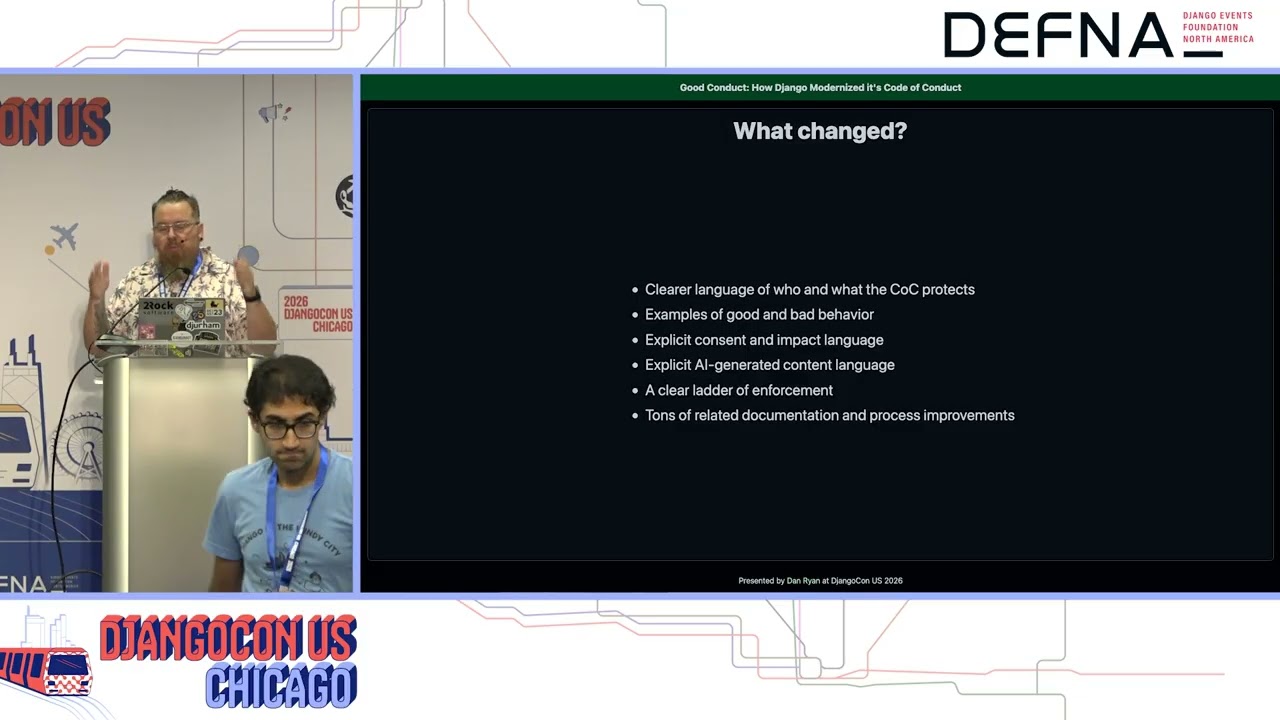
A Code of Conduct is only as strong as the community's trust in it. When it's time to revise one, the how matters as much as the what. Django's Working Group undertook a significant revision in 2026 — adopting CC3's expanded encouraged and restricted behaviors, adding explicit guidance on consent and impact versus intent, formalizing a graduated enforcement ladder, and even addressing the responsible use of AI-generated content. This was not just a find-and-replace; it required community input, DSF Board approval, careful sourcing from the PSF, OpenJS Foundation, Mozilla, and others, and an updated, transparency-first documentation process.
The talk opens with a look at what makes Contributor Covenant 3 meaningfully different from earlier versions — the shift toward encouraging positive behaviors, stronger language around impact versus intent, and explicit attention to consent and boundaries. From there, it digs into what Django's update actually changed in practice: new sections on encouraged behaviors, expanded restricted behaviors covering microaggressions, retaliation, and bad-faith reporting, a four-tier enforcement ladder with defined timeframes, and responsible use of AI-generated content. The middle of the talk covers the governance story. How we moved documentation into a version-controlled GitHub repository, establishing a formal proposal and approval workflow, knowing when to loop in the DSF Board, and how to communicate changes to the community without starting a firestorm. The talk closes with practical takeaways for any project considering a similar revision: how to source ethically from other communities, how to build in transparency without inviting endless bike-shedding, and what "done" actually looks like.
Following the talk we'll save a few minutes for Q&A with the working group.
This talk was presented by Dan Ryan at DjangoCon US 2026 in Chicago, Illinois, USA
https://2026.djangocon.us/talks/good-conduct-how-django-modernized-its-code-of-conduct/
LINKS:
Follow Dan Ryan 👇
On Mastodon: https://dryan.com/@d
Website: https://dryan.com
Automatically transcribed, so expect mistakes in names and technical terms.
Speaker 1: How are y'all today? Awesome. I'm Dan Ryan. I'm a software developer. I started as a front-end engineer before that was a term back in the day. I got into Django in right before the 1. 0 days in 2008. My first project was also the first time I had ever written Python. So I made a system to generate HTML emails for our clients at an agency and I've been abusing Django for the last 20 years since, doing all kinds of things no one should ever do with it. After I left that agency, I went freelance for a while, and then I got the opportunity in 2011 to come lead the front-end developer team at the Obama 2012 campaign here in Chicago. So coming home has been fun. After that, I got heavily involved in digital equity and justice work.
Speaker 1: I still do freelance work now. My major client is agricultural financing, so you know, a real thrill of a industry to work in. But I've been using Django most of my career at this point and I wanted to be able to to give back. And I never considered myself a good enough Python developer to contribute to the code base. So I volunteered to be on the Code of Conduct Committee. And then that led to me becoming the chair of the Code of Conduct Committee. And Mostly that's a pretty quiet job, thankfully, but sometimes we would run into issues that we didn't really have language around. So we embarked two years ago to set out to modernize our code of conduct.
Speaker 1: So why now? The biggest thing is we kept running into issues where frankly people were being jerks and there was no language that said you can't be a jerk in the code of conduct. And we wanted to just get a little more clarity around what was acceptable behavior and what was not. And thankfully, at least in in my time doing this work. We haven't had like a lot of like really serious like physical threats have not been an issue. Doxing that kind of thing has not really been a thing. There's a lot of communities that have a much harder time with this than we do, and I really appreciate the community for that But we do have people that like to just sit and argue their opinion all day and not let anybody get their jobs done. And I'm seeing some of the fellows in the room whose job is very tough because they can't merge a PR because we can't resolve the comments.
Speaker 1: So that was the why. Um the board at DSF gave us a budget and said go hire somebody and let's get this figured out. And PSF had just done the same thing and we went through several people that were going to do the contract and then never showed up to do the work. And legitimate reasons, no shade, but at some point we've been doing this for a year and nothing's changed yet. Should we just do this ourselves? The big turning point for me is I was doing a bunch of research for the group on What is what is everybody else doing in their code of conduct in the software space? And it turned out a lot of people had been turning to this contributor covenant. It was a itself an open source project, an open source code of conduct for open source projects And uh the Beware
Speaker 1: project, which is a Python project, it just adopted it and that was like, well, why don't we just do that? Like that's just done, right? Kind of. So we started this process and the the big risk was if we got the process wrong, we would break the trust that the document itself was trying to protect. So of sitting back and figuring out like how okay we've never updated the code of conduct since it was initially dropped in 2014. Nothing about it's changed. Step zero is we need to document a process to change the code of conduct itself. And that got us into this process that we'll get into in a minute. But this first part of that was arguing why the contributor covenant. The biggest reason is we'll talk about this a little bit more in depth later, but like
Speaker 1: We're borrowing trust, like this is already adopted by like over 100 organizations, including some of the biggest players in tech This isn't just something I came up with or the group came up with out of nowhere. Like this has been worked on by dozens and dozens of people and litigated by lots of lawyers and all that kind of stuff and we can just borrow all that goodwill and trust into us And then the the funniest thing about that research was realizing that we are standing on the shoulders of those who stood on us. So our original Django code of conduct was itself borrowed from the ADA initiative and from PyCon 2013. And then as we did all this research into all these other organizations that have codes of conduct, they all almost all will have a links at the bottom of where they got their ideas from. If you start tracing it all back, it all goes back through this same pipeline
Speaker 1: So the contributor covenant itself has a lineage back to the Django code of conduct. So we are now standing on top of the work that stood on top of us, and it's this auraborus eating its own tail, which is kind of fun. So I talked about this uh defining a process for proposing changes. We're coders by heart, right? So like we want to use coding tools. So we did all this on GitHub and it's public, it's transparent, and it's versioned. So if you want to make a change to the code of conduct, you can go propose an issue. There's an issue template that tells you what you need to do. and how you need to do it. And then the working group meets once a month and we will discuss any open issues at that point. If we think they're worth taking up, we will help iterate on the proposal and get it where it needs to be.
Speaker 1: If they're a large change, so like if we're actually changing how we as a group behave or the text of the code of conduct, there's a much bigger process. If you're doing something like we've we now support like right now we do a forum and we do Discord and we do Slack and a couple other things. If there's another thing that pops up next month that the Software Foundation wants. to be involved with. Like we're not gonna do a whole 30-day waiting period to name that in the in the documentation. But if we are doing anything bigger, like we have a whole process now for how do we announce that? Where does it get announced? There's at least a 30-day window or feedback from the community. And then if we're actually changing the code of conduct itself, the board has to approve it. So like this is not just a thing that a rogue bunch of people on the side can do.
Speaker 1: And then the final part of that process is to announce that the changes were made. So that's blog posts on the website, that's forum announcements, Slack, Discourse, Discord. I always want to say discourse We have a whole checklist, thankfully, as part of this. And the talk today, I'm not going to get in too deep on the actual like technical side of how we did all this. There's a blog post that just went up this morning on the Django project blog that actually has like sample spreadsheets and GitHub actions and all the like finer detail of of governance. The big thing this gave us was this, you're not asking us to just trust us anymore. Like there's a commit history. You can see everyone who worked on this, every comment that's ever been made. All the feedback's out in the open.
Speaker 1: It's versions. We have a bot that I put together that does a change log. So we always forget to do the change log. It comes behind us and does all that. Like what changed? Where did it change? Who changed it? And then as we were doing this process, we had some guiding principles. A lot of these were in Don's talk, so uh I don't have to like sort of start from first principles here, but the biggest one is protect the reporters, right? Someone who's reporting being harassed or reporting someone else being harassed That can't get out. Like it is critical that that is privileged information that doesn't get anywhere near the public unless they tell us they want it to. So that 's the first part of all this is how do we do that? And then the next part was
Speaker 1: anonymizing every everyone. So even the people being reported in our tracking system are all anonymized. There's one place that locks that anonymous ID to the actual person we're talking about and we don't talk about them by name anywhere really unless we're actually talking to them when we're taking an action because You don't want to ruin someone's reputation if they got misreported or they didn't actually do anything wrong. And then Don talked a lot about trauma-informed, and that was a big thing for us. Make this new rewrite trauma informed language, make it about the people that have been harmed, make it harm reductive. It's all about restoring the person who was injured back to the community. And then the last thing was we want consensus among the working group.
Speaker 1: If we can't get consensus, a two-thirds majority will do. But so far we've had consensus on everything, which has been great. We also have a set of shared values and these are in the document itself. But the biggest one is we want to respect the reason we're all here, which is to have a community. and build this software together. And if you're injuring the community and preventing people from joining the community or staying in the community, that is not okay. It doesn't really matter how you're doing that. If you're doing that, it's a code of conduct violation. You should engage kindly and honestly with others. It's okay to have a different opinion. It's not okay to be a jerk about how you're expressing the difference of opinion. It's really not okay to say that that person doesn't know what they're talking about.
Speaker 1: Especially when that person's a paid fellow by the Software Foundation who probably knows what she's talking about. Hi. You need to take responsibility for your own actions and contributions. We're going to get into a little bit about we have an AI policy in here now that's new. why that is, but if you're contributing to the community in any way, but especially in the code base, like that is yours and it needs to be yours and you to own it. You need to give and accept constructive feedback and you need to do it gracefully. And it's tough. Like I don't like getting feedback. That's never fun, right? Unless it's Praise and ha ha you're doing great. But like the the constructive stuff's always tough to hear, but we have to be able to hear it. Repairing harm again, like that's the goal.
Speaker 1: We want to repair the person who was injured or the people that were injured. Like that is the ultimate goal of the process. And then long term, we're just trying to have a sustainable community. So everything we do needs to be with that in mind. So what do we actually change? One thing is the length of the document. It is substantially longer because there's just more stuff enumerated in it. Another thing is all the supporting documentation around it. The first time we have a manual for people on the committee of how to actually do every step of what we do. including like sample language for emails, how do you respond, how who responds, how do you do all the tracking, what's our responsibilities? And that's all open source. It's on GitHub in the Django. organization under the code of conduct repo.
Speaker 1: It's all out there for everybody to look at. We now enumerate both good and bad behavior. We had a little bit of what was bad behavior in the original, but it was mostly hey be cool, which, you know, fair, but Not that useful when you have people that are very nitpicky and want to argue with you about every rule. We went very explicitly about what consent is and means and how it gets withdrawn. We talked more about impact. And we added this AI generated language that I talked about earlier. For the first time, we have a clear ladder of enforcement. Like there is a Very delineated process for what happens when you do something that violates the code of conduct. We'll talk about those steps in a few minutes. And then with all this side documentation.
Speaker 1: The actual like code of conduct changes is something like 200 lines of text and the rest of it's like 30 or 4,000 lines of text of all the supporting documents that we added. At the top of it all, it says we pledge to make our community welcoming welcoming, safe, and equitable for all. And like that is the deal, right? Like that is the job of the working group. That is the job of the community itself. DSF feels strongly about this. We all feel very strongly about this. And we started off by looking at like who do we actually talk about? Like who are we trying to protect here? So this is the original language. I'm not going to read these out These two are actually fairly similar. This comes both from the original code of conduct and uh the DFCF's DEI
Speaker 1: statement. And then we changed it. This one is probably the thing that stayed the closest. It's basically the same. There are a few things that we've called out like cast isn't is a new language. We are a global community. That word has meaning and value in parts of the world. Neurodiversity is explicitly stated in a way that it wasn't previously. We've broadened up Sex, gender, gender identity, expression, like there's no like you can argue with me about what I mean by sexual orientation. Like, nope, it's all covered here now. And also your socioeconomic position, your class and society, like that's kind of a new thing for us. Another one that we changed is we just got very specific on some of this language.
Speaker 1: So like this one, the original one says we cannot allow frustration to turn into personal attack. Now we actually say what is a personal attack? So you're insulting, you're demeaning, you're pejorative, you're directing it at a community member or a group of people, right? Like this is very clear like what we mean by this Harassment and other exclusionary behavior aren't acceptable. Well now we talk about what harassment is, including some very uh real-world examples for us. So one is is sea lining, which is a term I had not heard, but that just means you keep questioning things over and over and over and over and over. which some of our community members like to do. And instead of like proposing a change or a different opinion, they just keep asking you why you're doing what you're doing. Coordinated harassment.
Speaker 1: is a a thing that we thankfully haven't seen too much of, but we have seen a little. So like we want to talk about that. Like working with other people to harass somebody is a is a much higher thing than if you just went off say something by accident and you didn't really intend it. Tone policing, intimidation, trying to silence community members. These are all the different forms of harassment. In addition to the things we all think of, like sexual harassment, physical violence, all of those things. Um, we used to tell you don't have poor manners Okay, like that's fine, but like that's not that useful. Now we talk about the fact that impact more matters more than intent. An example I like to talk about a lot with this is if you accidentally drove over my foot when I'm walking across the street today, it doesn't really matter to my broken foot that you didn't mean to.
Speaker 1: Right? Like the harm happened. We do take it into account, but the harm happened and the addressing the harm and getting my foot fixed is the issue, not did you mean to drive over my foot And then consent based like defining consent boundaries more clearly. Previously we said if someone asks you to stop, then stop. We still say that. If someone says no or asks you to stop or sets a boundary, you must respect it immediately and without debate. If I say I don't want to talk about this anymore, you can't keep talking to me about it. Like that's not okay. And then this latter enforcement that we came up with. We start off with a warning. So if you, you know, it's your first offense, you've said something
Speaker 1: It violates the code of conduct, but you're new to the community or or whatever, you're gonna get a warning. We're gonna send you an email like, hey, don't do that again. If you do that again, we're gonna have to like take some actions and like block you from the community for a while. The online community working group, they are the moderators of all these spaces, and they do most of this work, and almost nothing gets beyond this Most people when you say, hey, that wasn't cool that you said that to that person, like, I'm so sorry. Let me apologize. Yeah, you're right. I won't do it again. And like it's over. And like that's great. That's what we want. We don't actually want a bunch of people in jail. But if they go beyond that and they keep persisting, then we do a suspension 30 to 90 days. This used to just all be at the whim of whoever was on the working group at the time
Speaker 1: and you could kind of do whatever you wanted and the the historical actions were sort of all over the place with severity. And a lot of times like if you said something on the forum, you might get banned on the forum but nowhere else. And it's like, well you So you just go harass somebody on Slack instead? Like that's not okay. So now this is more coordinated. We have a list of every every place we need to take an action. If you go beyond that when you come back from the ban and then you continue to to do the same things or new things that are a violation, now we look at a longer ban, so at least 90 days, maybe up to six months. And one of the critical things about this, you'll see in our ladder of enforcement, when your time's up, we don't automatically turn you back on. You need to come ask to be back in the community.
Speaker 1: Because maybe you don't want to be anymore and like or maybe you just are still in the headspace you were and you're still gonna be a a jerk So just come tell us. You don't have to apologize or say anything, but like, hey, I I want to come back. And if you want to come back, we'll let you in. And then the last one, if if things go Deeply enough as we go to a permanent ban, that involves the board, that's a serious thing. Like it's not just the working group that decides on that We have yet to do that. I hope we never have to do that. And one thing here that to be clear about, we can jump up this ladder if we have to. So if you punch someone here today, we're going to number four If the cops get called on you, we're probably going to number four, right? Like we're not going to let you keep coming back in.
Speaker 1: This is mostly for online interaction. It is of a much smaller scale. The AI generated content clause, um, this came from doing our research on what other people were doing, and Microsoft added one to their code of conduct last year. And the company that's probably putting the most money into AI in the world saying maybe you can't use AI to work on our stuff was like, okay, we should take some note of that. Why is that there? What are they trying to get at? And basically this just says you're not going to make a contribution to the code base that AI wrote and you didn't because you don't have a copyright claim to it. You can't actually do that. So This is basically like you just can't go steal somebody else's work and claim it as your own, right? So
Speaker 1: we have to openly talk about how we use AI. So a brief sidebar, how did I use AI to make this presentation? I wrote this stuff, but I did have Claude interview me about the whole process and ask me to explain it and give me questions and then look at my outline and say, oh, you missed this and you missed this. I think that's pretty cool. But I still put in the time to actually make the slides and do the talk and everything else. And then I had it take all of that work and give me speaker notes. And those are online and public and it did write those for me. They're fine. They're not as good as like what I have in my own head. But I think it's important for you to know that like I got help doing this, but also like I put in the time. Like I got asked to come speak at this conference. I'm not just gonna have an AI write the whole thing and then show up on the day and read it and be like, okay, cool, that was fine.
Speaker 1: The process itself. So this was um about a six month process start to finish and I think four months of that was it was like public work we were doing so um we used GitHub projects to manage all that and made Dozens and dozens of issues about all the things we wanted to address and how we wanted to do it that turned into 13 different pull requests, 2700 lines of code added, a thousand deleted. This is all on the Django code of conduct repo if you want to go look at it. Pull request 91 did most of that. That was all of our supporting documentation, including Well, the the PR before this one was how do you change the code of conduct and like getting all that approved and then once we did that, changing everything around it, so our event policies got updated.
Speaker 1: Our working manual got created. There's like a dozen documents there. And then when it was time to actually like go adopt Contributor Covenant version three, that was a very small PR that was A couple hundred lines added, 90 lines deleted, because again, they started with us, so like some of the stuff was actually the same, which is like really fun. Just like to see that in process. And then we had a three-day comment period on each one of these PRs. That's also like in my blog posts if you want to see how we do that. That's a GitHub action that just makes sure you can't merge anything that's not 30 days old. Super simple but it gives us time for the public. And we did have some comments during that period, and we had some things that we chose to change then, and some things that we did
Speaker 1: some conversations with folks were like, can we do this as a separate pull requests after we've getting gotten this done because we don't want to derail this while we get the finer points of like uh one of them that came up was um we debated about having a weapons policy in the code of conduct But the software foundation itself doesn't do events and we do the events that happen are all over the world and laws are different and cultures are different. So we decided in the end. Let's talk about the fact that the event should have one and leave it up to the events to get one that matches their locality, right? So like we went back and forth on some of that stuff. And as I mentioned at the beginning, like this was my first time contributing to Django. Like this is the first thing I landed. And like that's kind of cool.
Speaker 1: Like this is not code, but this is a massive contribution. And I say that thank you. I say that Because if if you don't feel like you or like me have the Python skills to go write core Django, like there are plenty of other ways to get involved and help. There's the working group that code of conduct does, we always lean more people. We are currently five people across three continents and a 13 and a half hour time zone difference. We had a 23 hour time zones difference until recently. So all that coordination gets fun and tough and if you want to come help me do time zones please do because I'm bad at them. Just keeping the calendar invites in sync isn't is a nightmare. There's the online communities working group.
Speaker 1: I know they're always looking for more folks. If being a moderator or an admin is something that you enjoy, they always need more help So yeah, if if you feel like I don't know how to give back to this thing that's given me so much, like there are so many ways that aren't writing code. And then the thing I want to say now is that the we've updated the text. This probably won't change for a while. Contributor Covenant 3 has been out for a year. They don't do a lot of changes all that often. We will keep in sync with them going forward. The text is is done, but this process of building trust just never stops. And like me doing this talk today is a big part of it. We're gonna do QA here in a few minutes and I hope you have tons of questions to ask about how we did all this because otherwise I'm pulling up travel photos and we're all going to be very bored.
Speaker 1: Um But this it's a conversation, right? Like this is not a dictatorship. This is a group of people that are willing to put in the time to try to represent the community's will. And part of knowing your will is being out here and talking to you. So please do give us feedback today. Some lessons that we learned. Number one, start earlier than it feels necessary to start because it's going to take a long time because you're all volunteers and you're all busy. This thing we thought would take three months, took two years. Time box aggressively. Part of how we actually got it over the line was these very strict, like this PR goes live on this day, it closes it on this day, and everything we have to do to get it closed on that day. Like we don't want to run long on anything. We talked about it at the beginning, but borrow trust. Don't just start from scratch. Like if you're in another community that needs a code of conduct, come borrow ours.
Speaker 1: Take like all of our documentation. It's all out there. And then you're leaning on these other people and all this other work. You're not just doing it yourself. Know when you need consensus versus when you gotta just make a decision and how you gotta get those decisions done. So sometimes people had comments on the process during that review period. And rather than going back and forth on GitHub where you're waiting on someone to notice that you've commented and you need this answer, just like they were in Slack, they're a DSF member. We went and had a chat for three minutes and then we put all that back into the comments on GitHub so people could see what we talked about and we got the problem solved and we moved on. And the biggest thing, I think, for me always is humans matter more than anything. We're also the worst, so that's why we have to have a code of conduct to begin with.
Speaker 1: But protect all the humans involved so like making sure all the members of the working group are protected during this work that we are taking care of ourselves that we are not being harassed as part of this. And then from that we can take care of all the humans in the community doing the work. So here's your call to action. You can fork the process and not just the text. There's a blog post I have a link to on at the end that tells you how to do some more of that stuff. And I want to open it up for questions. There's a QR code on the left for the slides to this talk and one on the right to the blog post itself. And then the blog post should have a link to the repo if you want the whole thing. So if you have questions, raise your hand. I'm going to repeat them back for people online to hear them.
Speaker 1: Yes. Finding a contractor that would answer their emails. But besides that, yeah, yeah, yeah. Once we actually got into it, Nothing was contentious. The thing we spent the most time on was the weapons policy because we needed to be very thoughtful about it and we didn't want to be US centric in it. And um figuring out that the right solution was give guidance on how an event should do it, but that the events needed to do it themselves. And and you all have one for here, right? So like that's clearly working. That probably took a week or two of like board feedback, lawyer feedback, us, like nothing else really needed to go through that kind of scrutiny. That was the biggest one. Yeah. So the question in case people that are online and can't hear
Speaker 1: , how do we balance transparency reporting and the health of the community with the anonymity and like That is the crux of the toughest part of this, right? Is um part of what we got out of these changes is we all of our stuff's tracked in Google Sheets locked down to accounts owned by DF. and all that. And we separated a bunch of the stuff out. So like the sheet that knows the real people's names is locked to a very specific set of people. And that can't leave Google. I mean Sure. But if if you got around Google, you're gonna get around me. So like there's nothing I can do that's better than that. And then the actual incident tracking is a separate sheet that doesn't have anybody's identity in it.
Speaker 1: And that has things like um Where to get reported, is the harm ongoing? Who's acting on it? Who on our group is taking the lead Any documents we have, screenshots, all that. This all comes into email mostly, so like we'll link to the email on Google Groups. And then one of the big benefits we got out of this new system is we have another sheet that pulls from that sheet that can do anonymous statistics in real time. And that's a new one for us. So you could there's actually a a page on the Django website that shows our year by year numbers and you can see if a number goes up and you can then like hey what's going on and like we may not be able to tell you immediately because we've got to go do all the fact finding but then once a year we do publish um
Speaker 1: a full text report that will summarize what those incidents were and as much detail as we can give. So um like last year's I'm top of my head I may get these numbers wrong was like three times that someone Um got reported for pestering comments on GitHub and we had to say like, hey, please please stop doing that. And then one or two that happened out of Django Con and they got handled by the local code of conduct committee, but they're they still report to us, so we have a record that it happened. So that they'd already been taken care of at the local level. And in every case there, the person apologized profusely and you know the harm was fixed. But yeah, like how deep can we talk about it?
Speaker 1: Like this year's is going to be tough to not lie. We've had some tough issues this year. We had to ban someone that required like 12 people coordinating a ban at the same time because they had core access to the to the core project and this is used by two million people including governments doing infrastructure and if someone gets mad and decides to go do harm and it gets pushed out in a release like that's that's a real issue right um I would love to have never had to dealt with deal with that but we did and it like that took us I don't know, it was over a month of planning to do the action before we did the action. So like look for that one this year. We'll figure out how we're gonna talk about it. Um but and in that case to um
Speaker 1: That person had been doing these behaviors for a decade and no one felt like they had ever done anything strong enough to really report it. But like I came into the community like DSF community, you know, three years ago, everyone was always talking about how much this person was a jerk. And I'm like, no one's reporting him. Oh, well maybe we should. And then the report started flooding in. And then you start asking, did this happen to you? Yeah, it's how it's he's done this to us forever. So like getting all these things in place so that we can even track those reports internally and know that more. Like one of the things that we changed. When I was pulling historic data into the new reporting system, uh the original working group redacted everyone's name after three months.
Speaker 1: And you can't actually track long-term bad behavior if that you take their name out of the document. I get why they did it. Like it feels like the right move, like the person paid their time, but like I don't know how many of those were the person we finally dealt with this year. Right. We've got 50 people in the tracker that we'll never know who they were. So yeah, thank you. Any more? The question is, um have we had issues where uh a community or an event's code of conduct conflicted with ours, and how do we resolve that? So If it's a DSF sponsored space or event, part of your funding is that we take precedence. And thankfully n none of us have conflicted. In fact, I think
Speaker 1: uh DjangoCon EU already had a contributor covenant ahead of us. So like they were already up there. The US one is completely compatible. So like that's fine. We did work with DjangoNot space and I'm blanking on the other one who like wanted to be like an official, like we're part of their appeal process now. Like that's a new thing we added where Groups that aren't run by DSF directly can ask to be like have us as a court of appeal basically, which is not a thing we really want to get into because none of us want to be litigating other people's problems all the time. But it made sense because these communities people think are part of DSF, even though they're not. So like it, you know, we got involved. Um They wound up just adopting the same
Speaker 1: contributor covenant at the same time because that made it easy. Like if if groups are willing to that, it's simple. If not, you just gotta kind of work around. What's different here? Mostly there it's it's ambiguity is what you're talking about. And like if we're more precise than they are, just making sure they understand that like this precision is gonna matter. And in most cases, they actually want to join and be more precise with us, but thankfully that's not been too big of a deal. Anybody else?
Speaker 2: Hi. First of all, I just want to say thank you for the work that you've done because we do see it and we notice it and there have been really complicated cases and it's really reassuring to see the code of conduct team get involved and to handle these things. I wanted to ask about how you meant you mentioned that um Uh you've added a section about AI.
Speaker 1: Yeah.
Speaker 2: And uh I wanted to ask how Uh much you think people should report this kind of behavior um to the code of conduct team because um I feel I have noticed it in many, many spaces. So for example, uh the security team certainly gets a lot of reports and it would be interesting if you would want us to m share that kind of um impact and and I'm sure conference organizers get this in their uh talk submissions. I'm sure we get a lot of this kind of thing. And so I'm curious about um how much reporting you would
Speaker 2: how you would recommend we report or whether you think people should just feel empowered by it that they just kind of respond to people saying, oh, just so you know, this is against our code of conduct, blah, blah, blah.
Speaker 1: Awesome question. So if for like the security group in particular, there's a private Slack channel in the DFSF Slack that if you're not in, tell me, it will get you in there called Ask C O C and it's literally like, is this a problem? Should I report this? And then we were like, yes or no, basically. We'd rather have more information than not. It's way easier to be like, oh no, that's cool and like let it slide and not worry about it than to like have someone go on for 10 years doing things that the whole community knows about and no one's talking about. So yeah, and especially with the AI one, like that's gonna be judgment calm. We're all gonna have to talk about it. Like if it's actually giving you real security reports that are legitimate and we need to fix, like and it helps them get there, like I Do we care? Probably not. If they wrote a patch to fix it and that is by AI and they can't claim ownership and therefore can't sign the
Speaker 1: the stuff to like give the foundation the copyright to it, like that's a problem because like no one's actually litigated AI generated content ownership yet in a real way to the Supreme Court in the US. let alone anywhere else in the in the world that I know of. So like we just don't know. I think we're all trying to be like very cautious about we don't want to wind up having a third of Django be AI written and then all of a sudden no one owns it. And Now uh Sam Altman owns Django, right? Like because don't think he won't try. Um So yeah, I mean that's it really is being proactive and it was like such a red flag to me that Microsoft added this. I'm like, they are spending a trillion dollars on AI and they're like, but you can't use AI on any of our open source projects without telling us. Okay, we should probably think about that
Speaker 1: just Figure out why we need it as we go. But yeah. Was there a lot of submissions this year that were like clearly body? Yeah. I I'm on the board of a nonprofit in Chattanooga where I live and we hired a new CEO two years ago. And We had 250 people apply to that job that and 230 of them weren't qualified and clearly had a bot just submitting things for them. Like no background in nonprofit work, no background as an executive, and they're trying to run a multi-million dollar nonprofit. I'm like, it yeah, just That work is like the you're how how bad is it for the fellows getting like reports and spam and stuff now?
Speaker 3: So I guess that's uh Sarah's point. Um I would say I don't know ninety-five percent of the reports are clearly AI generated. Like A hundred percent generated. And some of them have some value, but we need to do a lot of work around all that verbosity in order to find what is going on there. So in a way if we have to report all the AI usage that seems unreviewed It will be like a lot of work.
Speaker 1: Right.
Speaker 3: Because I mean the thing is they are clearly AI generated, but they don't seem reviewed. You know, there are some things.
Speaker 1: It's different if someone had AI help them and they but they wrote the code and make sure it works. Right.
Speaker 3: Yeah.
Speaker 1: If they're just firing it off because they're trying to get a bug bounty or whatever.
Speaker 3: the thing with PRs, with tickets, with security reports, and it's a flaw. It's it's overwhelming. So I'm not sure that I'm not sure how we will factor that in in in the COC uh what we will. I mean I can raise it in the next meeting and we can discuss it. But it's i it's the numbers are extremely high.
Speaker 1: Yeah. It's I mean that goes back to the the impact is kind of immaterially of the intent. You might be coming from a good place, but if all you're doing is overwhelming people, so we can't actually get anything moving on It's tough. If y'all have not followed the curl developer and like his whole saga on AI reports and like false reports and all that, like it's nuts. Having worked in politics, I have spent the last 15 years of my life being targeted by foreign national spy things and get these pop-ups that from Google that my Gmail account's been attempted to be hacked yet again. I have to think some of this stuff is like just people like that trying to land in a real project so they can have a GitHub profile that looks legit so when they go to spam somebody or whatever. they've got credibility.
Speaker 1: That's got to be part of it. And some of it's just people are bored and doing it. But yeah. We got a time for one or two more. I thought I saw a hand up, maybe not. Well, I want to say thank you to the organizers of the conference. Oh yes, yes. No, you're great.
Speaker 2: Sorry. Okay, another thing about reporting.
Speaker 1: Yeah.
Speaker 2: Um I would say that in general, um There's an element of you want to give people kind of the benefit of the doubt and sometimes uh someone perhaps has said something or done something where you uh it's not ideal, but um you know perhaps there's some cultural difference, etc. I think that people add in a little bit of of leeway. And I would say personally I would normally report something when I feel like I'm starting to see a pattern of behavior. And perhaps this delays when you actually report something because you you've gone, okay, I th uh my spidey sense says this is this is actually a problem. Is that
Speaker 2: Again, you're gonna say perhaps talk about the Ask COC Slack channel. That's a really good point. But I'm just curious whether you feel like that's uh a reasonable way to report or whether you think that people should report. You know, even when they're not sure and they just see something randomly.
Speaker 1: So I would say if you are the person being harmed and you're the only person being harmed, like it's your judgment call. Like we also can't overstep our bounds and force ourselves on you. If someone else reports something happening to you, then we will, but like Yeah, or if we see it directly, because you know we're in this in those spaces too. But if you're seeing it happen to somebody else, I would report earlier than later. Just because I don't know how many people got driven out of the community by these bad actors, but we know some. Like we've talked to some people that like just left because they were like They couldn't actually like get a question answered or they they tried to commit code and then got harassed basically about the quality of their code and like it's their first contribution. Like the job is to go in and help them land the code, not tell them they're an idiot for not knowing how to do it the way we do it.
Speaker 1: Right. Like so err on reducing harm, right? And you made me think of a thing that um A lot of times you'll hear in these spaces assume good intent, and that is a weaponized phrase. You should not assume any intent. You should just look at the impact. Because uh I I was always that assumed good intent person until some other organizer friends of mine a few years ago were like, yeah, that's what they tell black people in a room so that the white people can get away with it. And it's like, well, they didn't mean it. It doesn't matter, like you hurt them, right? And so like getting that lesson in your brain that like are they hurting someone? It none none of the rest of it matters. Is someone being harmed? Stop the harm.
Speaker 1: We have a rule on the working group that if someone's being actively harmed, we don't have to get consensus to act, we can just shut it down short term. The community can also just do that. Like you can just set if you feel comfortable saying like What you're doing is not okay. You don't even have to bring up the code of conduct. You can if you want, but like this is not okay. This is not how we behave. You can do that, right? Like please do. And then report it so we know about it. Um A lot of the goal of the reporting is to see things happening across spaces because that that was not happening previously. Like the different communities weren't sharing info and like At least now we can see if someone's like pushing the the edges all over the place. It's more of a pattern than if You know, the the somebody goes in the Discord
Speaker 1: and posts a job listing, which they're not supposed to do, and then you tell them like, oh, I'm sorry, and then they'll do it again, whatever, fine. You don't need to report that. But if they do it 10 times, maybe maybe you do. Like they're clearly not going to abide by the community norms. So yeah. One more? Yeah. Go to 10 for. Okay.
Speaker 4: So uh you mentioned the Slack channel for people who are in the DSF Slack.
Speaker 1: Yeah.
Speaker 4: As someone who's not in the DSF Slack, if I see something that uh, you know, say someone fills uh files a PR that says pure slop. That you that you want to get that knocked out save the maintainers some trouble. What's the best way for them to do for someone like me to do that?
Speaker 1: joproject. com that goes to the working group. We will keep you anonymous unless you choose not to be. Um anything you see, just send it there.
Speaker 4: Awesome. Thanks so much.
Speaker 1: Yep. Was it a good idea?
Speaker 5: I was just wondering what's next for the code of conduct working group now that you have the new code of conduct implemented.
Speaker 1: Hopefully peace and and nothing happens. That would be the best. Uh we need a few more members. Um part of our changes we're implementing we're now on one year terms. They used to be longer, and you now have to proactively say you're re-upping. And if you don't answer my email, then you drop off because. People get, you know, they get they got to move on and people feel bad about moving on. So we've made an easier off ramp. Um there's five of us right now. We should probably six or seven. We never want to be too big because then too many people know all this stuff we're not supposed to share and it's just harder to keep track of. But we could use another volunteer or two. Particularly if there's anyone in Africa that wants to be involved, we would love that. We don't have any representation there. Anyone in Asia, we don't have any representation there currently.
Speaker 1: We have uh one person India and one person Africa now, but we need more in both of those spaces. Yeah. What's that? Oh no. It's all volunteer. Yep. Um I think that's all the time I've got, right? So I appreciate all of you. Thanks for all the great questions. And I will be around today. I'm in the Slack for the conference. You can email the Codaconduct group. It doesn't have to be a report of something. You can just ask us a question. We're all fairly friendly. You can also be spam that just spams us all the time. It's like that's the most of what we get now is just bots telling us about uh conference attendee lists we can buy. Yeah.
Speaker 1: All right. Thank you all very much
August 24 - 28, 2026
Chicago, Illinois, USA
Note: We understand that names change, people change, and bodies change. We respect each individual's journey and privacy. If you have any concerns about a video or need us to remove content, please don't hesitate to contact us. We will handle your request with care and promptly address any issues.
Published October 26, 2026

Published October 26, 2026

Published October 26, 2026

Published October 26, 2026

Published October 26, 2026

Published October 26, 2026