0:37:00
Lightning Talks (Tuesday) with Andrew Mshar
Published October 26, 2026
This video features Andrew Mshar at DjangoCon US 2026 in Chicago, Illinois, USA.
This talk was presented by Andrew Mshar at DjangoCon US 2026 in Chicago, Illinois, USA
https://2026.djangocon.us/talks/lightning-talks-monday/
LINKS:
Follow Andrew Mshar 👇
On GitHub: https://github.com/programmylife
On Mastodon: https://fosstodon.org/@programmylife
On X: https://x.com/programmylife
Website: https://programmingmylife.com/
Automatically transcribed, so expect mistakes in names and technical terms.
Speaker 1: I'm Mark, I'm with Lincoln Loop, and I'm going to talk to you about Django Absurd. So to begin, I'm going to talk about the problem. It's a hypothetical app. It parses large documents like a research paper or something, and there's a whole series of steps that you have to go through. So like OCR. We've got some summarizations, some text embeddings to push up to a search index. And the problem is that this is slow. It can't live in the traditional HTTP request. response cycle. So it has to be delegated to a background task. And so your first instinct might be like, yeah, let's just use celery. And um and seller is a great project. It's it does all the things, but it's this is the only thing I need to do.
Speaker 1: I just need to parse and do all this stuff with my document. And It comes at a cost, right? I have to get in the broker and the storage backend and all and I gotta monitor it. And somebody on your team, you know, a wise man, I think I see Jan over there. He's sitting there. I say hi, bonjour Jan. Uh is just gonna say no, right? We we don't need this. And you might end up with something like this, like a management command that you might run on a cron that does some polling, pulls your document, and then runs all these steps. And that's great, it works and it will genuinely get you pretty far. But we're on Django 6 now and we have a task framework. Yay! And wouldn't it be great to convert this Into this, right? And then you bring your own backend
Speaker 1: and you don't necessarily need to have celery and rabbit MQ and all those things. So the next hurdle is that these steps Um because AI, right? They cost money. And we have to start considering like if there's a failure, do we retry all these steps and incur these costs? And like this is trivial, and I made up these numbers, it's a lot of hand waving. But then, you know, you can account for this. You have, you know, the retry and you gotta do some some state tracking and this and that. And so, you know, this kind of sucks and I don't want to write more code. And so somebody in your company might be like And actually here it's the same person, it's Jan over there. Um, you need a durable workflow. And I'm like, what's that? And like go check out temporal I. O. And like temporal I. O. is cool and all that, but again, this is really big And I don't know about you, but I'm kind of tired of CCDD, which is credit card-driven development.
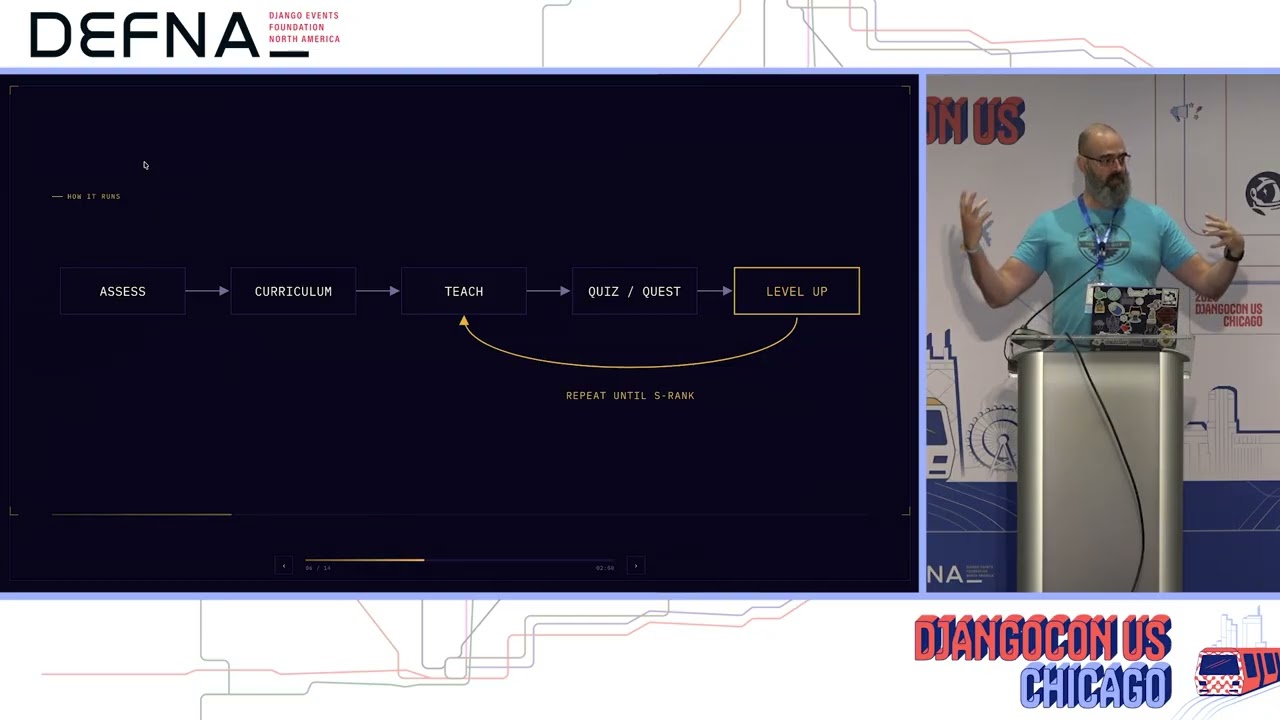
Speaker 1: And so and that's not necessarily fair because you can self-host, but again, you've got all these tech stacks and all these things. And you know what? Like I just turned 40 this year. And like I'm just too old for this. I don't want to learn new things and I want to sleep through the night. And most importantly, I just want to write Django. So um Armin Ronicker built this package called absurd. It's basically a giant Postgres file and it gives you a durable workflow. in in in Postgres. And so I decided to put that into Django because we're at DjangoCon and I like Django. And came up with Django Absurd. And this is my AI generated logo. And installing it's super easy. You write pip install, put in your installed apps, declare your task back in, run migrate, and then you run this worker.
Speaker 1: It's a little small absurd worker at the bottom, and it's magical. So if we take our task and we want to turn it into this durable workflow, we make one import and we convert all those steps into absurd steps. And so when we run this and there's a failure. We can retry it and you see we've incurred some costs. And the previous attempts have been replayed. They just pulled out a Postgres, and then we just pick up where we left off and we can push our results to the index. And so with this package, we get um you know the Django and Min visibility, all the things that we love and appreciate with Django. Um here you see like the checkpoints. Okay, here it ran twice, there's a failure step, and then the success, and then all the checkpoints of the steps that you know the OCR and the summarization and whatnot. And so so that's great.
Speaker 1: That's in Django. We are we're like a we're familiar, we're at home. We like this, right? Um and it's Postgres, which we probably already use. Um there's a bunch of different features. One that's notable, we've got schedule tasks, we can like define them like a celery beat type of deal, or in the Django admins so you can edit your schedule and you don't have to deploy stuff and change environment variables and all that jazz. So call to action. Pip install Django Absurd. I pushed 1. 0. 0 this morning. Um thank you. And One thing I wanted to mention, it ships an agents. md. So I have no idea what the like best practice is for this, but I'm just shoving this markdown file into um into the source.
Speaker 1: So when you when you install it, you should just be like, hey yo, I installed this package. Like set it up for me. And it should just go in and magically Do the things. So give it a shot. I'm gonna be here for sprints day one. So if you want to like hack on it together, like I'd love to see you just get it up and running and tell me like what the pain points are And there's the QR code to the repo. And that's the end of my talk. Thank you very much.
Speaker 2: Hi, I'm Jim. A few weeks ago, I was having a chat with a friend of mine, and a story came out, and I thought this would be a good audience to share it with. So this is my story. Several years ago, I was working at a company with a large old, old, nasty code base. And I got the opportunity To refactor a whole bunch of it and redesign and re-architect things. And it was great. I knew what was going on. I understood things. Perfect. But then as will happen in tech industry, management kind of went south and got psychotic. And so I did what people in the tech industry will do. I left.
Speaker 2: And I went to another company that had an old psychotic Bad code base. But I worked there for a while and it was okay. And then they shut down the site and laid everybody off. Now you're probably asking yourself, why is he dancing and singing? Well there's two reasons, one of which you'll have to find me in the hallway and I'll share with you then. But the second is the previous job that we were just talking about had gotten new management, they were somewhat sane, and they were hiring. So I got a nice severance package, and I got to go back to a job that I knew what I was doing. And so I sat down and I hit the, hmm, I don't know what I'm doing.
Speaker 2: I can't do this. I'm not going to figure it out. I was struck with the dreaded imposter syndrome. Alright, so now you may be asking you, why is he up here telling you this? Well Two reasons. One, if you're a younger developer, I want to speak out to you that this is a normal thing. This happens to everybody. It happens to not maybe not everybody, but probably some people that have egos that they can manage without this, but a lot of people. And I want to share that. But I also want to put a challenge to those of you that might have some gray hairs or some experience, some mid-level developers. I challenge you to normalize talking about this, to really get in there with your teams, particularly the young folks coming out of college, who are
Speaker 2: bombarded with messages that you don't need to code or AI is going to take your job and all those things. and really work them through that this is something, this is a feeling that happens to a lot of people. And that's my story. Thanks for listening.
Speaker 3: Okay, hi, hi everyone. Um hi, I 'm John, I'm founder of Foxy Talent, one of the sponsors here. A quick run through. Um I've been recruiting real Python and Django people since 2008 A DSF corporate member through the business and also an individual member organized community events. This is my first fourth time here as a sponsor. Delighted to be back. What I want to talk about is uh the the problems now um that are happening in tech hiring uh that I'm seeing day in day out and how it's actually affecting job seekers whether that's here in the room or online or you know and watching back on on video. Um So in the last 18 months, like the risk around hiring has gone up
Speaker 3: more and more applications are either deliberately misleading or just completely fake. When you put a job listing up and you get, you know, 500 applications, the majority of those are going to either just be bots or spam and this sort of thing. And it's a very it it adds a lot of fatigue to hiring. Um but what what I'll the the perspective I want to give on that is around um how that affects an engineer in a job search and the things that you can do. This things actually happen like this. This the guy in the blue shirt was had a full AI filter across his face and it was moving Um you can see like the the headset is sort of in behind it and you can see it poking through. Um on the right hand side, the pragmatic engineer, he reported a case and did a full article about how it's happening in Europe.
Speaker 3: um of the profiles of people who are just completely fraudulently in in our job processes. They're not edge cases, it's happening more and more and the scams are becoming more um advanced. People are using deep fake filters across their faces, scripts to help them answer questions to get through all of this. Um fake profiles are pretty much in every application, whether they're just direct through into your inbox, whether it's through uh the the programs or the the tools that you're using to to post adverts. And then now so more so the LinkedIn accounts of real people are being hacked, repurposed to look genuine. um with the the fake profiles. And this is an example of one that I caught um earlier in the year. As you can see the name on the top
Speaker 3: job title, location all looks real reasonable, um, but then the the name and everything doesn't quite match the email address. that was on the original profile, a bit of digging. This guy's profile, he was posting two weeks earlier um about life sciences and pharmaceutical things in Bangalore and India. And now he's been repurposed as a software engineer working for Nike in San Diego. So you've there's there's things that are happening there trying to just get those initial calls and what the long game is, I'm not sure. There's a lot of theory about it. But what this means is that hiring teams are adapting and every recruiter, HR team, hiring manager looking for red flags. um and look then needing more proof to take somebody through from just a a resume
Speaker 3: into an interview process because there's there's danger and risk of of taking the wrong person through. So it's now on a job seeker when you're writing your resume on applying for a job to prove that you're real as well as you know a good fit for the job. Unfortunately, the the list of red flags that have sort of been built up that you can look out for They also describe they describe scammers but also genuine people. So like you haven't got a LinkedIn photo or a photo on your social media. Well, that's fair enough, right? Do you you prefer to use an avatar? Or are you just a scammer trying to hide your identity? On your resume, have you made it up? Have you used an AI tool to fabric you know to to fabricate a profile or have you just asked the tool to um format and optimize it against a a job spec
Speaker 3: broken links, are you hiding something where you can't click through and get proof? Or is it have you just made a mistake? The profile itself, is there a sparse GitHub? Is the LinkedIn account brand new? Are you a bot? These are all things that we've got to consider. And one doesn't necessarily mean scammer two doesn't mean scammer but it's just risk and you can avoid it. Um so actually how to stand out and put yourself in a better place. Try to add photos. If you don't like it, that's fine. But make the occasional post about local tech meetup. Share that where you're real. Prove your digital paper trail. Prove yourself as human, be more human online. Um things that can't be faked is being here this week at sh uh in Chicago, JaggerCon, you've met a load of people, connect with those real people that you've met, it can help you in the future.
Speaker 3: Leave a trail take a picture here at the venue in Chicago by the silver bean thing or anything else like that. Um It's proof of life, it's proof of existence, it's proof that you're real, which could just actually help you um in your future job search Doesn't mean you have to be doing it in your search right now. Um there's a load of stuff. And then I've got written a blog post about all of this earlier in the year, and I've got a couple of things on my YouTube about it as well, but it's all stuff that Yeah, we're all real, we're all here. It's just online like you can't it's just to prove yourself a little bit better. Thank you.
Speaker 4: All right. Good afternoon, everybody. I'm Timothy Allen, Principal Engineer of Wharton Research Data Services at the Wharton School. And I'm Flipper PA, and you can Google me, I mean um duck-duck-go -me to find out more. And I'm here to show you some first steps toward ending your dependency on Google. So I was blown away when I first used Google Search in 1999. In the early days of the web, I had used many search engines, including Yahoo! But within a few minutes of using Google, it had become very clear to me that a vastly superior web search experience had been realized. And it wasn't long before word of mouth caused Google to become a verb, with the vast majority of people holding a pretty positive view of the company.
Speaker 4: It quickly became the dominant search engine. And around the turn of the millennium, depending on whose mythos you believe, the founders adopted the phrase, don't be evil, as the company motto. Those days are long gone. The Don't Be Evil motto was officially dropped in 2015, around the same time the company restructured to form Alphabet Inc. Since then, a few things have happened. Co-founders Larry Page and Sergey Brin have faded into the background. Annual revenue hit $100 billion a year. Current CEO Sundar P Shy was hired and promptly ended Google's famous TGI Fridays Town Hall, where employees could keep management in check with all kinds of honest feedback.
Speaker 4: The company's exceptionalism has faded alongside its moral image. My wife and I, our child, has had a school-provided Chromebook since third grade. Which requires a Google account and many Google services for her to complete her school assignments. She has to use her school district-issued Google username and password to log into the computer, must watch lessons on YouTube with advertising Write papers in Google Docs and store information in Google spreadsheets. States across the country have spent over $30 billion replacing textbooks with laptops. And studies have now shown the result. The first generation of students less cognitively capable than their parents. Congratulations Now Google has decided 13-year-old children can remove their own parental controls.
Speaker 4: You heard that right So the final straw for me was when Google emailed our 12-year-old kiddo as she approached her 13th birthday, telling her she was the one who could choose when to remove the parental controls. This is happening right now. So what can we do? Step one, ditch Chrome. There is no reason whatsoever for anybody to still be using Chrome or Microsoft Edge for that matter. None. You can get a better experience while having your privacy and security without having your privacy and security constantly invaded There are so many better options these days, even if you still want to use Chromium Blink, which is the part of the browser that actually renders and paints the page.
Speaker 4: That's open sourced and many other browsers have been created with the same rendering engine at their core. You can see my advanced grading system here. And uh I'll give a detailed rationale behind these grades in an in-depth article. I'll include the link to the article later. But basically, use Helium or Vivaldi or Firefox. It'll take you less than five minutes to switch your browser with all of your bookmarks and history and everything else imported to your new browser. Give it a try. By the end of the next lightning talk, you will be able to be on helium, which you can download at helium. computer. That's the web address. It's that easy. So, what else can we do? Did search! Stop using Google search. It isn't necessarily that other search engines have gotten that much better
Speaker 4: But Google search has gotten that much worse. It isn't just you. Google has intentionally been making their search worse since 2019. Ed Zitron has a huge article about it. They've been intentionally insidifying their product. So give DuckGuckGo a try. It's come a long way over the past decade. Or if you're not ready to give up Google's search results, start page as a privacy-first-based search engine that proxies Google's results. That's right. You can get the same results that Google gives without all the widgets, AI summaries, and noise. Give it a try. There's DuckDuckGo and there's Start Page. Lastly, what else can we do? Ditch Gmail. This one takes more time, but it's absolutely worth it. Changing email providers can feel intimidating, but it's something you can and should take your time doing.
Speaker 4: The first step is to find a new email provider. I'm a big fan of the Proton ecosystem, and they have a robust free tier for email, calendar, VPN drive, password manager. There are many other options, such as Fastmail, Mail. com. So many more. I found the Proton ecosystem to have the most generous free tier for a privacy first provider and I liked it so much I've become a lifetime paid member. You can also create email addresses on several of these providers, email each other and give them a try. So I encourage all of you to ungoogle yourself because it is easy to dismiss the effects of big tech on our lives when we look at the micro level. Ah, it doesn't really bother me. I don't have anything to hide. We can justify targeted ads as as useful. It is crucial to consider the macro level instead. The huge influence and power Google has over the world, being the biggest
Speaker 4: arbiter of information in human history, is greater than any company ever The ability for Google to influence governments, policies, and elections has never had a parallel. Changing your browser, search engine, or email provider might not seem like a big deal, but if enough of us start to do it, we can help put a check on that power. While improving our own lives and our online experience. So I'll throw the link into the deeper dive into the DjangoCon US Slack, but I encourage you all to give it a try. Thank you.
Speaker 5: No slides. I lied, I actually have slides, they're just not for you. Uh small trigger warning uh burnout is mentioned, but it is a one slide thing. So just a heads up Hello, I'm Eric. I work on Read the Docs. Who here is familiar with Read the Docs? Sweet. Thank you. If you're not, we do documentation open source hosting. If you saw the Wagtail talk earlier, that was hosted on Read the Docs. as are lots of other things. I have been doing read the docs for sixteen years now, which just makes me feel old. It actually started, fun facts, since we're at DjangoCon in the same basement in Lawrence Effing, Kansas, where Django was created.
Speaker 5: Random, right? I moved to Kansas after college from Virginia and everyone's like, what are you doing? Like And it uh it worked out great. It really set my whole life up in an amazing way. But read the docs is a big part of that. That's my day job. I'm gonna tell the story of that. And there's some takeaways for Django here at the end. So really start is labor love, 48 hour hack day, Django. Sprint back in like in 2010 apparently. Uh built in 48 hours, solved a problem. I have a GitHub project I want to host my docs. I just have a cron job running in the background. Let's solve that problem for everybody. Slowly started to take off in the community. We got a PSF grant. I looked it up for $840. for one year of hosting back in 2011. We launched on Git
Speaker 5: Tip in 2020 2012, made $75 a week. It was amazing. Then I started wearing a pager. Less amazing. Turns out wearing a pager for free is a great way. to burn yourself out. But then what's how do you solve this problem, right? You have a bunch of users, people love your product, but like are open source maintainers who we want to charge money to? Is it your money that I want? I don't want your money. I want someone else that is related to you. I want your company's money. And so that we started a company in 2014 to try to figure out that problem. Let's do private docs, let's host them. Let's kind of figure out a path to sustainability because I'm sick of wearing a pager. And we didn't want to bootstrap it.
Speaker 5: We did an incubator in Portland, but we were explicit. We're like, we're not raising funding. We just want like a re we want like a start date. Like I need like an excuse, like this moment to actually like turn this into a company or else it's never gonna happen. And so we did that for a couple years. We kind of built the private version. It like kinda worked, kinda didn't. And so we're like, oh well, we we have this company. I'm doing it full-time, but I'm still not making enough. And that's really hard because you're like, oh, the company, that was the thing, right? But it's like the company is not the business model. A company is just a company. It's just like an organization. It's just like some people that sit around and talk about stuff on a timeline. And so that was really hard. So at that point, basically, I actually looked it up on my birthday in 2016. I started writing the file. It was called Read the Doc Succession Planning.
Speaker 5: How am I going to stop working on this project? Because I'm burnt out. It doesn't work. People don't want to give us enough money to make it keep happening. I don't know how to how do we keep it going? And then, you know, I could started talking to people about it. Didn't write the blog post all the way. I just like saw the modified date and it was on my birthday and that just like stabbed me in the heart. But that's the real lesson was like donations aren't enough, right? We need to find the people with the money and we need to ask them for money. We thought it was the companies, but we don't know how to get the money from the companies. And so that's really where we we're like marketing budgets, right? We're a publishing platform. Every other publishing platform in the world, from newspapers to everything else, like they run on advertising. That's how it works. But we have to do it in a way that doesn't suck, right? I think it took us forever to get to ads
Speaker 5: because it's just felt really hard for us to make that step. But once we got there, we're like, let's just do this correctly. Let's not track people. Let's not do all the weird stuff. Let's build the thing that we want and the community wants so that we can keep their trust. Because that's the only thing that we have is the trust in the community and the motivation to keep working on this project ourselves. So that's what we did. Twilio, like one of the guys at Twili was just emailing me every like two months trying to buy ads. Like, maybe that's the market telling me something. So we just put like a Twilio logo on the docs, went to their blog post. It was great. And it worked, right? We we were able to kind of build this team. We were able to kind of like solve that motivation problem. Now we have five people working on it full-time to this day, which is pretty exciting. Um and that was really kind of the path that we took.
Speaker 5: Is like it took us a long time to kind of get to that mental state where we allowed ourselves to do the obvious thing. And I think there's a lesson there. Um it's really hard to kind of make yourself do the thing when you've built an identity that doesn't let you, but sometimes it's good to reevaluate that. And it's been really motivating over the last few years. keeping that model the same. We have just one ad on every read the docs page unless you pay us five bucks a month to get rid of it. And that that's enough for us. We have a small team, we have enough people, and there's a lesson in that as well. And I just kind of want to zoom out a little bit and think about Django, because I'm at Django Con. I I wonder how many people in the Django community are in that space, how many people in the DSF. Or in that space.
Speaker 5: Like I feel like the DSF is at at that same kind of inflection point. You're hiring an executive director. You're starting to build that like engine of support and mo and sustainability. I mean the fellows program's been going forever, but I feel like there's this kind of larger goal, kind of larger ecosystem that you're trying to work to support. And I think it's like really exciting, but I also think it's a point where you need to kind of step back and really think about like What are the things as a community that we want to give the companies in our ecosystem so that we can actually build that model and sustain that executive director, sustain the fellows, sustain the foundation? But then continue to have enough, not sell yourself out, build the model that you actually want to see in the world around the community. And I think that's kind of the question that I'm here
Speaker 5: thinking about. as I've gotten kind of more motivated to help the DSF be more sustainable. So that's the the takeaway from my perspective is like the DSF is at this inflection point and we should have the conversations and uh talk to our companies to try to figure out how we build the thing that we want it to be. So thank you.
Speaker 6: Hi everyone. This is my first talk ever at a conference, so go easy on me. Thank you. My name is Jeanette. I'm a software engineer at Six Feet Up, specializing in UI and UX. A lot of us are reaching for uh AI tools now to go from an idea to a working prototype. In minutes. One of those tools is Figma make. You get to type in a prompt, like a community feed with posts and comments, and it generates a real functional React app with working screens, working state. Working interactions, it's not just static mock-ups. That part is really cool, but there's a real cost waiting at the other end of speed.
Speaker 6: The moment you actually have to build the thing in Django. This talk is about that gap, what it actually looks like in a real code base, and what I tell you to do differently before you hit it. So I want to start with a really gigantic number. 16,000. That is the number of lines that is in my app TSX. You can throw rotten tomatoes at me if you want. That is a huge file. App TSX is the root file of every React app that every React app starts from. And here's why I got to 16,000 lines. Figma make doesn't split components, React components Into separate files by default. Unless you explicitly prompt it to. Everything lives in one file, one component tree with no marked seams.
Speaker 6: So here's a real example of some code straight out of the file. I'm building a Reddit-style community app. So inside the card that renders, oops. Inside the card that renders a post on the main feed, there's a full reply composer. It has its own state, its own text area, its own submit logic, about 80 lines. I won't bore you with the gruesome details. thousands of lines away in the same very same file, there's a second completely separate component used on the post detail screen of this community feed or community app that does the same exact thing Same text area, same attach button, same submit logic, built twice, independently, because Figma is kind of derpy, and generated these two screens in different passes
Speaker 6: with no memory of what that reply composer is. and that it was already solved. And here's what it could look like in Django as a real Django component. Just an include tag. That's the wrong code, but it could look, it could look better as a Django component. This is the trap. Porting app TSX page by page into Django doesn't just duplicate code. It inherits a mental model that never structured around components to begin with. With a 16,000 file line, you don't even see the duplication. You have to go hunting for it. So build the pattern that the page actually starts earlier than Django. It starts at the Figma prompt.
Speaker 6: Now you might ask why I didn't rein in Figwimake early, and here's the real answer: this is a live client project, or was a live client project, and requirements are genuinely still moving. If I'd locked in clean structure really early, I'd have to refactor it every time the model shifted underneath. So I made a call that was deliberate, prioritize fast iter iteration, defer structure until things Settle. The shape is mostly settled now, so merging that feed reply box or reply composer and the inline reply composer into one real component is next on my list. So if you take one thing away from this, uh premature structure is its own trap, just as much as no structure at all. The skill isn't always moderalized from the first line or line one.
Speaker 6: It's knowing when the trade-off flips. Thank you. I'm Jeanette, and you can find me at the booth right outside.
Speaker 5: Okay.
Speaker 7: Who here thinks contributing open source could help them improve their skills? Raise your hand real quick. All right, there's a lot of people. Who here thinks contributing open source can help you grow your network? Raise your hands. All right. That's another good reminder. Who here thinks open source contributions are useful when hiring or being hired? Okay. Yeah. And now lastly, who here wants to contribute to open source? Yeah, that's a pretty good number. All right. So my goal here for the remaining four minutes and thirty seconds is to convince you to make like a self-commitment to contribute to uh open source, hopefully Django. See if I can do that. Um First, I want to make the point, your skills are desired because we need software engineers, we need DevOps people, we need front-end folks, we need designers, we need technical writers, we need fundraisers, we need testers, we need
Speaker 7: security folks. Translators, we need product owners, data scientists, SEO optimizers, marketing people, organizers. Whoo! Oh, I'm already to the entry level. But it's not just the skills, it's also experience levels because we need entry-level people, we need senior and uh senior level people, and we need staff level people. Basically, if you're in this room, you have something to contribute to Django. I promise you that you do. Well, look at that. Even more clicks. My second point is that hiring is about who you know. And there's gonna come a time when you're looking for a new job. And it'll be very useful to have a network of people that are outside of your current employer. Because it's really nice to not have to like talk to like whoever's
Speaker 7: giving you your paycheck to find a new job. That might be a little dicey at times. It's also really nice to have a group of people that are in a different tech stack. Maybe you want to jump over to Java or a different language or maybe a different framework. And it's a lot easier if you know people that have connections in that world. And my third and last point is it's a public record of your ability. So a lot of your work uh is probably closed source or behind some sort of NDA. open source in their hand, something you can publicly share, displays what you know, what you're capable of. And then lastly, I don't know about everybody else here, but if I don't have to do another whiteboard exercise, I'm not going to. So yeah, this is a really good replacement. So I'm gonna assume now I have everybody's hands raised for I want to contribute.
Speaker 7: Uh so the next logical question is where do I start this week? So good news, we have sprints this Thursday and Friday. They're free to attend. If you're not sure what sprints are, sprints are collaboration events where community members get together to work on open source. You're gonna have the opportunity to contribute to a number of projects like Django or Django Language Server. On Thursday morning, we're gonna have two presentations. One about how to contribute to Django like contribute code. We're gonna have another presentation that is based on how to do code reviews for Django And then in the afternoon, there's going to be a session around looking at the new features process for Django. I don't know if people are aware there's a new features repo on GitHub for adding features to Django that's relatively new. And if you've got questions or want to get started early, check out the Sprints channel.
Speaker 7: You can tag me there. If you're not going to be at Sprints, or maybe you just want a little assistance getting started, DjangoNot Space is an eight-week mentorship program for helping people contribute to open source. specifically like the Django community. It's full of space puns and welcoming people. We match you with some community members who help and help guide and support you as you learn to contribute to open source. We expect the mentees to spend about five hours a week during this program. We're currently accepting applications, and the next session launches October 12th. SpacePun. Uh if you're not interested in code or documentation contributions and maybe you're more focused on community marketing, stop by the DSF booth that's back there, uh outside the hall. Ask how you can get involved. Someone from the board or the steering council or maybe one of the working groups will be around to answer your questions and help you find your path to contributing to Django.
Speaker 7: And if all those fail, feel free to come find me. I'm happy to help. You can find me on Slack as Tim Schilling. Discord is codename Tim. You can email me. Uh which reminds me I didn't introduce myself. My name's Tim. I'm an advent Django community contributor. Uh I'm on the steering council, which uh kind of steers Django from a technical direction. I'm a Django NotSpace Admin, which is the contributor mentorship program for Django, Django Commons Admin, which is an organization that supports community-maintained packages, and I'm also one of the maintainers for the Django debug toolbar. So I hope you choose to contribute to Django, not just because we truly do need your help, but because I believe it's good for you. And with that, thank you, and I'll see you on the internet.
Speaker 8: So uh I'm here to uh share some interesting Chicago history facts and kind of like tenuously relate them to software engineering as an excuse to talk about them. Um so many of you uh have maybe had time to do an architecture tour, maybe you visited Chicago. Uh show of hands if you know that Chicago reversed the flow of the Chicago River. Yeah, see that's a good one. But did you know that we also raised our buildings? From the ground to slightly above the ground so that we could provide sanitation. Um so a little bit of a background. We had some technical debt in the 19th century. Uh Chicago had successfully shipped its MVP by the late 1800s and was growing rapidly. But legacy infrastructure was overloaded and there were serious bugs impacting the end
Speaker 8: user experience. For example, in 1854, six percent of the population died in a cholera outbreak. So the city needed to address its technical debt and set a better foundation for massive growth. And I just share this table from Wikipedia. It's just Always crazy to look at going from 500,000 people to a million people. It's real. But so there were problems with this. Big problem is that Chicago was built on swamp. Uh so we had no sewers. The city was only four feet above Lake Michigan. Sewers need to drain down. They need somewhere to go in order to get rid of what they're carrying. So the streets were also made out of mud. We put wooden planks above the streets, but that didn't work very well either. The streets were still mud.
Speaker 8: Nice try, good patch. Didn't fully solve the problem. Uh and mud and disease was the norm. I don't have time to read this entire quotations, and I have a lot of quotations to these slides because I found the primary sources were very interesting. But I will point out that Uh occasionally loose planks would give way under the weight of a passing cab and the foul sewer water would spurt into the air as high as the windows. So you know, not great uh end user experience there. Um so the Chicago style solution, I think many other cities might have just given up, but we just decided that we would need to raise the streets and raise the buildings as well. And uh I love this little newspaper clipping of just kind of putting out an RFP uh looking for people who are maybe interested in figuring out how to move buildings.
Speaker 8: Uh And this is something we did. Um uh you can see here this like illustration is kind of uh an example of a a hotel building that was raised. Uh it was using a series of jack screws. Uh And men, uh, these buildings were raised. Um, hundreds of them were raised over the periods of years. Um Again, don't have a ton of time to read all of these, but I just these quotes are amazing. I love the idea of uh many of these hotels and buildings uh while being raised. Um continued to function. There's a quote I didn't include on here about a man who was staying there and just like slowly noticed every day he was staying in the hotel that the window is in a different place than he thought it was before. Uh
Speaker 8: and uh that's because the city was growing too fast. There was literally no time to shut down uh business. Um the other thing that happened a lot in addition to refactoring in place is we relocated buildings completely. Uh I will read this second quote down here because I love it, which uh from this guy, David, who visited from Scotland, I believe. He said, Never a day passed during my stay in the city that I did not meet one or more houses shifting their quarters. One of those crossing Madison Street was a double shop, cigars at one end, confectionery at another, and as it moved along the shopkeeper stood leaning against the door post smoking a cigar. So yeah, that's it's just uh that's really fun to read. Um so what did we learn for this? We can tackle debt Chicago style.
Speaker 8: Um we make a series of small incremental changes that keep the existing behavior in place. consider whether a piece of code is best refactored in the same place, lay the foundation for future improvements, or perhaps that legacy code uh needs to be relocated so you can better organize your code base, uh make space, move focus for new, more critical functionality. Also, I really love this old uh Vienna beef poster of a giant hot dog uh in place of where an AV peer should be. It's unrelated, I just think it's great. Um and so I wanted to close with some final inspiration. I think for any locals, this is kind of an iconic quotation, uh, but I'll share it with you because I think it's surprisingly relevant for uh open source communities. Uh Daniel Burnham was a Chicago architect.
Speaker 8: Uh he was involved with the plan for Chicago and the parks system. Um so with that context, this is his quote, he says, make no little plans, they have no magic to stir people's blood. Make big plans, aim high and hope and work, remembering that a noble logical diagram, once recorded, will never die. I mean tell me that's not open source software development. But long after we were gone, we are gone will be a living thing asserting itself with ever growing insistency. Again, open source software development totally. Uh remember that our children and grandchildren are gonna do things that would stagger us. Let your watchword be order and your beacon beauty. And that is the last of my slide. I'll share these slides too because there's links to primary source. Docs that are uh pretty interesting. And uh I don't
Speaker 8: how much time do I have left? I'm done. I'm done. All right. Oh great. Hi.
Speaker 7: Hi everyone. I'm Derek. I'm not anonymous. I know my name didn't enter in on the spreadsheet, but I'm Derek. My talk is we don't have to build the Panopticon curtailing surveillance at the local level. I wear a number of different hats. I'm the founder and partner at Datamade, my Datamade people. Wave your hands, hey. We're a Django shop here based on uh in Chicago. Uh I also am the co-founder of Tri Hack Night, which is a civic
Speaker 8: tech event, a weekly event.
Speaker 7: Who's been to Tri Hack Night? All right. Hey, if you haven't been to Tri Hack Night, Tuesday, tomorrow night, six o'clock. Uh at 750 North Orleans at the IC Star 's office is uh the Dex Triacne. So you should check it out since you're in town. And then the third and most recent hat that I'm wearing is I uh have joined the local government uh where I live, which is Oak Park. It's a suburb just west of the city of Chicago, and I'm a trustee there. So it's basically like the city council for a municipality of about 50,000 people. Okay, so uh as a technologist, I've built a lot of stuff. Uh a lot of it's about Chicago usually. We do a lot of work in the city of Chicago, uh Chicago's million-dollar blocks where we map where uh we spend money to incarcerate people uh in the city of Chicago. We also built a project called Chite Block Builder, which manages all the city's vacant land that they're selling.
Speaker 7: So if you want to buy land that the city owns, that's a place to go. Uh
Speaker 6: if anybody ever played uh SimCity 2000
Speaker 7: like I did in the 1990s, I was so inspired by that that I made a website called Second City Zoning that lets you see all the zoning in Chicago, but in the frame of a video game from the nineteen nineties. And then if you want to know what's going on with Chicago City Council, uh Councilmatic is another tool that I've worked on. So I've done that. I've also gotten to speak a lot. For a while, the local PBS station, WTTW, would invite me on to talk about technology. Like, hey, we just heard something about routers getting hacked. Can you come on the show tomorrow and talk about that? Or can you talk about data cookies? and things like that. So I've done a lot of talks about the power and the danger of technology. And at Chi-Hack Knight, I've learned over this
Speaker 8: almost 700 presentations that have happened at ChiHack Knight. uh about
Speaker 7: some really dangerous things that can be done with technology.
Speaker 8: I've learned about police tracking and surveillance systems.
Speaker 7: Uh and that's actually what I'm going to be talking to you about right now, which is uh the concept of uh license plate reader cameras. So this is me, this is me and the board of Oak Park. This is our lovely board photo. We're so happy. Uh the first issue that really kind of jumped up uh when I started the board, which is only about a year and a half ago, is this concept of flock. cameras. Has anybody ever heard of a flock camera before?
Speaker 8: Okay, hey. So
Speaker 7: automatic license plate reader cameras. This is actually a picture of one in Oak Park. It's looking at you. What is an ALPR? It is essentially a camera that's always on. It's always taking pictures of every single car that goes by and recording the license plate number.
Speaker 8: and turn that into data, into a database that then officers can go look up and see, oh, okay, there was a car that was stolen or there was a crime that happened. Let's see where that car was.
Speaker 7: And they can sort of run it back and say, okay, we can trace this car, we can use it to help solve crimes, right? That is how it works and how it's sold, and it's in a lot of places. But I just want to underscore what that actually means it's doing. Literally every car that drives by has its picture taken. So if you've done nothing wrong, if you've just been driving by, you're in the system This is a map of all of the ALPR cameras in the country. It's 132,000 according to dflock.
Speaker 8: org. Uh not all of them are Flock.
Speaker 7: There's many other vendors that exist out there, but Flock is probably the most uh most common.
Speaker 8: Uh we can enhance and zoom into the city of Chicago.
Speaker 7: This is all of the ALPR cameras in the city of Chicago.
Speaker 8: How many people drove here today? I know it's like a fly in kind of conference. Anybody drive in today? Okay. Anybody drive in the last 30 days?
Speaker 7: Hey, you're in the system. This is actually the cameras. We've zoomed into where we are. There's actually thankfully none in the immediate like four or five block radius, but if you're downtown in a car, you're probably in their system And if you drive anywhere in city of Chicago, you're gonna be in the system. There are a few gaps. There's a few places. And one of them is Oak Park. And I'm gonna tell you about why and how we did that. So what could go wrong, right? Uh we have this pervasive system that's taking pictures of every car. What could go wrong? Well, here's a few things that could go wrong, and this is just the things that have been reported on. Uh the cops in Illinois gave access to this system to ICE during Operation Midway Blitz, which was when ICE was doing a ton of inf
Speaker 7: uh immigration enforcement between uh like summer and fall of last year.
Speaker 6: A Texas cop used this database to go and enforce their
Speaker 7: anti-abortion uh law in the state of Texas, and they did it here. They use our data in Illinois. They also have given data to the uh federal agents, and they also regularly pull over innocent people because as anybody who's done OCR work before knows. It's not 100% accurate. I think Flock uh estimates about 93% accuracy. Uh that's still 7% people who are getting it wrong, and other studies have shown it's more like 30%.
Speaker 8: accuracy, so
Speaker 7: a lot of innocent people are getting pulled over when they shouldn't be. So these are the arguments though that I've heard to be fair about why we should we should have kept flock Police needs this tool to do their jobs. This is 21st century policing. You'll get the let the bad guys away. Or hey, just throw up your hands. Uh our phones are tracking us anyways.
Speaker 8: But these are the reasons that really stuck with me. It is dragnet surveillance, it's authoritarian and it's anti-democratic. Uh it reinforces racial profiling. The benefits are widely oversold, and the systems are not just easy to abuse They are made to be abused. That data is collected and guess what? It's sold and shared. So the title of this talk is
Speaker 7: We Don't Have to Build a Panopticon.
Speaker 8: This is the original Panopticon. It was a prison design system that gave the wardens like a complete view of all of their inmates. And it is oftentimes used with surveillance. because it is we're building that system essentially on the outside now. Uh in the famous uh movie The Dark Knight, uh they uh built a system, if you remember, that tracks everybody hacks everybody's phones and like you can kind of jump in to see where the Joker was.
Speaker 7: And they built the system and they decided to destroy it at the end of the movie. And so I think if they can do it, so can we. So one of the first sub
Speaker 8: uh consequential votes that I ever did in Oak Park was to uh vote one of the be the one of the votes to cancel this contract. Um this is the vote.
Speaker 6: This is us doing it about August of about a year ago today. These are all the other cities that have since followed suit in the last year, year and a half. And my question for you all is who's next?
August 24 - 28, 2026
Chicago, Illinois, USA
Note: We understand that names change, people change, and bodies change. We respect each individual's journey and privacy. If you have any concerns about a video or need us to remove content, please don't hesitate to contact us. We will handle your request with care and promptly address any issues.

Published October 26, 2026

Published October 26, 2026

Published October 26, 2026

Published October 26, 2026

Published October 26, 2026

Published October 26, 2026

