0:47:31
Lightning Talks (Monday) with Andrew Mshar
Published October 26, 2026
This video features Andrew Mshar at DjangoCon US 2026 in Chicago, Illinois, USA.
This talk was presented by Andrew Mshar at DjangoCon US 2026 in Chicago, Illinois, USA
https://2026.djangocon.us/talks/lightning-talks-tuesday/
LINKS:
Follow Andrew Mshar 👇
On GitHub: https://github.com/programmylife
On Mastodon: https://fosstodon.org/@programmylife
On X: https://x.com/programmylife
Website: https://programmingmylife.com/
Automatically transcribed, so expect mistakes in names and technical terms.
Speaker 1: Lightning talks will start in just a couple minutes. I just want to go through a few things first so everyone knows where we're at. Uh Lightning talks are a maximum of five minutes. Important to respect the time limitation so everyone gets their full time and we all get to eat lunch on time. very important things around here. Uh for the first four minutes I will be standing right here off the side of the stage and with one minute to go I will inch closer to you until we are giving the talk together. Uh new thing for today for any of our speakers, uh there will also be a clock right here that's pretty big if you want to check out where your time is. If you don't have your own timer And you should mostly be in the slot you signed up for. I didn't need to edit edit any of the list. So I'll go through the names now just to see who's here and who's ready. We have Rachel coming up first.
Speaker 1: Chris Williams. Awesome. She was on her way down. Okay, great. We'll see Natalia soon. James James, fantastic. Uh E, awesome. Marcello, I think I saw you, yep. Uh Dan? Great. And then Tim, you want to give one? Okay, okay. We can't yeah, we have time. So Yeah, okay. Sounds good. All right, so our first speaker will be Rachel Calhoun with DjangoNot Space Open Source Mentorship. Take it away.
Speaker 2: All right. Hello everybody. Um I am here to talk about Jnot Space. I'm one of I'm Rachel Calhoun. I'm one of the co-founders. The organization's been around for a few years. Um and in that time we've helped launch Um more than a hundred people into open source contributing and leadership in the Django community. So, what is DjangoNout Space? Well, it's where contributors launch. Um and we love a good space pun. So um getting into open source contributing can be intimidating and overwhelming. And you can sometimes get in your feels about code review, for example, as Sarah Boyce explained this morning in her amazing keynote. So we wanted to create an organization where it's a bit easier to onboard into that space. a helping hand
Speaker 2: mentorship. And so Jonah Space is an eight-week free remote global mentorship program to get folks into open source contributing. We have teams that are, for example, we have Django, we have Django Accessibility, we have CMS, Django CMS, Debug Toolbar. This session we have Beware documentation and render engine is a new one. One I'm super excited about is Django Girls website, which is an amazing way to get more easily onboarded into open source contributing. And so why am I here talking about this? Well, um our next session is open right now for applications. We have our volunteers. If you are looking to volunteer with us, we'd love to have you. Please check DjangoNot. space. And you can sign up for our newsletter
Speaker 2: for future sessions. This is our seventh in those years. So the applications are open, they close. September 6th. So if you're here and you're interested in getting started in open source contributing and you don't know where to start, this is it. And if you're watching from the future, Check our socials and our newsletter for future sessions. We will definitely have more. And so you can see you have a week and five days to submit your application. Please don't wait. Um and if uh so if you sign up, you get selected. Um there is a process for selection and you'll be put on a team with um About three other people and you'll have two mentors, you'll have weekly meetings. The commitment is about five hours a week for the participants. Um yeah, it's a good time. There's a lot of support. Um if
Speaker 2: you are interested in this and you have more questions, I'm hosting an open space at three o'clock today. Come find me and others that are in the community. Love to talk to you. Or if you want to do something like this in your own space, you know, happy to to share resources and etc. So yeah, come find us. Thank you.
Speaker 3: Hey everybody, uh my name is Chris Williams, field CTO for Six Feet Up. I'm AWS Hero. I run a community technical education podcast. I used to be a psychologist, and so I have a really uh deep passion for learning and learning paradigms. And one of the things that is it's not a flaw about me, but I fall asleep when I'm watching video courses. Uh I use them at night when I'm trying to get some sleep. Uh Udemy is my best. sleeping pill. But if I'm really trying to learn something, what I'll do is I'll stop that and I'll flip over and I'll play Fallout or read Dungeon Crawler Carl or do something to wake me up and then I'll flip back over and um get back into the learning.
Speaker 3: So I was talking to a couple of friends of mine over at the Teaching Python podcast, Kelly and Sean, and I was learning about learning and how to encourage the the mental juices to get going through the process of the things that already excite me. So I was like, okay, well what if I turned learning something, in this case Django, into an RPG? So I built an RPG tutor. It's got a couple of subagents, it's got skills, it's got projects, it's got a bunch of different stuff. You can use it with a frontier model, but I also encourage you to use it locally. um burn down less rainforests, use less water, and you can basically go through this. So there's an assessment period in the in the tool. And uh the CTA at the end of this is going to be download it, fork it, play with it.
Speaker 3: It's got modules, it's going to be a game master for you. And when I first started creating it, I was actually just I I did it for this talk, but then I actually got into it. I was like, oh my God, this this is actually really, really fun. I have been Steve the gasoline uh reaver. uh in a post-apocalyptic setting connecting the nodes of the of of this um post-apocalyptic village using you know uh fragments of the old tongue, aka Django. And uh and it's it's been hilarious and fun because I mean AI is a non-deterministic hallucination engine, so what better thing to do than to make it make up stories for you. So so I did that. So what the tool does is basically it assesses where you are.
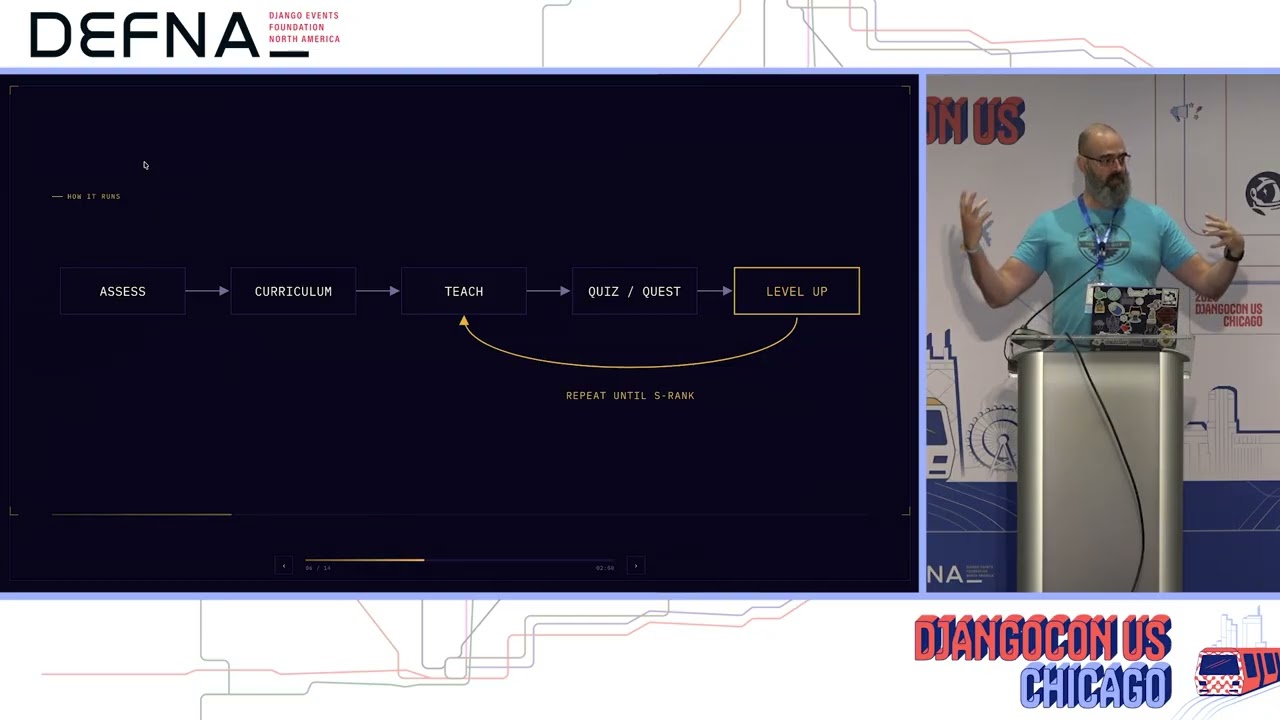
Speaker 3: So in learning paradigms, um Picking something that you already know and then making analogies towards the thing that you want to learn is the best way to like layer on new pieces of knowledge It then goes in and figures out the curriculum based upon either roadmaps. sh or its own internal knowledge to figure out what to teach you It creates a character sheet based upon the knowledge paradigms that you want to learn and you go through from D tier through to S tier doing quizzes, doing quests. It has a storyline that it that takes it takes you along. And it's got agents that track all of these different pieces of information. So it uses the Socratic method. It never gives you the answer. It makes you sweat. And what Kelly and Sean taught me was that it's the struggle that really makes it sit in your head. So it it's never going to teach you anything without really making you struggle first.
Speaker 3: And the more you struggle, the more XP you get. The faster you learn and the bet faster you level up. Or not faster you level up, but you know. It's grounded in roadmap. sh. If you guys don't know what that is, that's also another community-driven website that actually has hundreds of different career paths. And it has all of the information of what you need to know to be good at that career path, mostly in tech. So it references roadmaps as the source of truth for the information so it's not hallucinating what it thinks you ought to know. It asks you at the beginning, what are you now? Are you a truck driver? Are you a network engineer? What are the things that you know? And then it layers the information on top of that. And then basically you then pick a genre, you pick a saga, you say, I want to be fantasy, I want to do
Speaker 3: I want to be a romance story, I want to do a post-apocalyptic story. It then crafts this entire storyline for you. It gives you like hints along the way, it gives you like a little person to like a a Batman and Robin scenario. And then it you get a character sheet. It gives you like a little local website that shows you your progress through your character sheet like the um the old DD character sheets. So it's the same system, but you can pick any topic for it. You can do Django you can do technical stuff. I did it for guitar theory. I did it for um cooking. It's you can really put it's it's very versatile And uh so yeah, fork it, play it, have fun with it. Please enjoy.
Speaker 4: Who knows what this site is? Django site. Okay. Who reads the uh news Not that many. I'm scared now. Okay. So if you go to news and if you scroll down, you will see there is a new entry for the Angus Moving to Annual Release Cycle. So you should definitely read that one. In here, Carlton uh explained how Diango went through a process in order to decide and agree as a community to change from the traditional. 0. 1. 2 um release cycle into a calendar version um approach.
Speaker 4: That means that we're going to have instead of One feature release of Django per eight months, we're going to have one per year. But before We used to have. 0. 1, which will have support for only eight months, and then one more um eight months of security and data loss fixes. And then the dot two will be an LTS release. That means that you will have um eight months of feature um support and you have two years of security. Now we're having every yearly uh release is going to be an LTS. So that means that every release Starting on 2028, which is going to be the first one, uh you're going to have one full year of support for back fixes, and then you're going to have
Speaker 4: two more years, so three years total for security and data loss fixes. Uh I think that's a huge win. So I um we feel that companies and and and all all the projects using Django, m many people sometimes wait until the next LTS to upgrade. So now you can upgrade every year because every version is going to be an LTS like. Since every release is going to be LTS, we're dropping the LTS suffix because every release is going to have a three-year support period. So uh this also means that we are instead of having every eight months a release, so so the release will be sometimes in April, sometimes in August, sometimes in December, we're having every feature release.
Speaker 4: around mid-January. So on mid-January 2028, we're going to release Diango twenty twenty-eight. This means that we're going to start working on the feature freeze and the alpha beta and release candidate at the end of 2027. This also means that we are aligning the Django release cycle with the Python release cycle, which is a great thing. So on Django 2028, we're going to for sure include support for the Python that was released on october twenty twenty seven. So this way we are sort of increasing a little bit the Python that we support and we're also making it easier To reason about which Pythons a given Django version supports.
Speaker 4: What am I missing? So if you go to the blog post, there is an example table showing The different Django versions and uh the different supports that I have and when the support ends. We are also very explicit about Django 6. 2, which is uh going to be released in April next year is not changing. The angle six dot two is going to be an LTS and it's going to have all the promised support for three years. We are not changing any dates. nor any quality nor any guarantees that we do for it. We are starting fresh in Django 2028 and since 602 we're going to have only LTS's releases. So for sure, read the blog post
Speaker 4: and then on the download page in the same website, there is a nice graph showing more visually the different support versions and and how the uh support period expands. So I think that's it. I'm not missing anything. So if you have any questions, just ask. Thank you so much.
Speaker 5: Okay, I will be talking tomorrow about the browser, but as I wrote that talk, I got distracted trying to force an analogy about something fun and nerdy I've been learning. Ended up dropping that part, but figured it'd make a reasonable lightning talk that might pique someone's interest and tangentially relate to the conference. So thanks for indulging me I have a bucket on my roof. Inside the bucket is a microphone. And that's because it's fall migration for birds right now. And while you can track their movement with radar, that doesn't show you what's flying over your house. So during migration I point the mic the microphone at the sky and record through the night. And then I run the hours of recording through multiple sound classifiers. One is a modified version uh variation of what powers the Merlin app called Nighthawk. It's trained specifically on a subset of birds that call at night with their specific nighttime migration calls.
Speaker 5: Another classifier is birdnet, which is much worse, but catches other birds like black-ground night herons and lease bitterns. The third classifier is even worse, but I'm training it myself, hoping to be able to dial it in at some point on my backyard's particular cacophony of trains and neighbors' dogs. If all goes well, it will pick out this 50-second or 50-millisecond flight call of the migrating birds. These are called nocturnal flight calls or NFCs. Then I need to go through and verify each call is correct, sometimes hundreds or thousands a night. So I do that by looking at the spectrogram and matching it to known patterns. So this is a wood thrush. And this is an indigo bunting and a savannah sparrow. Those are the easy ones.
Speaker 5: This is supposed to be a picture of an American pippet, which is the closest relative to a wagtail. That picture didn't come through. Sorry, I'll share it later. Then you get to the warblers, and some of them are easy to differentiate, but then there's a whole slew of warblers that are some variation of this little bumps. Or this. This is also a warbler. These zeeps can occasionally be differentiated by measuring the number of humps or the distance between the peaks, or even if there's a subtle lean to the hump, maybe. There are some other reasons why these bird calls are unknown. So the bird is flying hundreds or thousands of feet off the ground. It's dark. How do we know what bird is even making this call? It's a great question.
Speaker 5: We don't. In some cases, the birds make the same or similar calls during the day, but not always. And some birds have Very limited proven data. For instance, much of the basis for identifying a morning warbler call is from a 1994 recording of an unidentified yellow-bellied warbler that we hope is a morning warbler. So we don't know. It's great. And this this whole problem, it also is a problem where there's a low signal to noise ratio where we have hours of audio that needs to be processed for just a few flight calls. My audio files constantly compete with Docker for the last dregs of disk space on my poor computer. There is some work starting on taking infrared photos of migrating birds, but that requires even more equipment and processing.
Speaker 5: But is there a Django connection? Of course. While the overlap in the Venn diagram between birders and coders is high, the tools are primarily available through CLIs and Python packages. All with very particular and exclusive Python environment requirements. There is a Django app called Vesper that provides a UI and uh pipeline for NFCs. I haven't had much time to play around with it. but it is working to lower the barrier, especially for people who don't want to learn um conda and things like that. So to summarize, birds are cool. There are a lot of them. They will be flying over tonight, and no one knows what kinds. And I find it somewhat comforting to know that there are still mysteries in the world. Thanks.
Speaker 6: Great. Hi. I love Django. It really does feel like you can build anything with it. So let's talk about how to build a bike lane with Django. So uh I'm E. I'm a volunteer technical officer for Philly Bike Action. We are a 100% volunteer grassroots advocacy organization working to build safe protected bike infrastructure in Philadelphia. Since its formation in 2023, PBA has been instrumental in a handful of major victories for those who safely navigate the city without a car. And much of that work is powered by a Django site, bikeaction. org. So yeah, it's a little bit clickbait because you can't yet pip install Django bike lane and unfortunately there's not even an underlying package or bike lane. Um but we have our top scientists working on it and we'll let you know
Speaker 6: Uh in reality, bikeaction. org is built with many familiar tools. But why? Why is it built? So we're gonna buckle up, we're gonna do a really quick lay of the land for Philly and bike safety. So Philly has a problem with traffic violence. It leaves the country in tap traffic fatalities per 100,000 residents, with disproportionate number of those people being folks who are walking or riding their bikes. Um Chicago also has a a sim sort of on the same tier. So since twenty twenty since twenty twelve, an ordinance in Philadelphia's legal code has required council approval uh for any bike lane that remove a travel, parking, or turning lane. So basically any change to the road, you have to get a council ordinance passed.
Speaker 6: So the streets department can't just do things. Villy's council uh has a seat for each of its ten districts and seven seats at large. And there's a thing called councilmanic prerogative, which is like a handshake agreement that is If a project in your district is happening and you're the council person for it and you vote yes, all of the other ten district folks will also vote yes. Because of that 10 -7 split, that means that basically one person makes a decision about whether a project happens or not in a given district. And further down the line, uh you subdivide into these like neighborhood groups called RCOs, and because district council people have like very little time for any specific thing, they'll look to those RCOs to say Well, what do you think about you know the this project that's in your neighborhood?
Speaker 6: So the result is a bureaucratic hellscape. You almost can't get anything done, but it's also an opportunity. RCOs are very small volunteer groups, and bike lanes and safety improvement projects tend to intersect with maybe one, two Macs. So there's an opportunity. If we can get enough people who live within a specific RCO or district to contact their RCO board or the council member in support of a project in their neighborhood, they can have a real impact towards safer streets So, trade offer. If you give me your email address and your street address, we'll email you very occasionally with high-quality actual emails that maximize your impact. So the crux of what we've done with this with this with these tools has been very simple
Speaker 6: and something that almost anyone in this room can probably imagine. GeoDjango and PostGIS have allowed us to send 50,000 high-quality emails over the past two years to about 3,000 people who have created accounts with our database. And the code for it is very straightforward and very similar to what to things you might be familiar even if you've never worked with GeoJango. And it gets the goods. Uh we've seen two completely new bike lanes built in Philly in the in the last year or so that otherwise would not have happened without PBA's advocacy There's a ton more that we've built with basically zero budget on volunteer time, things like petition tools, events and RSVPs, memberships, donations, integrations that help us improve. uh implement and automate organizing processes in our Discord and it's all open source. I'd love to talk about literally anything that we're doing there.
Speaker 6: But the takeaway that I want to want you to have is that Django really is magical. Um or like the skills that we have and the tools that we have with Django really are magical. And they're particularly magical because like other organizing uh groups in Philly can barely believe what we do for almost zero dollars. And so a little persistent effort over time can create real impact with cash-strapped volunteer organizations doing real work in your community. And I think you should participate. So maybe you can build a bike lane with Django.
Speaker 7: Hi, I'm Marcelo. I'm going to talk about uh this talk is you have to write the code or how to learn to code in the age of AI. This is me. I'm Meliseche everywhere. I wear many hats but I currently I work at Authentic and I help to organize the Python Paraguay community. Yeah, that's Paraguay, that's the other way. And yes, this is my license plate. And I have an alternative uh talk uh title for this talk that is All Man Yells at Cloud. But yeah, uh the idea of this lighting talk. This lighting talk is based on a blog post that I wrote about a talk that I give about a blog post
Speaker 7: of Carson Gross. So open source is great Uh this is the um my blog post and uh Carson's uh blog. I'm going to share that after. And but yeah, the the the the the the thesis of this is like yes and like yes programming is solving problems and controlling complexity that doesn't get less valuable with AI. And yeah, you need to learn how to use the tools. So you need to write the code. Generate instead of writing, it's uh rob you uh rob yourself of the understanding that only comes from the struggle Uh not that it this is not a technology argument, it's a cognitive one. If you don't do the thing, you don't learn the thing
Speaker 7: uh if you don't write the code you won't be able to read it. So uh this talk was uh especially for university students. So Uh the idea for this is to uh tell that yeah fundamentals doesn't expire and you know writing code what you know writing the code is not the job of a developer itself. Like the the the job of a developer is to solve problem and coding is just a tool. And yeah, uh if solving the problem is the job, understanding uh it ends end to end it's an optional. Because you can outsource tasks, but you can delegate understanding. So uh as I say, like this was uh meant uh directed to uh university
Speaker 7: students, people that are starting to learn to code So is it fair to tell them, okay, if I use this tool I'm going to use it right, but if you use it, you are going to, you know, screw your learning? I don't know. It's I don't know if it's fair or not. But I think we can come in a middle ground and to use uh AI as a TA to have it to explain concept, not solutions uh to solve stuff that usually it's a little uh that are a little hard and to understand uh things about the code base. So uh this is an agent that MD that basically does that. So it doesn't give you the answers, uh it walks you through. Uh this is in Spanish but uh you know clunkers are smart and they understand so you are
Speaker 7: going to good. So this is an example. I put it like uh created a Django app to function as a basic blog with uh post and authors and it's uh and basically It guides you with the steps to do it. And yeah, in the end, uh it says like start with step one and two, blah blah blah, if you already have an idea. So you get how it basically it works. So it's a way to help students so they they're going to use the tool. So let's guide them how to do it. So and also yeah, uh about AI, uh always follow the incentive. Um if uh every you know every six months you hear that uh in the next six months you know programmers are going to
Speaker 7: And they're selling things and you know it's so powerful that replace engineers, so dangerous that we can contain it. It's just for the stock price. So uh Today AI is cheap, but we don't know later. We watched this with you were streaming Cloud Credit. It was cheap until it wasn't. And uh don't get praise out of your own profession. Uh knowing how to code is your insurance. Uh yeah, this page is amazing Uh but yeah, the idea of this is you know like the hype will pass, uh the the things that work and the tools are going to uh something going to st going to stay. uh the appraiser will change, it's going to change names and yeah, people who understand what they build uh
Speaker 7: will still have work. But yeah. That's it.
Speaker 8: Hey everyone. My name is Dan Silvers. I'm still surviving as a independent software contractor in this day and age. Um how many of you have had to deal with AI crawler bots? Okay, so I did a little experiment and it kinda got out of hand. Um and we'll kind of get into it in a second. But there's already some existing examples of AI bot traps out there. There's you have a traditional slow tar pits, which is move slow. You have ones that just Create garbage which is just random letters like the library of Babel. And then you have uh this one which is really fun. Um this one's actually intended to poison the well. Um So what happens if you publish a a valid robots
Speaker 8: tax file and then you have a theoretically infinite amount of content and then you don't do any throttling or blocking or managing traffic at all? So uh you get this fake website, which is a fictitious company that we created. It's the American Corporation for Public Well-being. It's not a real company. It's attempting to be authentic and author authoritative. It's very text-heavy, easily crawled. It's a simple structure. This launched in March, and it's kind of uh just uh exploded. Uh the the bots love it. Um it's a uh Django site, powered site. It's Pretty pretty vanilla. Some of the stuff's disabled to make it perform a little bit better. Like sessions
Speaker 8: and there's no database calls for any of the AI slot that it generates. But basically the the URL structure is set up so that it can create a random seed that repeats the same content if you go back to the same URL. And then you get all kinds of like corporate reports and uh voting, like here's a board meeting minute thing. Um there this is this is a slide share thing. There's thousands of those. Um there's there's also this is actually like 20 years ago this was a spam trap. It operated as a span trap, so this is kind of what it looked like 20 years ago too. But you have an infinite number of employees that you can just
Speaker 8: You can actually email these addresses and I'll read them, but you know, what whatever. Um so the results are in about five months it served about a billion page requests. And in the last, I don't know, six weeks or so, it's done another half mil half uh half billion. And of that one billion um number, most of those were uh unique. URLs served, which is pretty crazy to think about. Um peak traffic has been about 1500 requests per second, which if you don't do GZIP, that's about a gig and a half of traffic per second. And uh we've observed some pretty strange uh behaviors. Um Alibaba's bot seems to be probably the worst actor in this. There there's it comes and goes, but when it comes
Speaker 8: It does like a huge spike on the hour for about 20 or 30 minutes. It claims to be Chrome. It always sends a Google refer. Not great. Some bots ignore redirects and if your site is taken down for some reason, it'll actually come back like a thundering herd type thing and bring you down again. So here's a few numbers. Um I gave this talk about a month ago at I IETF in Vienna, and the the guy that the people that led before me worked for anthropics, so that was kind of awkward. Um so uh those are those are some older numbers, but here's this is as of like last week, we're pushing about a hundred megs of traffic and in a one hour window
Speaker 8: Actually, the the traffic has kind of changed over the last few weeks. This one-hour window had two million requests and there was 1. 7 million unique IPs. So the theory that I have is uh these are this is some kind of thing to try to get around the way Cloudflare blocks. Uh it does their blocking service. Um and then it really got off the rails. I went on vacation a few weeks ago and there's a career fake careers page up on the site. And this had been basically ignored for I don't know for five months. And I came back to uh it was these jobs are posted on LinkedIn now. And to my horror People were
Speaker 8: real people were applying for these jobs. So I've since shut that down. You can't apply anymore. I don't want your resume, please. Um Anyway, so future experiments. Um we're working on some internal nationalization, probably Chinese, Russian, who knows what else, maybe Latin, I don't know. Um Yeah, that has been suggested actually, Clingon. But that's that's it for now. Um it's up on GitHub if you want to look at it. Um thanks to Anton for donating compute and network for this, and that's all I got.
Speaker 7: All right, I'm gonna have to wing this and try to remember what's on each tab. But so tech search is hard, right? Text search is really hard. And Postgres has a built-in tech search that's had for many years Which hasn't really changed since it was first put in. And it works wonderfully for my personal blog. But when you start getting into some more difficult problems You can run into some of its limitations. So for example, it only has a maximum token count allowed per document of 16,383. So when you're doing things like we're doing, where you're taking every filing on the SEC. We found out that when we ingested the documents, we were only actually allowing our users to search about under 25% of the total corpus of the documents because it was only searching the beginning. It doesn't give you any errors, it doesn't tell you it's doing this, you just have to kind of find out the hard way.
Speaker 7: And this is a less than ideal situation. What's also less than ideal for me is the cost of Elasticsearch. Having an entire stack, Elasticsearch is really, really expensive, but it has the best ranking algorithm out there, the BM25 algorithm. So I stumbled across a pretty cool group of folks who have been working on this very problem called ParadeDB. I am not affiliated with them other than knowing them and have uh they put a lot of effort into putting out a pretty cool product Which is called PG Search, which is an extension for Postgres that gives you the same ranking algorithm as Elasticsearch inside Postgres So you heard that right. Within your Postgres infrastructure, you can get elastic quality search
Speaker 7: without any other infrastructure. without paying Jeff Bezos for OpenSearch, which he basically stole for Elasticsearch, you can get the same quality rankings within um within Postgres. And it's relatively straightforward to put together. So you can see here that the installation is pretty straightforward. And I will move over to the second tab Which shows there is a new solution called Django Parade DB, which provides a Django ORM-like experience to the PG Search backend So if you install the PG Search extension into Postgres and pip install Django Search, you will now have in Wagtail and Django a Elasticsearch
Speaker 7: quality ranking algorithm that you can use. And I'll just show a couple examples here for brevity. But you can see here, and I will squint because I am fifty-two years old, but The installation is pretty straightforward. If you're familiar with installing Django and its packages, you can see here that we just added to databases and installed apps. And here is an example mock item you can take a look at. You'll see down here there's a special ParadeDB index function that you put in the class meta, which allows you to take a standard Django model and plug it into the ParadeDB index. If we scroll down a little further, you'll see there's an example here that will populate the dummy data. So if you have a Docker installed, you can be up and running with ParadeDB.
Speaker 7: And a PSQL prompt with a one-liner that's on the front of the uh Django Parade DB site. And with a pip install with a Django DB shell, you can fully populate this and test it out for yourself in about five minutes So after you've gotten the dummy data in, there are a couple examples here, which you can see on the example page. And uh You'll see in here you can get the Elastic style rankings. So you can see a basic text search here. We went out of our way to try to make this uh follow sort of the Django look and feel as much as possible. So if you're familiar with the Django ORM, it should look pretty familiar. It handles facets, it handles the BM25 scoring So within a fairly jangonic way, you can get a really good search from your Postgres
Speaker 7: infrastructure without having to pay for any additional infrastructure. I don't know if you've ever tried to install Elasticsearch on your own infrastructure. Uh it is not what I would define as fun I also don't like giving money to Jeff Bezos, but we have a pretty nice Postgres cluster, and being able to just type in create extension PG Search and pip install Django PG Search has been pretty powerful for us. And this will now fully index all of our SEC filings. We've tested it with all kinds of different searches that our pretty advanced researchers do. And uh we found some edge cases where open search is still a little bit better, but for the cost benefit, it's uh it's night and day. So take a look if you get a chance. There's vector search, there's um
Speaker 7: top K ordering. It's got every feature that you could possibly want. It's got the syntax highlighting, which you can see here where um the results come out with the highlighting in a special column. So Um, we've tried to make it as straightforward as possible. And I would be remiss if I didn't mention thank you to Frank Wiles for also looking on this. We've got some members, they reached out to us as members of the Django community and asked us for our help because they'd seen us um work and struggle with search before. So it was really nice to work with these folks and uh I can't recommend it highly enough. Check it out when you get a chance. Thanks Rickers.
August 24 - 28, 2026
Chicago, Illinois, USA
Note: We understand that names change, people change, and bodies change. We respect each individual's journey and privacy. If you have any concerns about a video or need us to remove content, please don't hesitate to contact us. We will handle your request with care and promptly address any issues.

Published October 26, 2026

Published October 26, 2026

Published October 26, 2026

Published October 26, 2026

Published October 26, 2026

Published October 26, 2026

