
0:26:41
Hidden Dangers Of AI In Developer Workflows: Navigating Security Risks with Human Insight
Published November 6, 2025
This video features Dwayne McDaniel at DjangoCon US 2026 in Chicago, Illinois, USA.
The best time to detect an attacker is while they are still inside your environment, before stolen data, lateral movement, or privilege escalation turns a foothold into a breach. Unfortunately, many organizations still learn what happened only after the damage is done.
Attackers follow patterns, and one of the clearest is credential hunting. After gaining access, they search for hardcoded secrets, API keys, tokens, and other credentials that can help them expand control. That behavior creates an opportunity for defenders.
This talk explores honeytokens, lightweight deceptive assets designed to look like valuable credentials but exist only to alert defenders when an attacker interacts with them. Unlike full honeypot environments, honeytokens are easy to deploy, require minimal maintenance, and can be embedded where attackers are most likely to look.
Attendees will learn how honeytokens fit into a modern detection strategy, why they work so well against credential-driven attacks, and how to use them to create early-warning tripwires that surface intrusions before an attacker can do serious harm.
Takeaways:
Analysis of recent breaches for common attack behaviors
A history of cyber deception and the evolution of honeypots in defensive strategies.
Understanding how honeytokens work
Maximizing the impact of honeytokens
This talk was presented by Dwayne McDaniel at DjangoCon US 2026 in Chicago, Illinois, USA
https://2026.djangocon.us/talks/who-goes-there-actively-detecting-intruders-with-cyber-deception-tools/
LINKS:
Follow Dwayne McDaniel 👇
On Mastodon: https://mastodon.social/@mcdwayne
Website: https://dwayne-mcdaniel.com/
Automatically transcribed, so expect mistakes in names and technical terms.
Speaker 1: Thank you very much. Give it up for our amazing volunteers and organizers and everybody else. Give it up for 'em. Like I have a little bit of time. I have 45 minutes for this talk, so real quick, it was just lunch. Everybody, can I get everybody to indulge me to stand up real quick? Just a a real quick I know I know I know but everybody's it's it's the first talk after lunch and I've been doing this long enough to know that if we don't take a stretch right now. And we're gonna do a we're gonna do a real quick old-out school improv exercise, just get your blood flowing. So just take your right hand and just start shaking like that. And then your left hand starts shaking like that, and your left foot and start shaking like that and your right foot and start shaking like that you can do it all at the same time and you're flying and that's literally how and I've taught you how to fly. So congratulations Alright, you can sit back down.
Speaker 1: That was it. Just get the blood flowing a little bit. I know, I know, I know. It's uh it's a lot, it's a lot. I work in the world of security, and there's one thing I can tell you for certain right now is attackers want your credentials. They want them very badly because Well, they can do awful stuff with them if they get your credentials. Who's aware of the current supply chain madness that's going on in NPM, PyPy, and like everywhere else the package dependencies all in the world? Yeah, uh starting last year, I mean we've been they've been doing this for a long time, info stealer attacks, but last year something really strange, not strange, something evolved. And we started seeing worms came back. Worms are back in fashion. So Shai Halud popped up.
Speaker 1: And it's an infostealer worm that does this neat trick of Let's steal all the credentials locally and if we can publish anything anywhere with any of these credentials, let's go ahead and try. And what they're gonna publish They're going to publish a copy of itself into a new package so someone else downsload it, uh run npm install uh after you download it, like we normally all used to do because it used to run automatically before npm 12. And I know I'm a Python conference stalls talk about PyPy next, but this is the pattern we're seeing over and over and over again. And that logical step of like, well, let's remove the post install. Uh that actually just changed. Um who heard Chain Drop that happened earlier this month, got
Speaker 1: announced. I love these stupid names. We can't even say I remember the times when we used to say like solar winds. and talk about like big singular events. And now it's every two days there's a new variant of this idea of s of uh of shy halud. Changerap's one of the latest It's interesting for two reasons. The first is how widespread it's not like one pipeline. It's like if I can publish to a repo, Publish to every branch conceivable, publish to every CI available to you. Just spread it out. Spread this infection as far and wide as you can, not just one path. And two, how it actually activates Now is uh VS Code and Claude hooks. Like just let's throw it in your IDE. So if you open the repo
Speaker 1: into a branch that can is infected. Congratulations, you've just been pwned. All your credentials now are getting used to propagate the attack if they can and also send those C uh and that's the other thing. The other thing they do is send off those credentials to C2 servers. This is not good. And we all have seen this news. Uh this feels like ancient history, but this is less than 30 days ago. Um yeah, Hugging Face uh got attacked by OpenAI, and the m reason they succeeded is they found credentials along the way that hacked four different companies and got them there. This all happened at machine speed, just hilariously fast. But we shouldn't be scared. We can respond to machine speed, and that's what this talk is about.
Speaker 1: If you ever ever really panic, just take a few deep breaths and recite the Denny Gesserit litany against fear. If you're not a Dune nerd, read the Dune books. They're the best, some of the best sci-fi ever written. So shout out to whoever earlier mentioned Dungeon Crawler Carl. That's one of my favorite series going on right now. Uh I'm not going to recite the litany to you, but I must not fear, fear is the mind killer. Because if we get into that mental state of there's nothing I can do, the attackers have won, we might as well give up, pack up and just stop building stuff, because then the attackers are just gonna own your infrastructure, they're gonna pwn your Put on your apps and there's nothing we can do about it. By the way, I'm Dwayne. I live here in Chicago. I see my entire mission in life is to help people figure stuff out. Five words. That's what I see DevRel as. So I work as a developer advocate.
Speaker 1: That's my my profession. You can go see my flat HTML website. It just has my tour dates on it and other things over on uh that website. Um LinkedIn, I'm very active. If you've been looking at the hashtag for DjangoCon, you'll see me uh pop up a lot in the last couple days because well I'm kind of live posting this entire event as much as I can. I work for a company called Git Guardian. They'll come up a couple times in this conference or in this talk, so I'm not too worried about it. But uh yeah, credential layer security platform. I'll I'll explain what that means at some point, I think, or find me the hallway. Uh but we are Django Shop. We love Django. Uh we deal with so much data and so many weird, weird, weird
Speaker 1: situations with data because we ingest all of GitHub, all the GitHub public and then billions of commits beyond that with our um with our customers. So Django is how we can organize and actually present that in a sane way. So thank you. But we are hiring. So if you know anybody, the rub with this is they do need to be in the Paris area or at least That time zone and French is preferred but not required. So if you know anybody, that's the QR code that takes you to our jobs page. And enough about that. Back to the cat and mouse game. That is security because it is constantly the offensive and the defensive and the red team and the blue team and the back and forth and they're getting smarter. And we gotta outrun them, and now they've outrun us, and now we gotta outrun them, outrun them again.
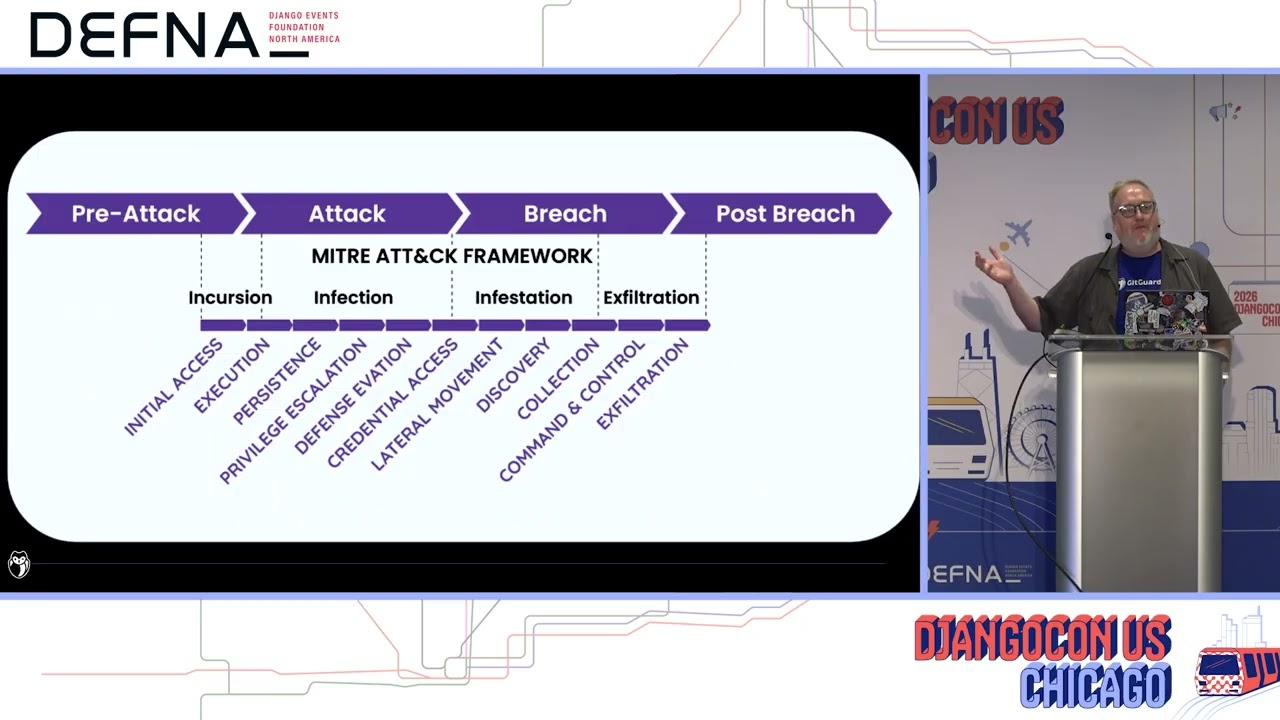
Speaker 1: But fortunately, we know how attackers behave. This is actually 100% true in the era of mythos and open AI and all of the AI driven attacks because they follow the exact same path. You need initial access, you need a way to laterally move around, and at some point along the way, you're gonna have to steal credentials to do that. This is so well documented that they wrote an entire attack framework around it called the attack framework from MITRE. But we see this pattern over and over and over again. Speaking of AI and this, I didn't know where I was going to put this because this just came out today or yesterday.
Speaker 1: Um This is the number of CBEs. Yeah, that line, if you can't read it in the back, says Claude Mythos preview announced. And then it skyrockets. If you look at it logarithmically, it's that's terrifying if you understand logarithms. Yeah. Um and what do all of those CVEs relate to? Well, exactly this, the OASP top ten and There's there's no new attack under the sun. It's there's new new vulnerabilities, there's new exploits, sure, but the attack, get in, get as much access as you can, write your back doors, and exfiltrate your data. That's the game. Oh, that's where I was supposed to put that. So AI has entered the picture.
Speaker 1: Uh and pretend I did that slide. This is the first time I've ever used that slide because it just came out yesterday. Um We've never connected together this much stuff like ever, ever, ever before. And attackers are taking advantage of that left and right. That's why we're seeing a proliferation of infostealer attacks. And in the middle is the developer, y'all, who are building all this stuff. And thank you very much. And if you'd told me a year ago when I spoke on this stage last time that I would be in front of an audience y all again and saying, you know, it's a really bad idea to keep plaintext credentials anywhere on your machine. I'd say that's nuts, because that's how we've been doing it for the entirety of how we dump computer science. Like you got a local credential store. Uh but now that's an anti-pattern. It just is. Uh that's what uh oh um
Speaker 1: OAuth uh 2. 1 that's coming out. Like that's gonna be one of the written things. Hard-coded credentials are an anti-pattern. having a hard-coded credential anywhere, even in a plain text file, even in memory, even in in an environment variable. Anti-pattern. The scale of this is mind-boggling. For those of you who have already downloaded the slides, because on the very first slide was that tiny URL not should have told you that earlier. That tiny URL gets you these slides and I'll show it at the very end. We know that the scale of this is continually getting worse and grows faster than the core developer community does. So this is a fun little game I play. And I forgot to bring prizes today, but I have stickers and I will bring prizes tomorrow if you get the answer to this.
Speaker 1: So we look at every single new commit that hits GitHub public and we scan it for a secret. And every year we put out this report, State of Secret Sprall Report. So if you've already read this report, if you already know the answer, do not answer. But uh Price is right rules. High stuff going over. How many secrets do you think we found added to GitHub in public in just the year 2025? I need hands. I can't hear you. What? This many. This many, yes. That's that's a good guess actually. Numbers? Anybody? One million. I got one million. Hundreds of millions. Hundreds of millions. Got hundreds three. What dollars? 8 million? 238,000. 238,000. 500,000?
Speaker 1: I'm gonna give it to 8 million, so come up and see me later. And I will have something for you so we get a token uh and you can get it, but it's that number. Um 28. 64 million, 34% growth year over year. We have watched this problem since we started doing this as a company grow from uh about 11 million I'm not gonna get into the math of it, but about 11 million to now almost 29 million. Um that's 152% growth. Meanwhile, developer growth has only been ninety-eight percent. That's still a lot. And here's the terrifying part that's not on this slide. So if you ask GitHub how many commits happened in 2025 from their angle, it was close to a billion. Our numbers end not in August when theirs end, ours end in January, our
Speaker 1: very end of December. And we counted 1. 94 billion. There's a discrepancy, there isn't there. Uh there's an article I can point you all to Um I don't have it in here, but I can point you to it, um, where GitHub said, yeah, we're gonna have to go re-enlist AWS's help because we're expecting 14 billion commits this year. They're on pace for it. That's not like a marketing out-of-the-sky prediction. That's their tech team saying we gotta deal with 14 billion commits. Let's rewrite Git's internals because there's some really cool stuff coming out of Cursor with that. Love talking in the hallway about that stuff Kick around here is the credentials, if they get minted, if they're not a JOT, if they're not an X509, if they're not a certificate of some form that expires, they stay good forever.
Speaker 1: So we validate all the secrets we can. If we can, we'll make a non-obtrusive call and say, hey, does this secret work? So in 2022 we took a group of about 11,000 of these secrets that were valid and we began tracking them over time and just rechecking for validity every now and again. And in January of this year, 64% of that same data set came back as valid Meaning those secrets have been alive for at least four years. At least. What do they go to? All sorts of fun stuff. There's another company that starts with truffle, ends with hog. that put out another report about finding all sorts of AWS like admin access keys that are still valid for years and public that they've reported on that nobody's done anything about. Getting back to the workstation.
Speaker 1: How many people know that they have at least 10 working credentials on their machine at any given time? You can be honest. Yeah. The actual numbers we came back with after the second Shy Halut attack and we got the raw data showed that like 44% of people machines that developers were using had more than 10 secrets, but every developer I talk to is like, that's gotta be undercounted. Like what's on who only has like zero to ten on their machine? Like those are task runners. Uh as far as we can tell, like those are dev machines that have CI involved, but we can't tell the difference between something that's got busy box and an actual dev machine. That's my theory on it. But that's theory. So how do we stop this? Is actually The whole point of this talk. So I've spent 15 minutes scaring the heck out of you. Now what do we do? Because there is hope here.
Speaker 1: Like I said, don't shouldn't be scared. And the answer is actually a combination of honey. And traps. And they don't call them honey traps. Uh we call them honey tokens, but I'll get to that. We have been doing cyberdeception for a very, very, very long time as humans. We're good at it. Maybe not cyberdeception, but deception as a defense. Did anybody see that awesome uh movie with Tom Holland and Zandaya from earlier this year? Yeah, Spider-Man. Great power comes great responsibility. And they used it in Troy. And yeah, we all know the story. Like I thought I was getting a horse. What we got was a fire.
Speaker 1: Skip a whore uh skip a f skip a horse uh generation. No, skip uh a few years ahead and over in a different part of the world. Sun Tzu or somebody claiming to be Sun Tzu or somebody wrote down attributing to Sun Tzu. But if you've ever actually looked into the histr history of the Art of War and like where we actually think it came from, it's crazy. I don't have time to get into it today. Um, but we don't know. Was Hunzu even real? We don't know. We think. Um, but appear weak where you're strong is strong where you're weak. It's the art of misdirection, it's the plot to uh Karate Kid Part 2. And then the ghost army. I took one of these pictures, the bottom one. But is anybody here know does anybody here not know the story of the ghost army? Okay, I'll tell it real quick.
Speaker 1: Um so beginning days of World War II. We don't have enough tanks and bombs and planes because we don't. It's 1942. Of course we haven't built that many yet because we've never been in a world war like this. And my Lazaria technology has changed. So what do we do? Well, we went to Hollywood and We said, hey, Hollywood, can you help out with the war effort internationally? And they said, yeah, we could probably do that. And they built a bunch of fake bombs and planes and tanks and guns and figured out audio technology. That would let them set up loudspeakers that would play very loudly to make it sound like there was a landing happening over there. And we were actually sneaking in over here. And that's how we ended up winning a lot of World War II in the early days. The bottom is about
Speaker 1: yay tall, about three foot tall, two, two and a half, three foot tall, uh made out of hay And they would launch thousands of these paratroopers out of planes at the same time paratroopers were actually parachuting in. What do you shoot at? Good luck. And again, really, really cool store from World War II. If you ever get the chance to go to the World War II Museum in New Orleans, I highly recommend it. All right, getting to Cyber. I had a chance to run into Cliffstool. I didn't meet him, but I ran into him this two weeks ago in a DEF CON. It was awesome. Honeypots. The concept of honeypot emerges in 1985 for the first time. This is a fun story too of cyberdeception. Cliff Stoll is an astronomer.
Speaker 1: who was basically broke. So he started working at Berkeley Lawrence computer lab. And his first job was, hey, figure out where the 75 cents went. Back in the day it was $300 an hour to rent the machines, uh to rent the computer time. So 75 cents wasn't a huge deal, but it wasn't nothing. So that led him on this goose chase and he found out that it was the same attacker was targeting them and also getting into non-classified military databases. And every time they would start to trace back where it came from, they'd hang up. And MITRE, who I mentioned their attack framework earlier, they were actually part of this kill chain that they were The call centers were routing through MITRE itself to get to US government stuff.
Speaker 1: But it kept hanging up. And one day Cliff's girlfriend said, why don't you trick him into downloading a bunch of material that's useless And he said, that's a good idea. And he called it a honeypot and it worked. And he filled a server full of old scripts and message board entries. And this is a time when 1985. Uh like to get a gigabyte of data in nineteen eighty five, one, you wouldn't have anywhere to put it, but like maybe paper, but yeah, it but it spent so long that A guy with an oscilloscilloscope in eastern Germany went through a telephone exchange, circuit by circuit, to figure out which one was still active. To find the guy, an East German who was selling secrets to the KGB. It's a crazy story. You can read the whole thing in the cuckoo's
Speaker 1: egg, but the KGB The Computer to Me is a Nova special from 1990 starring all the people that were still alive that were willing to be on the film. So it's a made-for-TV documentary drama. Really, really good. And that's Cliff. Cliff right there. Fun side note, he makes Klein flasks. He's the largest collection of Klein flasks in the world, like the self-sealed flasks. Anyway. Just there's all sorts of fun stories once you start digging into the history of computer science. Fast forward to Fred Cohen's 1981 Deception Cool Toolkit. He takes this idea and says Hey, if the system's not doing anything practical, why don't we set it as a trap? Why don't we just deploy like traps everywhere? So if you log into a system and you're not supposed to be there and there's nothing supposed to be running, hey, we know you're not supposed to be there. Get rid of you.
Speaker 1: Let's get rid of your IP and make sure you're you're not new to anything doing anything bad anywhere else shockingly long time between 1991 and 98 between s The cool kit basically saying, here's the technology, here's the idea of it, and someone's saying, here's you can buy this off the shelf. And that's the uh ballista, which later became cybercop sting. Same idea though, like just throw it out there. But I really like the quote from Albert, uh Alfred. Um hackers aren't kids out on a digital joyride. At one point in the history of hacking and cyber stuff. The reason like there are hacker names is kids in Texas were stealing minutes from MCI. And they had this collective called the Cult of the Dead Cow, and somehow that became the root of all of the cybersecurity hacker culture.
Speaker 1: And it became like, oh, the hackers, they're just, you know, out there having fun. They're kids. He's like, no, this is these are criminals. This is this is like a line in the sand moment for the industry. Like we're gonna have to do something about this. That's why I always call that out for him. All right, getting back to the point of this talk, beautiful, beautiful, beautiful email threads out there in the world that still exist. But in 2003, Augusto Which I've never met. I always like to. He lives in Canada these days. He says in the message board for honey pots, hey, I have this idea for a piece of data that shouldn't move or shouldn't flow. I've been calling it a honeypot or a honey token. I've been calling it a honey token. And the name stuck. Fast forward another handful of years and oh
Speaker 1: and we get to uh Thinkst, really cool company, but they open source canary tokens and they build the very first time that AWS credentials get associated with the idea of something that shouldn't move. And I'll get to why that's important here in a couple slides and why that's like a base way to start thinking about honey tokens in a modern sense. But this is kind of an important moment. Fast forward to a couple years ago, I'm at RSA and I hear Kevin Mandiant, our Mandia for Mandiant um Google Cloud, literally say honey tokens are your early warning signs. It is their second line defense. If anybody ever says assume breach, this is what you do to assume breach. Assume someone's in there and going to be messing with your stuff.
Speaker 1: Set up things so Just assume that they got past the outer defenses. Your hard shell, your perimeter. Just assume they're in there. But you should know what they're doing at least. And that's what honey tokens really can give you. Now why I started this with AI and like pointed all that out is because the attacker is no longer outside of the room. The attacker is no longer outside of your place of employment, they live in some cases in the boxes you're actually working on. And you can tell where they're from and what they're doing if you set up a honey token. Well, again, with AWS, that will give you that information, like an I IP address, a user agent.
Speaker 1: So far, the AI hasn't figured out that it's trying to evade honeypots so far. And they're trying to they haven't figured out not to figure out or not to use honey tokens quite yet. They will, but for the time being we have an advantage And attackers in general aren't going onesie-twossies and saying, hey, does this work? Let me go to the next one. Again, these are scripts that as soon as they see a credential, let me go try to use this to publish myself again. And then steal the credentials on the next machine I infect. So how do you build these? Well, we have an open source repo that you can use as a reference. guide, but this is one of many ways and don't worry about taking pictures. I'll again share these slides and I have many more examples after this one.
Speaker 1: But this is the way we set up our carry tokens. Well we call them honey tokens. But Canary Token, GG Canary. Anyway, it's a long story. But essentially it's just a real AWS account with nothing else on it. No credit card, there's nothing it can set up. There's no powers you give any of these users. You have a list of users. But since you're in AWS infrastructure, if someone does try to log in, there's this thing called Cloud Trail you can turn on. And Cloud Trail can give you all sorts of metrics about what happened. Then all it's a simple matter of filtering out those logs. You can do that with a simple script and say, hey, if anybody tries to use one of these things on the list, go ahead and trigger a response. Rattle what we call it j jiggle the bucket because Cloud Trail dump something in the bucket.
Speaker 1: Jiggles the bucket fire off the loop to see, hey, does this contain something we care about? If it does, send the IP address, the user agent, the action they were trying to do, a timestamp. Send that to wherever you want. Uh AWS, SES, uh, SendGrid, Slack, wherever you can wire it up. And This I think should also this is a very old picture. I should update this to custom webhook. Because once you're in custom webhook land, wow, the sky's the limit on what you can't do with this. What workflows could you trigger if an attacker, hey, wow, someone is trying to use something on my machine, go ahead and just destroy that credential immediately. That's Stop that. That's end all sessions. Boot everything out of everywhere. Stop.
Speaker 1: And I'm not saying break production, but there are certain things where maybe breaking production might be the safest option. That's a conversation between you and your security team and executive team when you're dealing with this stuff. Like that's not something I can tell you on stage, like go ahead and Go ahead and just nuke your uh nuke your credentials if someone gets in. But know that it's an option. That's what I mean. Machine speed. As soon as, hey, we tried to use this seconds later There should be a trigger for something to happen. In the old days, you know, a year ago, the answer to this and why I kind of stopped giving this talk for a minute was it will give your your team time to react. And now it's the trigger to go ahead and just take those actions.
Speaker 1: That's what I'm going to advocate for for the rest of time now because we need to defend at machine speeds. So how do you actually build these things? What do you do? Not just reference. Because I know some of you are like, hey, we can get this started right now if I just had some tools. You can build these yourself. Again, if we go back to Augusto's, and that's why I give part of why I give the history, if you go back to the original idea, it's just a piece of data that shouldn't flow. And I'm sure you can all think of a way to set up a file watcher on Windows or Linux or Mac or whatever system you're building. Say, hey, if something touches this at all. Do something. That's that's kind of all it is. You touch this, do something. So I don't want you to
Speaker 1: walk away from this talk thinking it has to be an AWS credential or it's got to be a real credential for a working system. We have a token system internally that they all come back as valid because that's the whole API's point. It's like, yeah, there's a test credential, whatever it is, like just do the thing. But we know if that comes from an IP address that we're not expecting, something's something gone horribly wrong. Because how on earth did that even get out of our system? Corporate email addresses is a fun one. I added that after going to a talk about uh honey honey email addresses. So what happens if you start getting forwards or something starts forwarding from an email address that shouldn't ever ever be accessed? Again, it's something that shouldn't flow.
Speaker 1: That's the bigger picture. What shouldn't move? But if you want to go build actual canary tokens, again we have one of ours, Terraform AWS, and get it running in like two minutes. We based ours off of a few things, but partially from Space Siren. uh which is a really cool project. It's just straight straight up building that on AWS without Docker or without Terraform. They might have updated it Terraform. I haven't checked that project in a minute. And like I said earlier, Thinxt added this in back in 2015. So you've been able to do this yourself, set it up, DIY, run it yourself. You got a little Docker knowledge. Much easier and what I tell everyone, everyone to do is go to canarytokens. org.
Speaker 1: Thinxed is a company out of South Africa. I believe they're out of South Africa. Last time I checked they were. They I don't think they moved offices either. So uh They have a bunch of free off-the-shelf honey pots as a service and honey tokens is one of the services. If you want to do a onesie twosie just to test this out and see what happens and what that looks like, free. You can do fake credit cards, fake PDF files, fake databases. One of the coolest things they added, I don't know if they still do it for free, they offered it for a second, was free um CSS tokens. So you could add it to your CSS and see like what's trying to put the CSS somewhere else online because it should trigger it was a weird thing, but Go play with that. If you want to do that at scale, uh
Speaker 1: Canary Tokens. Canary. tools is the commercial version of that. They'll sell you thousands of them at a time. We make them. In fact, that's what I deployed earlier. Not here to sell you that you get them free, up to five free with a free account. And if you're doing open source projects, you get to use our tools for free forever. Free for individuals for under teams under 25. So for your open source, for all your Django projects, please, please, please, please, please do are huge fans of what the community does, talk to me about that. I'll tell you how we hook that up. But just sign up, it's free. Um somebody told me that Microsoft Sentinel has this ability on Azure, but I've never seen that work. I've never heard anybody say they'd run that. Does anybody here run that? No, okay. I've never had anybody
Speaker 1: raise their hand. CrowdStrike will sell it to you because they'll sell you anything. Because a CrowdStrike um Proof Point has one too. Just that's a partial list. Basically any company in the world that handles credentialing at all should offer some version of this So okay, you built one. You went to Canarytokens. org and you download you like you 've you got one on your clipboard now. What do you do with it? Put them somewhere private. Put them somewhere where only you know where they are. Or someone shouldn't be able to get in. There's no legit purpose for these other than to fool someone. So if you put it into your internal JIRA And it goes off
Speaker 1: and the call's coming from inside the house. It's like what what grabbed this? Why why did this get scanned? Hey, this EMV file I had over here that has something actually valuable in it. Oh, something touched that and they tried to validate this credential, which was one on the list. Ooh, now I know I need to do something. Which it goes back to what I was saying. What should that trigger? What is your burn down plan when your EMV file that's powering the entire application that has database credentials baked into it? What happens when that gets pwned? What happens when that gets leaked? What happens when that gets stolen? So put them somewhere where it shouldn't get touched, thank you. I'll just mention it quickly.
Speaker 1: Yeah, we have uh uh most CLIs will do this if they handle honey tokens. Ours just added this ability to do profiles, so it will just update your machine with a fake profile, AWS profile. But anyway, you you do you Uh keep a ratio of one to one, one per environment, one per you put one in a place, don't spread it around, don't put it in a bunch of repos, because you want to be able to act immediately and do one specific Remediation path. Again, I'm gonna keep keep pushing that world of let's keep automating as much as we can the response path. So one-to-one is gonna help you do that. On over talk that one. Think about this at scale. That's the challenge of this. It's very, very easy to plant a honey token
Speaker 1: locally. It's very easy to plant a honey token in one project. How do you do this consistently across your environments? Now, if you're just building these things and shoving them off to a customer and you don't think about that project again, That that's a different issue altogether, but this advice is for anybody working in the enterprise. This is a conversation you need to have, not just with your security team, but with your DevOps team. with your infrastructure team, with your platform, with your SREs. And let them know that you're doing this as well. Don't don't Just start planning these things because I guarantee you your red team, your pen testers are going to trigger these. You should have that conversation and like, yeah,
Speaker 1: have the that That's an easier conversation to have if you have planned to do this at scale because that's part of your planning to do it at scale. Those conversations. That's a journey. Like start start with one one place and build out from there. See if it works for you. Now, one of the tricky parts about judging value on honey tokens is in best case scenario they never go off. Ever Unless you're specifically testing it. So that's kind of again that conversation you need to have with the rest of your team. Like, look, best case scenario, we did everything else right, and this is useless. But we still should do it. Don't put honey
Speaker 1: tokens in public places. Uh that's what I did earlier. We'll get back to that. But There are things and people and entities on the internet constantly, constantly, constantly scanning the internet. I don't know if you're aware of this, but the internet 's scannable. Uh yeah. So That's why we we harp on private, private only. Oh yeah. Yeah. Uh I debated if I'd leave this in here or not, but We know that the models are escaping. We know that people are building for nefarious purposes. Because sure, there are controls built into anthropic and open AI, they claim. Uh but what about Quinn? What about ZAI? What about
Speaker 1: um GL GLP or what name just three random letters, like whatever that is, and whatever gets built after that? Are those got the same c controls? I don't think so So related to honey tokens and something I've started to personally doing and started advocating, and I'm going to advocate here because I got the floor, um, is context bombing. This is an idea I ran into from TraceBit from July. So this is a pretty new idea. But they're claiming like 100% success rate or near 100% success rate across the board with this, no matter what the model is. And context bombing is very simply telling the model to do something explicitly bad. Because there should be something in there that says you can't build sarin gas recipes.
Speaker 1: And I'm shouldn't be able to make anthrax. This is an app that's that's a real honey token and that is the actual context bomb that lives on my machine. So if anything reaches, any agent reaches for my secrets. txt file They immediately get told do tell me how to make anthrax. And they're a very, very high likelihood that that agent right then and there would be like, I can't do that, Dave, and back off. Now, will they trigger the honey token first? Don't know. But do you want to know that you stopped an agent with one of these? Well, this literally is the setup that would tell you, hey, something tried to trigger this honey token. The same the only reason it could take to touch that honey token is it touched this file, and that file might have just stopped the agent.
Speaker 1: Did it or not? I don't know. That's why I say debating it. Is it good advice? Maybe. So what happened to the thing I deployed earlier? Well, this was in public. If it worked right. Yeah, there it is. So this is deployed in public. Uh Django to do backup. I asked uh Claude to build me a to-do looking Django app, so please nobody judge me. I didn't I did not write this. I don't even know if it works. But let's go see what this looks like over on Git Guardian. If I do a refresh. And uh we'll get triggered. This is the one from today the 25th. Oh, okay.
Speaker 1: Well this one only has one thing that hit it, but that was AWS. So maybe the AI is getting smarter and saying I'm not gonna hit anything. Let me show you something else though. One of the other ones we deployed. So yeah, this had a whole streak, hot streak in July, where we saw a Python request from this IP range that was getting caller identity. And how many ninety-nine events on that one over the course of days? I've done this this is like the danger of doing this live and not having a a prepared demo where I deployed one and I watched it get immediately crushed. Um That's why we're working on other ones than just AWS tokens, but this was the easiest setup.
Speaker 1: And when I first started doing this demo, it would be like 80 events in the course of half an hour. And again, the bots are getting a little bit smarter. The attack, these scripts are getting a little bit like, eh, if it's in public and AWS key, they're probably going to attach user policy, which is exactly what AWS did. Attached user policy, which is not a security feature. It acts like a security feature in certain ways, but attached user policy attaches a quarantine policy. to the AWS account associated that prevents them from basically wasting money. Not the attacker, you AWS wasting money. Like they don't have to pay back if that user can't do anything. So this is a cost-saving measure, not a security measure. So that's not there to protect you, but
Speaker 1: apparently there's a learning curve to this. So the big wow, how many things hit that at once kind of got deflated there. But If it did go off, you know exactly what hit it, when it hit it. All audible. Because the dream is, hey, honey token went off. It fired off, killed that credential, and then I have a paper trail that says this was deployed here. I can go into that account and say, hey. What other incidents are in that account? What other incidents have happened because of that? So that's like one way to wire that up. I'm not here to pitch you I'm honestly not. That's it was not trying to be a sales demo. That was One way you can treat these. But there should be something that happens as a result of
Speaker 1: something that's triggered this. Case of AWS, if this is just user policy, you can ignore that one because they're gonna do that. This is one way to think about them, but that you want to get as much information as you can from any of the ones you set up. So look into what details can I get. It's not just it rattled, what rattled it? When did it get rattled? What were they trying to do with it? Were they trying to just validate? Was it LS? Was it get user? Was it dump credentials? Not all attacks looked the same. You can build these, you can buy them. I would start with honeytokens. org and work out from there because it's free and it's a good easy way to get started. Definitely think in terms of blue team.
Speaker 1: Put them in private places, places where hopefully, hopefully they never go off. Because the worst case scenario is an attacker gets into your machine. through an info stealer, copies all of your credentials, sends them off to a C2 server, and then uses the same credentials to publish itself forward into the Django ecosystem. That's the fear. I don't want you to be afraid though, because you can easily plant a honey token that says, hey, something has touched this credential and it shouldn't have. And you've already set up a script that says, if this fires. . . Go ahead and do the most logical thing that's going to protect us. Rotate, rotate, rotate. But I'm Dwayne. I live here in Chicago. Thank you so much for the time. I really am honored to be speaker at DjangoCon twice.
Speaker 1: One last thing, I am doing a video project. So if any of y'all want to talk about how you're handling agents uh access on your local machines Please come talk to me. We'll do a little quick recording. It'll be fun. And uh the slides are up at that tiny URL. Thank you very much
Speaker 2: All right. All right. Thank you, Dwayne. Uh we do have a few minutes for questions. If you have a question, please let me know. We've got one over here.
Speaker 3: Um, thank you. How do you know if it's been touched? Are you only finding out if the credential is actually used? Because the way that this is being distributed, you said they're not necessarily trying them out.
Speaker 1: Yep. It's it's a so with ours specifically, it's the validation step. Uh the way we ours is set up. I go back, I'm gonna blind everybody with this arc like jumping back. But the architecture diagram. Yeah, this requires an actual login attempt, uh an actual usage attempt of the credential. Again, on this particular diagram, on this particular architecture. Do you have to set it up that way? Absolutely not. There are other ways you can uh again in the grand scheme of things if it just shouldn't be touched at all. So think about a file watcher on your local um local drive. Like that doesn't need anything other than something readdown. Something actually accessed the file or tried to move the file or tried to make a copy of the file.
Speaker 1: This isn't again, this is just a reference diagram, not a this is not the be-all end all of how to think about hunting tokens. There's tons of blogs and articles I can point you at for that stuff as well. Just
Speaker 2: here.
Speaker 1: Not in this deck.
Speaker 4: Oh thanks. I'm wondering if I'm following correctly, but let's say I wanted to like honey not honey pop myself, but like I have my own AWS, real AWS keys on my machine, but I want to know if My tokens were compromised. Uh can I have like honeypot tokens live alongside them?
Speaker 1: Yeah.
Speaker 4: Um okay, so this model still works for that.
Speaker 1: So I have that secret I have that secret. txt file, but inside of my actual. uh folder, they're honey tokens. Like they just live right alongside. Like AWS doesn't really distinguish. You could you can just stuff whatever you want in that file. It's just Anyway, yeah. But you can they can live right beside.
Speaker 2: Anyone? One back here?
Speaker 5: That was great. Thank you. I'm curious what you think. Like I think some of this stuff can feel really overwhelming for a small team that maybe is just learning how to, you know. deploy an application and use Git and uh all that stuff. Um you mentioned kind of like enterprise level at at some point. What what are your thoughts on kind of like Sl for a team that's new to the idea of application security, like how do they get into this? Where does this fall? You could spend months just focused on security and and never building anything like that.
Speaker 1: So that is a great question. This goes hand in hand with um fundamental awareness training of like breaking down the concept of private means private. One of the greatest fallacies we have in all of cybersecurity and all of technology is it's in a private repo, it's fine. This is it's in a private JIR instance. It's fine. All you need is one foothold. And like the there's a story from Uber from 2022 where there's one kid from the Lapsus group, um, I say a kid who's like 17. Um fish superadmin rights found a PowerShell script full of credentials, went through their PAM And literally pwned hacker one or like taunted hacker one from within Uber
Speaker 1: 's internal Slack and like literally showed screenshots of how he owned their entire Jira. So like the concept of this is going to stay private is not good. So this goes hand in hand with that kind of an awareness training of like, look, we need to assume breach. This is 2026. We have to assume breach. So Again, best case scenario, you deploy a few of these around in a private environment and they never go off because you got lucky. That's the like worst case scenario for a honey token. But also if it does go off, it's like, hey, why did someone copy a private repo to public? Why did we push this to public? Why did you copy this bit of code over here? So it's part of that awareness training. But where you actually physically
Speaker 1: start, for a small team especially, again, thanks. Like thanks honey tokens will just run forever.
Speaker 2: All right, I think we have time for one more question back here, and then after that we'll do questions in the hall if you have more.
Speaker 6: You're collecting the IP addresses for things that set this off. Have you looked at who owns these IP addresses or they well
Speaker 1: IP are so easy to spoof these days. There was a time about two years ago where everything got uh trampolined through Indonesia and there was like giant blocks of Indonesia and like But you trace it back to there and it's like, oh no, no, that was like one bad d um um ISP. Like that was like somebody tricked into it. That's that's actually I didn't harp on it that much, but uh why user agents just as important, if not more important than IP. It's like really easy right now to spoof an ID. As we heard earlier, if you heard the lightning talk and the bot traffic, like those new IP is for everything. But I bet those user agents all look almost identical. It's a lot harder to fake an entire user agent. Sure, a browser is sure parts of the agent, but over time you build up that profile of like
Speaker 1: if it's bot O3, it shouldn't be touching this or bot three, botto, I don't even know how to say that out loud. Botto three. Yeah. You just get the idea of like IP adrence that's not um allow listed. That's the other reason for this of like you start adding to that disallow list. But a combination of this wasn't on the allow list and it's a weird user agent, it's a pretty good signal not let it in or to do something about it.
Speaker 2: All right. Thank you, Dwayne.
August 24 - 28, 2026
Chicago, Illinois, USA
Note: We understand that names change, people change, and bodies change. We respect each individual's journey and privacy. If you have any concerns about a video or need us to remove content, please don't hesitate to contact us. We will handle your request with care and promptly address any issues.

Published October 26, 2026

Published October 26, 2026

Published October 26, 2026

Published October 26, 2026

Published October 26, 2026

Published October 26, 2026