0:12:30
Tips for Optimizing Images in Wagtail
Published July 9, 2026
Wagtail CMS 2026
This video features at Wagtail CMS 2026 .
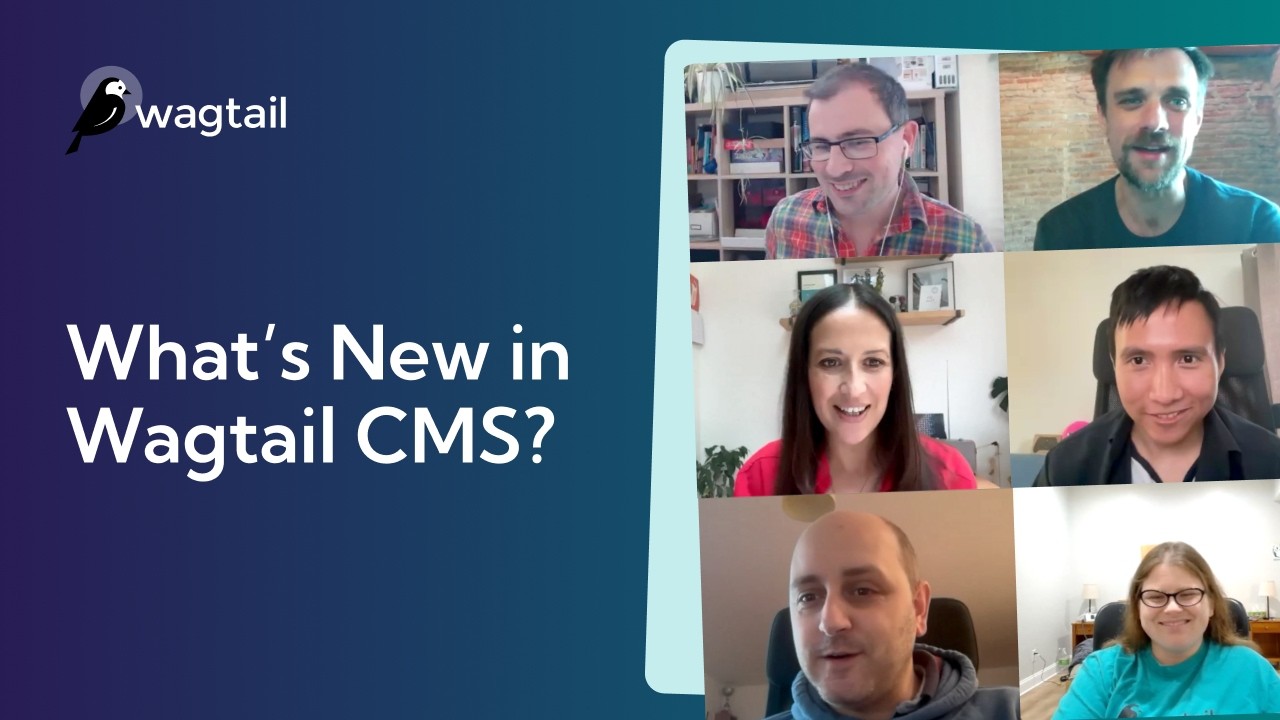
In this episode, we cover the recent 7.3 and 7.4 releases of Wagtail CMS. Special guest Tim Cowlishaw from the Green Web Foundation also joined us to go over the carbon.txt standard and we showed off an upcoming package for Wagtail that will help people provide more transparency about the carbon footprint of their Wagtail websites. We showed off exciting new features, includin improved autosave functionality for editors, advancements in search capabilities, and enhanced block settings as well as page explorer columns for more customizable layouts. We also demonstrated our new content quality checks and discussed upcoming community events and contributions.
00:00:00 Welcome
00:02:53 Wagtail community & data Insights
00:08:00 Introducing carbon.txt with Tim Cowlishaw
00:23:52 Wagtail autosave improvements
00:27:29 Wagtail search enhancements
00:31:28 Wagtail block settings & layout customization
00:37:32 Customizable page explorer & listings
00:42:04 llms.txt for AI documentation access
00:47:05 Content quality checker updates
00:52:44 Upcoming community events
💻 Wagtail is the easiest open-source Python CMS to use:
Install the demo and start building your first site in 10 minutes: https://wagtail.org/get-started/
What will I learn from this video?
From this video, you'll learn about the newest features and improvements in Wagtail CMS, focusing on the 7.3 and 7.4 releases. You'll discover how to leverage the carbon.txt standard for website sustainability transparency, understand the enhanced autosave functionality designed to prevent data loss for editors, and explore the latest upgrades to Wagtail's search capabilities, including filtering over related fields and fuzzy search. Additionally, you'll see how block settings are becoming more flexible with new layout customization options, learn about content quality checker improvements for better SEO and accessibility, and get updates on community initiatives and upcoming events.
📹 Related Videos To Watch Next:
▶ Video Tour of Wagtail 7.4 https://youtu.be/XFEmUYoX4OM
▶ The Latest on Wagtail AI https://www.youtube.com/watch?v=4zfs1u4Vy5Y
▶ Wagtail Localize in Action! https://youtu.be/sBKv255dwoU
Wagtail future proofs your CMS system, as it’s open source, continuously updated and built on Python, one of the most popular global programming languages, used widely in machine learning and big data. So you’re always ahead of the curve when it comes to CMS platforms.
Wagtail is the #1 choice for accessibility, is scalable and most importantly, secure.
👉 Get started with Wagtail CMS for free: https://wagtail.org/get-started/
and see how easy it is to build a website that works for you.
📊 Read why Google, NASA, and the British NHS, are powering their digital estates with Wagtail: https://wagtail.org/about-wagtail/
🎥 More Wagtail Videos: https://www.youtube.com/watch?v=cne2kxemMAQ&list=PLfwZ-fob20cPvSQ_v1hkjto8BAPN21tLJ
📣 Follow us on social:
#WagtailCMS #Django
Wagtail 7.4 adds a customizable page explorer, improved autosave, configurable block settings, and built-in ordering for non-page listings. Autosave now supports incomplete drafts, clearer conflict and network-error feedback, and quieter page history; search improvements include related-field filtering, PostgreSQL fuzzy search, and groundwork for vector search. The speakers also present Carbon.txt, an open format for publishing machine-readable sustainability disclosures, and show how Wagtail could generate it from CMS settings and hosting information. They begin describing Wagtail’s adoption of LLMs.txt and related tools to make documentation easier for AI systems to use, but the transcript ends during that demonstration.
Summarised automatically from the transcript.
Automatically transcribed, so expect mistakes in names and technical terms.
Speaker 1: Okay, we're going live everybody. Welcome to What's New and Wagatail. Lots of people in the meat waiting room today as well, super keen, which is fabulous to see. If you'd like to say hello and what the weather's like. Josh, what's the weather like in the NYC? I think it's hot at the moment, I heard someone say.
Speaker 2: Use some of that over in Cambridge. The weather is getting tentatively good around here, but um yeah Needs improvements.
Speaker 1: There's rumors it's gonna be hot in the UK next week, which is when I'm going to Croatia, and it's not going to be as hot as the UK. Oh what's it like, Mohammed, in India? Not hot in Dublin. I think it's coming, Ryan. Hey
Speaker 2: Ragat, great to see you here.
Speaker 1: I love it. It's so international. Yes, Ralph. It's getting warmer though, I promise. So this is why it's so good on this webinar, because you have people from all over the place. Some of the webinars we do, and it's just like I'm in Slough and Swindon and boring things like that. So this is much more interesting. Right, as everyone was so prompt today, I think that we can um probably get going. So welcome everyone that's joining us to What's New in Wagtail. If you're joining us for the first time, hello. And we're really glad that you could all be here. And people that are returning, we're really glad that you're here as well. I'm Lisa and I lead marketing at Torchbox
Speaker 1: and we love hosting these sessions because it's a chance to take a step back and look at everything going on in the world of Wagtail and there has been quite a lot recently. So we've got a really good lineup for you today. We've got updates on the 7. 3 and 7. 4 releases and we're delighted to be joined by our guest speaker, Tim Cowishall from the Green Web Foundation, as well as Matthew, Sage, Thibaut and Megan. They are going to go through a few different demos and we are going to have time for a couple of questions after each section as we go through. So pop those in the Q<unk>A that you should be able to find from the Zoom navigation bar on the bottom. or in the chat and we'll try to keep track of that and we should have a bit of time for some more questions at the end as well. I will share a follow-up email afterwards as well with any of the resources that we reference
Speaker 1: and any unanswered questions. And I think that's it. So I'm going to hand over to our fabulous, fabulous French compare Thibaut.
Speaker 2: Oh Lisa. Hi everyone, I'm Thibaut and uh yes, I have a bit of a state of fact for us to get started with. As Lisa has mentioned, we'll have a ton of feature demos focused on Wagel 7. 4, which we shipped few days ago now, WagTel 7. 3, back in February, and also a few things coming up. But before we dive into the features, I wanted to share some of the latest uh reporting we've done on I guess wagtail out there adoption patterns in our community um things of that sort. And I have no less than four reports to share. Apparently May is a very heavy report season.
Speaker 2: First, I wanted to share some of the results from our AI and developer experience survey. It's a massive paradigm shift for developers, obviously AI and AI tooling for engineering. And we really only wanted to capture I think what it looks like within the context of Wagtail. And I'll only share a couple of the results from that survey, which is looking at the top charts here on usage patterns. We have a wide majority on the order of 70% of our respondents. who say they use AI either always or daily or weekly and most of those people also express quite high degree of uh confidence or familiarity. with their AI usage. So again we're on the order of 70%
Speaker 2: for people who say they're familiar, confident or advanced in their AI usage. And with that 70% figure again, that's the kind of number we're looking at when it comes to people's satisfaction with the degree to which AI tooling works on Wrightel projects We've made a few investments in AI optimized aspects of the Wagtail project, but even without people tremendously using those, they're already seeing quite clear benefits as well as sharing their constraints and considerations when it comes to AI adoption. So I'm really happy we have this survey out there and we'll be using this through our decision making this year on which aspects of Wagtail we work on.
Speaker 2: And yeah, there's not just AI adoption. We also really care about accessibility. And just yesterday we reported on our yearly statistics for accessibility of Wagtail sites. I don't think I even need to look at the data here simply because this is the first year ever that literally every single thing we measure has seen an improvement year to year. I can't express like how outstanding it is. I'm still not sure if I can quite believe it. Whether you look at which sites have or don't have issues. that number is going up with fewer and fewer sites uh having issues on them or more and more sites being issue free, at least as far as we could detect. If you look at government websites, we have people like the UK government with their Wagtail usage
Speaker 2: arriving at this perfect 100 score on average across all of their sites. Literally every government that uses Wagtail in our top 10 is seeing improvements year over year. If you look at specific checks, content checks on the quality of content pages in Wagtail. Again all the checks we're running that we have built into the CMS are seeing improvements and uh same for alt text where clearly are built-in alt text improvements and quality checking rules are paying off with the number of file names in alt text um dwindling down as well. Anyway, I feel like I'm uh giving ourselves too much credit. Maybe there's potentially other patterns here, but it's just outstanding to see this We also got a very recent security audit, an independent security audit, which is quite
Speaker 2: great for us to have as a community. And it comes from the French government, no less who are using Wachtel for on the order of 60 websites of the central government of France, among which the Cybersecurity Agency websites. And it's just excellent for us to get to work with those people in the open, for us to have those audit findings to share. And there's plenty of interesting points of the audits for us to unpack that I've done in that blog post. Should you want to take a look? And last but not least, I'm also very happy that we report on the carbon footprint of the wagtail ecosystem at large. So all of the tens of thousands of sites built with the CMS, what's their carbon footprint once they're deployed, once they are serving requests for those sites
Speaker 2: audiences. Not all of which is under our control, just to be clear, but we definitely have a few levers, product decisions we can make to reduce that footprint. Which we see a decrease of this year, which is really good news, but unclear whether the decrease is for the right reasons or no Anyway, I'll use that as a bit of a transition to move on to our first presentation of the webinar. which is Tim from the Greenway Foundation who's going to talk about carbon. text, a new format which we're very eager to adopt in Wagtail. Hi
Speaker 3: there, Felix. Thank you, Thibaut. Yeah, give me a second to start sharing. One sec. That looks good. Lisa, does that look good to you? It
Speaker 1: is good to me.
Speaker 3: Perfect. Okay. Right. Hey everyone. My name is Tim. I work for the Green Web Foundation. We are a um a nonprofit based in Germany. Um actually officially based in Holland, but most people are in Germany, um, although we're all over the world. Um And our mission, I guess, is to work towards a fossil-free internet by 2030, which is both kinda s I guess a simple kinda um simple kind of aim to have in terms of explainability, but also kind of difficult in terms of execution execution and also kind of terrifyingly soon given the scale of the challenge. So we believe that the internet should be a global public good and healthy for the planet and for the people who use it. It's a sort of um and all our work works towards those ends.
Speaker 3: How we work on that, we do a bunch of policy work. We do a bunch of um work producing kind of data around around um around carbon emissions, around energy use on the internet, and we do a bunch of uh kind of like prototyping and design and development work, working on tools, protocols, um technologies which can hopefully make the internet a a greener and more and healthier technology. And one of these is Carbon. txt, which I'm going to talk to you a bit about today. Um So common. text um is intended to solve the problem of discoverability and transparency of sustainability claims on the web. And what do I mean by that? I guess um We could start by thinking about the web as something which is sort of implicitly transparent in a bunch of respects. In general, if you look at a web page, you can view source and see something about how it was made.
Speaker 3: It kind of brings along um brings along like this inspectable kind of representation of what it's made of in some sense. So you could always, I don't know, go into a web page, see what code is being run on your computer, learn how to do similar things, which is one of the things that makes the web great. One of the things it's less easy to to know about, however, is the kind of material side, what's happening um where physically things like website websites or other kind of Technologies are hosted, um, what impact they're having on the world around them, and all of this stuff is pretty opaque. Like you can't in any kind of reliable way go to Wikipedia and work out where exactly in the world that um that website is being hosted from, what uh how much energy it's using, what kind of impact it's having on people around them.
Speaker 3: And uh this is one of the problems we're really interested in solving. So as a bit of background, one of the services we've run, probably the most, probably the thing we're most well known for, is a thing called the Green Web Checker, which is a website where you can go and Type in any URL, in this case I've used uh bigroom. eco, and we will tell you if according to our database uh that website is hosted on 100% green energy or not. And the way we do this um is by collecting evidence from hosting providers. So a hosting provider will register with us, will provide um a set of evidence about their uh about their energy sourcing practices, about uh about the way they work, um, and then we will use that to enter them in this database and then match the sites that they
Speaker 3: that they host with them normally by IP address or by ASN or something like that, uh in order that people can can see whether or not the websites they're visiting are hosted green. What type of sorry one second? What type of evidence we we do we accept? Like often this is um people will send us invoices. If they use another provider we know is green, they might send an invoice that they have paid to this other provider. They might, if they run their own infrastructure, send us things like remote uh renewable energy certificates, guarantees of origin, um, stuff like this. So we look for documentation and we maintain ourselves this database of green uh green providers which allows us to provide the service. Um this is all great, but there's a I guess there's a few problems with it. The first is it obviously makes us into this huge middleman where this kind of single point of truth.
Speaker 3: for um all this information about how uh the material effects the internet 's having, about what people are doing around energy sourcing, around emissions. It's also a vast amount of work, both for the providers who register with us who have to to provide all this documentation and for my colleague First Ad who has to spend a lot of time every week reviewing these submissions and keeping our database up to date. The other, I guess, slightly more technical problem is our way of matching websites to these providers is very fast becoming trickier as people start using stuff like Cloudflare. We can no longer be sure that your IP address which your website resolves to is actually the IP address of your provider. So we have a whole bunch of kind of problems we're attempting to resolve with this project called Carbon Text. So
Speaker 3: CarbonTech starts from this kind of, I guess a question that what if this type of ability to make and verify sustainability claims, so claims about your sustainability commitments and what you're doing to address them? was built into the kind of built into the web itself at a kind of protocol level rather than being an application that someone like us has to run. And our analogy here, I guess, is something like Something like SSL and the way SSL works. You can go to your browser if you see the green padlock in your address bar, you know you have a secure connection to that website. We were kind of wondering what something would look like if you could have A similar thing that operated at the level of the web itself that would tell you that would give you some guarantees about the environmental impact. that website was having. So it's something which is decentralized. There's no kind of central authority of SSL certificates.
Speaker 3: And it's something which is kind of open and extendable and usable by any role. So yeah, but if we had something like SSL but for sustainability claims? And this is the question we're trying to answer with carbon text. So the big idea here is super simple. Carbon text is a single file. that you host on your website in this known location, so always at forward slash carbon dot text, which contains machine and human readable sustainability data for your company or for your um or for your website itself. You're probably familiar, I guess, with robots. txt, which is an analogous thing, and I think Timo later on is going to talk about LLMs. txt, which is another proposal. Robottext is the, for those who don't know, is the file that tells Google's web crawlers and any other search company's web
Speaker 3: crawlers what pages they're allowed to access and what they're not. and you can always go to slash robots text on pretty much any site and get that information. So we're trying to do something similar for these kind of for sustainability information. And I guess the question is what type of information that might that be? And at the moment, what we're doing is we're allowing people to share organizational disclosures. So these are things about uh like documents about your commitments and your actions around those commitments. So it might be things like a corporate sustainability statement, it might be things like impact reports. Um Or I guess if you're in the EU and covered by this things like CSR and ED reports, you may not be. It might be renewable energy certificates if you're running infrastructure that you pay for yourself. It might be AI model cards if you're relying on some kind of um upstream AI inference model and you want to make it clear what
Speaker 3: your um what emissions or what energies is arising from that, you can link out to these things and Carbon Text will kind of pull all this stuff together in a structured way to give people an overview of the impact your website is having. The other thing you can include is your upstream supply chain point towards the companies you're using for hosting your energy suppliers, your content delivery networks, things like this to show um to kind of show transparency of the whole um supply chain and show the energy impact of again of the whole supply chain. I'll go really quickly because I know I'm kind of going on a bit. What does that look like? It looks like a bunch of code, which is a language called Tommel, which we've kind of chosen as a mostly human readable uh but also machine readable. kind of compromise. So this is our one. This includes a set of estimation we did using something called the Tech Cardboard Standard.
Speaker 3: It also includes our um our upstream providers. The good thing about Comtext though is you don't necessarily need to look at these files directly or kind of read through code if you're not. familiar with doing that because we've also produced a bunch of tools which allow you both to create and to refer to carbon text files. So on our carbontext. org website you can um You can go to the builder or the validator tool, which will help guide through the process of creating these disclosures for your own company. You can to put in your own documents and you can download a file which you just uploaded. And also this file validator which you can put in the URL of any website and it will pull out the sustainability information that it has found via Garden context for that URL and kind of present it in a more friendly in a more friendly way.
Speaker 3: We've got some big plans for this. We're looking into how we support things like certification schemes. So I know I think quite a few Wagtail users might also be B Corps and B Corps are a certification scheme where you make certain commitments around reporting, around sustainability, and we'd like to be able to Kind of advertise those and give people kind of ability to advertise what kind of um standards they subscribe to, things like eco-labels Um we're working in supports for energy estimates and measurements. So if you're doing any kind of real-time um energy monitoring, you should be able to link to that. And we're doing hopefully some work on uh integration into CMS in Webtail, which Thibaut is going to show you in a second. So the idea being that um as much of this information as possible should be something which um is provided for you automatically and you have an easy interface to provide the rest of it.
Speaker 3: And this can be something we can we can start using across the whole kind of Wagtail ecosystem. That's it from me. If you have any questions, please pop them in the chat or drop me an email later. And you can see more about this at carbontext. org if you're interested. The final thing I was going to say is this is all an open source project. We're working on this entirely in the open. And if you go to the Carbon Text Git app repository, you can contribute issues, pull requests, and kind of get involved in the project if you're so inspired. Thank you for your time and shout if you have any questions. Thank you.
Speaker 2: Thank you, team. This is super interesting and I'm really happy we get to work. together on this. I see a few questions in the chat. I'll just get on with my demo of how we do this in Wagtail, give you a chance to look at the questions in the chat and then I'll ask them live after my demo.
Speaker 3: I think I have to stop sharing in order to see the chat. Apologies, one second. I didn't test this earlier. Stop sharing. Oh yeah, that's much better.
Speaker 2: Great. I'll do a quick demo of what this will look like in Wagtail and then we'll go through all of the questions about this. Yes, so super interesting and definitely the kind of transparency we want people building with Wagtail to be able to leverage when they publish their websites But ideally in a way that's as integrated with the CMS as possible. So you don't have to know the specifics of the format. You can just trust us to publish it with the right information. And yeah, I thought I would showcase what this would look like once we have this better integration in place in the CMS. Starting with an example of a page on a website. and I'll go in our user bar in the right hand side of the of the page
Speaker 2: and I see this user bar has um estimation of the weights of the page. as well as its carbon footprint when loading the content on my computer based on the weights. I think it's just one worth being clear that those numbers really aren't that hard to come up with. The methodologies are out there. It's not that hard to measure it and publish it. So we really need to domestify all of this and in my opinion start to publish this on our websites. So with this kind of extension in Wagtail, you'll be able to get the numbers and you'll be able to publish the numbers in a consistent format. When it comes to the publication, there'll definitely still be decisions to be made. So I'll now head over into the CMS of my little demo sites and show you what this kind of carbon TXT builder or validator
Speaker 2: would look like in the context of Wagtail. So I'm in the settings area and I have a settings panel just for Carbon TXT where I'll essentially be able to link to the different disclosure pages or documents that I have on my site. Some of these might be in very specific formats, some of these might just be a web page about sustainability. And within that, there'll be options to customize all of the fields of the format, just like you would if you built the file by hand. And since we're in Wactail, it's not just a settings panel that's very dry. Over on the right hand side, I also have a preview of the file. as it would be received by browsers or also by automation tools crowding for this data
Speaker 2: And uh in this preview area I can see specifically this um upstream services. So Tim mentioned uh Cloudflare adoption and you know complexity in infrastructure. being an issue in understanding how sites are built and their footprints, uh this kind of disclosure of what the site is built with, at least at a very high level, we can automate that. completely there's no need for us to set in the CMS oh I'm using this with Heroku or it's GCP blah blah blah we can just infer that uh via Wagtail's understanding of the hosting infrastructure So we really should simplify adoption of the file and uh when it comes to things like our carbon footprint reporting, really hoping that uh by this time next year. We'll see on the order of maybe 5-10%, maybe 20%, maybe all the B-corps
Speaker 2: that are using Wagtail adopting this file thanks to this kind of automation and using it to be more transparent about their footprint. Okay, questions. I think we have time for one or two. I'll just check in the chat. We have one from Arian who's asking about the carbon. txt value when it comes to SEO and uh EEAT which stands for experience, expertise, authoritativeness and trustworthiness, which is a Google search signal on content Um team, I hope you know this because I don't.
Speaker 3: I think I the short answer is very likely no. I think we would know about it if Google were um. we're using this as a signal. And again, it's very early days to the project. But it's nice um I think it's a nice example of where we want to get to with this. Like I think we're trying to build an ecosystem around this and get this sort of adopted so that it could be used as a signal in things like search. There's already um kind of environmentally focused search engines like Ecosia who could rely on something like this in order to um in order to upweight results where they know the um the impacts. And lower than others, it's a thing we look we already use in the Green Web Checker in order to identify uh green hosted sites or not. Um and we're hoping there's potential for something like that in the future. But at the moment, um
Speaker 3: Unless something very exciting has happened that we're unaware of, it probably would not have any effect.
Speaker 2: Great. Thanks for sitting there straight. I see we have one more question, but in the interest of time, we'll hand over to Matthew, who's going to give us a demo of Autosave.
Speaker 4: As soon as I've shared my screen, the uh unmute button disappeared. That is helpful, but yes. Uh so yes, autosave uh So it's been a long time coming. We know that editors have uh different ways of working. Many of them like to prepare things up front. in a Word document or Google Doc and that is a valid approach but we do want Wagtail itself to be the most comfortable environment for writing pages in. And a large part of that is giving editors the confidence that their work is safe and isn't going to get eaten up. This is something that we've put a lot of work into getting the details right, having not just the continuous saving in the background, but also giving appropriate feedback to the editor.
Speaker 4: So this has been a big change in Wagtail under the hood and it started with foundational work like relaxing the validation rules. so that we can start saving drafts before all required fields have been filled in. So here for example the introduction is uh is shown as a required field and if I was to publish that now that would uh be flagged up as an error but uh as you can see we're already able to start saving draft of this as you can see from the saved uh indicator up here and uh so that's just with the title filled in we're already saving uh content there And if I switch over to another user in this other window, if we go into the blog section, we can see that
Speaker 4: that's already been created and so that already exists on the server. Now we shipped the initial version of Autosave in 7. 3 and we further refined that in 7. 4 based on the initial feedback And among the uh improvements there are better communication around conflicting edits. So uh you'll see that the other user who's visited this page is now uh shown up in this um in this uh header bar here. But uh since they haven't made any edits of their own yet, this is just informational, but if they started to edit it, it would show a warning there. And if I just uh stop the server for a moment
Speaker 4: and If I try to test it, then it will uh recognize that uh that and that there's been a network error, so that's being notified to the user. And if I start that up again now, then hopefully in a moment it will uh cleanly uh recover from that. and you'll be able to see that again to resuming the autosave. Another bit of early feedback was that in the sort of page history and audit logs things are getting a bit noisy with all of the extra saved now but now that's been fixed that's been collapsed into a single entry when you're viewing the history So this is all shaping up to be a really polished feature, thanks to Sage
Speaker 4: TiVo and the UX team. And if you haven't checked in on it for a while, now's a great time to check it out. So moving on to something entirely different is uh search. Uh so since uh the November release This has been spun out into a separate Django model search package that's usable in any Django project, not just Wagtail. This is something we've wanted to do for a long time because separation of concerns is an important principle for better software development. And in particular, this has allowed us to build a much more thorough test suite, including all currently supported versions of Elasticsearch and OpenSearch.
Speaker 4: in scenarios that go uh beyond how Wagtail itself is using it. Because ideally any sort of uh query that you can uh can make in in right in in Django should be searchable. And a great uh example of that is uh the new support for filtering over related fields. This is This has been a documented limitation since Wagtail 1. 3 more than 10 years ago, so it's been great to finally put that limitation to bed. And this covers scenarios like searching over books that were written by authors who were born before 1900 And that kind of thing might seem a bit niche, but as we move towards Wagtails
Speaker 4: admin interfaces becoming more uh customizable uh which is something that uh sage is going to talk about uh a bit later. Um we need to make sure that uh we can handle uh arbitrary combinations of filters and searches, whatever the developer comes up with and feels is appropriate for their particular content model. It's no use having developers hit a brick wall when they hit when they do something that's a little bit outside of the expected parameters. So that's something that having a really robust search infrastructure is really going to help us with. Another recent development is Fuzzy Search, which you can take advantage of if you're using PostgreSQL.
Speaker 4: If uh so let's say you're looking for a type of bread and you just remember that it had a name that is something like balani. And then this will find terms that match up to some threshold of similarity. So that's come up with the uh correct spelling of this, which is something that you wouldn't be able to do just from the sort of basic uh uh indexing of of of words that uh they that their standard search functionality would give you. And finally, no tech talk these days would be complete without a mention of AI. We're exploring the possibilities of natural language search through projects like Wagtail Vector Index And this is
Speaker 4: a shift away from how Wagtail Search has traditionally been designed to work. You're no longer getting a data set of results back from the search, but instead is it's a result that's synthesized from that data. But that doesn't mean that we have to throw away all of the uh existing work that we've done up to now. uh because uh we we have a robust framework in place for keeping track of the additions and changes to content when they happen and ensuring that those changes get passed on to external search indexes. whether that's a traditional search engine like Elasticsearch or something with new capabilities like a vector index.
Speaker 4: So while that mechanism of searching might change, we can still build on that solid foundation that Django Model Search gives us. And with that, I will hand back to Thibaut.
Speaker 2: Thank you, Matthew. This is super interesting. Both of those features, long time requests from our users and I think even our self-stock fooding wagtail can clearly see the um appeal right away day to day and yeah just great to have this. making progress on those. We have a lot of questions about this, but I think I only take one here in the interest of time. Brady asks, can autosave be toggled per field or is it the whole page? Our use case has a lot of hooks triggered after a save and we disabled our autosave to avoid consistently triggering those hooks. So
Speaker 4: yeah, it it is uh it is for the whole page at the moment. And um yeah, so this is uh it's the uh it's the equivalent of uh clicking save draft on the uh in the interface um so um yeah that that might be something that uh you it's possible to hook into and um uh to to avoid trick triggering the hooks if if you were to have these uh these hooks just apply on publish perhaps that would might be a way around that. But yeah, you can define the interval between autosaves. So that might also be a way to curb that the overheads of updating things.
Speaker 2: Makes sense. Definitely something we're keen to make further improvements on. And the other questions might defer to Sage to answer them in the chat, but I do realize that Sage is also our very next. speaker so we might have to wait for later on. Sage over to you with uh block settings I believe.
Speaker 5: All right thanks Steve. Let me share my screen. Okay. Yeah, hello everyone. It's been a while since we did uh what's new in Wagtail. So what I'm about to show you is actually the result of improvements over several releases. So what you're seeing here is what's called a struct block, which is essentially a block that consists of multiple fields. So for a quote in this case, we have the text and the person attributed with the quote. You can nest a struct block inside another struct block, but in previous releases what you would get is this flat list of blocks with no clear indication that these
Speaker 5: two fields theme and text size are actually nested under a block called settings Now in Wagtail 7. 1 we made it so that these blocks are always collapsible even when they are nested and you can also make it collapse by default. which is really useful for things like settings fields, where they may not be content per se, but rather something about how the content is displayed. For example, here I have theme and text size fields. And yeah, so we saw people in the community have been utilizing this feature since then and we heard feedback that the downside of this approach is that you have to create a nested block.
Speaker 5: uh to benefit from this collapsible panel. So if you already have the settings fields defined alongside the content fields on the same level you would have to refactor your blocks, which also means you would have to migrate the data to the nested structure. Well in Wagtail 7. 3 We added the ability to have built-in support for layout customization, which includes custom ordering of the blocks. as well as the ability to have dedicated settings fields that can be accessed more naturally at the block controls over here. Now there is a new settings button And if I click it, I have these settings fields that are hidden by default and will be shown after I click the button.
Speaker 5: And yeah, so you don't need to create a nested struck block for these fields Now another nice thing about this form layout or block group API is that it allows you to create nested block groups. and uh without having to refactor your struct block data. So your existing data can be flat as it is. And in this example actually I have the content fields. on the same level as the settings fields. So they are actually on the same struct block. It's just visually in the editor we split them into these children and settings groups.
Speaker 5: And we can also have nested block groups, which will create nested collapsible panels as much as you like without changing the data structure of the block itself. So hopefully this will be useful for making the editor interface more focused on the content, primarily, with additional fields to be shown as needed. One use case in particular that I would like to show you is to implement content personalization. In here I have the settings fields that control whether this call to action block is displayed to um everyone, logged-in members or anonymous visitors. Then I have also configured a custom preview mode for this page model
Speaker 5: where I can simulate whether it would so what it would look like if I were an anonymous visitor or a logged-in member. And then the uh you can see that the content will be rendered accordingly. We have an excellent documentation uh as an example for how to implement this kind of personalization written by Thibaut. So yeah, be sure to check it out. And the next thing that I want to show you is the customizable page explorer. So a few releases back, we introduced the page listing viewset that lets you create custom flat page listings for a specific page type. So in this case Brad
Speaker 5: Pages. This allows you to have custom columns and filters for the listing, but this would be its own view with its own menu in the CMS. Instead of being integrated in the page explorer. In Wagel 7. 4, we introduced the page view set, which has a developer experience that should be familiar for those of you who have created a page listing viewset or any other viewset really like snippet viewset or model viewset. Now the difference between this new page viewset and the existing one is that this new feature allows you to customize the page explorer based on the current parent page type. So for example
Speaker 5: if I navigate to this block pages You can see since this listing is now restricted to only blog pages, I can show fields that are specific to blog pages like date published and the thumbnail. Then I can do ordering based on those fields or I can also add a custom filter for those fields And you can also have the ability to add export options to CSV or an Excel spreadsheet, just like with snippets and other models. And this customization will also be applied to the built-in flat per page type listings that you can access
Speaker 5: from the page types usage report That we added a few releases back. So if I go here to blog page, this is a flat listing that combines all blog pages regardless of the parent page. So I have a different blog post under the nature blog here. But it will also show my customizations in here as well because they are using the same page type. So yeah, by using the new page views , Your customizations will apply to both the Explorer and this flat listing. So hopefully this will help your editors navigate through the CMS and look at the relevant information of multiple pages at a glance. Now, still with the list things, this is a few releases back in Wagtail 7.
Speaker 5: 2 We added support for custom ordering in listings for snippets and models registered through model viewset This allows you to do drag and drop reordering of non-page models through this menu at the top So yeah, now I have the ability to change the ordering of these bred ingredients. For example, I can move uh this cinnamon ingredient to the top. This was a highly requested feature that I'm happy to say it was contributed by a member of our community. Joey or Joey, sorry if I mispronounce your name, whom I believe is in the audience. So thank you for your contribution.
Speaker 5: If you previously used a package like Wartel Orderable, which is meant to be used with the deprecated model admin, you can migrate to this built-in new feature. So yeah, we have a bunch of other good stuff over the past few releases. I could be here all day if we went through each of them. But for now I will leave it here and you can always check our release notes for more details. Thank you. Back to you, Thibaut.
Speaker 2: Thank you, Sage. This is one of the reasons I love those. So we have our users, developers, people who spend time in the CMS, stakeholders, and our contributors all on the same call. And uh yeah, definitely elated that's features that you know solve such long-standing issues. Like we have the people who made them happen right there. I don't think we have any questions for you, Sage. So we might just wait for them to pop up more in the chats and I'll get going with my own demos. Okay, getting my screen sharing sorted
Speaker 2: So there are two things we have been working on that I'd like to demo today. The first one is lms. txt, lms. txt one of those other new formats that you can publish on your websites. I'm sure lots of you might have heard about it before in the context of AI. If I come back to our AI developer survey, for our survey respondents, we already have on the order of 20% of them saying that they use this format of our documentation. We've been really keen to adopt this because it's an opportunity to make our documentation more suitable for usage of the docs via AI tools. So that's both relevant for
Speaker 2: people who have questions about the CMS user experience and also people who have questions about developer experience or Python APIs and so on. And just to be clear, I'm only going to showcase how we as the Workflow organization are using those formats to publish our documentations. I am not showcasing how you could use these formats on your own websites. Although this is definitely something that I expect would be very appealing for a lot of our audience. Again, just to restate, the purpose here is to facilitate AI access to your existing documentation. And um I thought I would demo this with our user guide website, which is our documentation website for the CMS interface.
Speaker 2: It's a really good fit for this website because the website is already licensed to be as easily reusable as possible. In the footer here we have a public domain dedication of all the site content. So we definitely want AI to have as easy of an access to this content as possible. For other sites, you might have different policies on how much you might want your your AI your content sorry to allow uh AI training or AI content reuse. Anyway, so back to what this is about. We've introduced this new copy page feature in the top right of the site's pages, as well as ways to access many different versions of the content. You might have seen this on other people's
Speaker 2: documentation websites already where they have this kind of like chat with cloud, chat with uh chat GPT controls in there. But we were really keen to adopt this specific format because it's open source, because it's free for us to reuse because it allows us to help our users with their AI docs needs without us having to integrate with one of those proprietary providers. So here I have used this copy prompt feature that's gonna allow me to uh prompt my AI agents. Telling my AI agent, hey, please answer my question with documentation in this lms. txt format So all the AI
Speaker 2: agent will do really is just make sure to load the content of the site in that format that has been optimized for this scenario. And then I'll be able to use that to ask it a Wagtail support question. So with Wagtail, how do I recover a document I just deleted? And so this is really good for us because again it's a standard format that is not tied to any one provider. Uh it favors open source tools. And when it comes to AI, how it generates those answers, it's gonna encourage the AI to do its uh generation based on our authoritative documentation. So rather than having the AI out there scraping millions of sites and generating hallucinating from blog posts from five, ten
Speaker 2: years ago, it's going to answer based on the contents of our docs at this point in time. And the way that the prompt is structured, we can also encourage uh the AI to provide consistent sources for its answers. So here it's basically going to cite the relevant page of the docs that has this information, as well as adding the links to that documentation page. Um so yeah, this is the CMS user example of this. Uh the developer experience user for devs is the exact same, just with different contents. And uh we think it's really promising and uh we probably see ourselves publishing a version of this for reuse on um arbitrary Wagtail sites in the future if there's enough interest in our community for be able to
Speaker 2: publish their content in that format. Anyway, uh we're running out of time, so I'll hand over and switch to my next demo, which is um content quality checker improvements. Bit of a mouthful, but something I'm really happy that we are making improvements on year over year because that's exactly the type of feature That makes it possible for us to see ongoing improvements to the accessibility and the carbon footprint of Wattel websites So I'm inside the same guide website. I'm looking at a new in Wagtail release page. We have the CMS editor form to the left and we have our content metrics and content checks panel.
Speaker 2: to the right and there's been a few differences in the latest 7. 04 release. First off, we have a new meta description is empty check. We've been very keen to improve the SEO QA story in Wagtail for a long time. This is the first ever built-in check in the CMS that isn't accessibility focused. We think having SEO checks makes a lot of sense. It's just a matter of finding the right balance between opinions and flexibility. And just to be clear, BackTel does have a built-in SEO metal description field But we don't want to make this field just required on a site basis. We want this check, the the value of this check that it supports any site content model. So no matter how your site content is structured, whether you're using that built-in
Speaker 2: field or populating the description another way, this check will work just the same. And yeah, here the fix is really simple. Obviously I'll be able to fill in the field. Just for the demo purpose, I'm going to use our Wagtail AI integration to fill that in. And I'll see the check disappear because it's fixed But yeah, for things that don't map so well to a single field, it can be a bit annoying at times to track those errors down, switch back and forth between the preview panel and the checks and so on. So the next thing we've added is actually having annotations for those same checker results directly inside the preview panel. So that rather than going back and forth you can see right away which elements of the rendered page the error might be for
Speaker 2: And in the future, we also see ourselves having a direct link or synchronized scrolling between that preview panel and the form. so that if I spot this error I can just click here and it brings me right away to the right part of the form. For now I'll still have to find it myself and uh yeah just what's really cool about this is obviously it all live updates. So as I fix the issue in the form, it will render in the preview and the issue will disappear. Um and yeah, this is all available as well, obviously, once you look at the live page of a site. So here again I could see myself going through this. Seeing that there's an error here, but also being able to look at the annotation and I could have a link straight to the CMS, straight to that relevant field, so I can fix the error right away.
Speaker 2: And the last but not least improvement we've made to this feature is actually when it comes to the AI integration. uh making sure that our AI content feedback feature in the Wactail AI package can have access to those checks and metrics. So you get the best possible feedback and potentially content suggestions from that agent with any built-in and also custom checks and metrics there for the agent to be aware of. So rather than the agent having to guess what your site's um content quality you know thresholds or uh past fail checks might be, it'll be able to see right away the output and the metrics you're pulling in.
Speaker 2: It will be able to see whether your reliability score is good or not and change its output accordingly Yeah, this is really just the surface when it comes to the types of QA -oriented features we want to bring. So I'll just switch over quickly to our design prototypes. We have this under the SEO Power Tools umbrella for us to work on in the next release, but we really have to gather more feedback as well as potentially people interested in a feature sponsorship. to decide exactly which of those possible tools we build. So here we're looking at a new version of the page editor where there's two preview panels side by side. Just looking at this, I worry a bit about how we pull it off, but it's definitely a very interesting concept
Speaker 2: to be able to look at two full versions of the page next to one another. We also see in context review interface when uh here an AI agent has made suggestions on the specific fields. We also have bulk support for AI agent suggestions across many fields. So here just looking at all of the alt text fields of the page in bulk. And yeah, once we have this in the page editor, obviously also very eager to do this as reports that you could run site-wide in bulk for your existing content. Anyway, uh we'll take a brief look at the chat, see if we have any questions.
Speaker 1: No, no questions on that one, Thibaut. Yes.
Speaker 2: Great.
Speaker 1: There's still time if anyone has any questions.
Speaker 2: Great.
Speaker 1: Pop them in before Megan.
Speaker 2: We're just tight on time, so I'll insert anything in the chat and uh yeah, hand over to Megan.
Speaker 6: Great. All right, y'all. I got some uh great stuff about the community to share with you once I get my share on here. Awesome. Alrighty. So first of all, we had a lot of great Wagtail community mentors go to DjangoCon Europe in Greece this year. Everybody had a lot of fun and Tebow put on a great workshop. So thank you, organizers of DjangoCon Europe, for having us. Speaking of very fun events in Europe, we have an in-person Wagtail space event that's being organized by our friends at Q42 in the Netherlands. It is coming up on June 11th and 12th in Rotterdam.
Speaker 6: And so there will be two days in this event. The first day will be sprints. The second day will be. talks and we have two confirmed speakers so far which is our very own Tebo Colas on this call and also Dan Bragas who is also also on the Wagtail Core team. They are also still looking for speakers. So if you have any great ideas for a talk and you want to go to the Netherlands in June, maybe send them your idea through their call for proposals. You can find more information at nl. wagtail. space and get your tickets. I also wanted to share that we have Four amazing contributors for Google Summer of Code 2026 this year. Please be patient with the name pronunciation. I totally forgot to ask y'all how to pronounce your names, and I know at least two of you are on this call right now
Speaker 6: So first of all, we have Raha Dahi who will be working on revamping the Wagtail user guide. We have Aryan Kandadeya. who is going to help us refresh and upgrade the Wagtail starter kit. We have Rodrigo Yanas, who will be helping us scale up the translation operations in the Wagtail localize packet. And finally, we have Srishti Jayaswal who will help us redesign and improve the Wagtail Bakery. Congratulations, y'all. We are so, so very happy to have you here with us. us and finally I just want to remind everybody that Wagtail Space 2026 is happening in November this year.
Speaker 6: And uh I wanted to give you a preview of our shiny new logo. Isn't that Rocket Pretty, y'all? I definitely love the new design. And I am also going to Show you our social media one more time. If you're not following us on all the channels, you should totally go do that. But then I'm going to exit here and give you all an exclusive preview. of the new Wagtail Space 2026 website here so that y'all can get an initial look at how freaking cool this design is. I am so happy with what our designer did for us. this year. And we're going to be putting out a call for proposals probably in the middle of
Speaker 6: in early June. So start getting those talk ideas in your head so that you can prepare to submit them and start getting excited, y'all. It's going to be a great event. And I think that is all I have to share on the community update side of things. So back to you, Thibaut and Lisa.
Speaker 2: Thank you Megan. This is very exciting and I do love that logo as well. I hope we get to have this live really soon. I was looking for a link to share with people. already, but I guess we'll just have to wait for that.
Speaker 6: Yeah, no, the uh the staging database was not cooperative. So
Speaker 2: And I see that we are right on schedule to meet our totally arbitrary one-hour runtime. So I think we'll leave it there, but it'll definitely be a recap email from Lisa. And um Yeah, I think we'll have another of those sessions in the near future. And in the meantime, hope to see you all on the White Help Slack on socials as well as Whitehead Space NL in a couple weeks
Speaker 1: Thank you everyone and thank you to all of our speakers as well and Tim for joining us today and tomorrow. If you fancy coming again, we're doing it again tomorrow. Thanks everybody.
Speaker 2: Thanks everybody.
The existing approach makes the Green Web Foundation a central intermediary, creates substantial review work, and becomes less reliable when services such as Cloudflare obscure the actual hosting provider. Carbon.txt aims to make sustainability claims discoverable and verifiable directly on the web, without that central dependency.
Discussed at 12:31Carbon.txt is a single file hosted at `/carbon.txt` that contains machine-readable and human-readable sustainability information about a website or organization. It can link to disclosures, renewable-energy evidence, AI model cards, and upstream providers such as hosts and CDNs.
Discussed at 14:04Wagtail is intended to provide a settings-based builder and validator where editors link to sustainability disclosures and configure the relevant fields, while the CMS previews the resulting file and can infer some infrastructure information automatically.
Discussed at 20:43Wagtail can save a draft in the background even when required fields are still incomplete, and it gives editors feedback about saved state, network failures, recovery, and conflicting edits. Autosaved changes are also collapsed into a single entry in page history rather than making the audit log noisy.
Discussed at 24:57Yes, when using PostgreSQL. Fuzzy search can find terms that are sufficiently similar to the query, such as returning the correct spelling of a bread name when the user remembers only an approximate spelling.
Discussed at 29:39Autosave currently applies to the whole page rather than individual fields. It behaves like saving a draft, but developers can adjust the autosave interval and may be able to avoid triggering certain hooks by applying them only on publish.
Discussed at 32:05Wagtail supports dedicated settings fields that are hidden behind a settings control, plus customizable ordering and nested block groups that create collapsible panels. These visual groupings do not require refactoring the block’s existing flat data structure.
Discussed at 35:33The new page viewset lets developers customize the page explorer according to the current parent page type, including page-type-specific columns, ordering, filters, and CSV or Excel exports. The same customizations also apply to the flat listings available through the page-types usage report.
Discussed at 38:11Yes. Listings for snippets and models registered through a model viewset can support drag-and-drop ordering, and this built-in feature can replace packages such as Wagtail Orderable when migrating away from the deprecated model admin.
Discussed at 40:10Wagtail is adopting lms.txt to make existing documentation easier for AI tools to access and use. It is intended to support both CMS-user questions and developer questions about APIs and other technical details.
Discussed at 43:09Note: We understand that names change, people change, and bodies change. We respect each individual's journey and privacy. If you have any concerns about a video or need us to remove content, please don't hesitate to contact us. We will handle your request with care and promptly address any issues.
Published July 9, 2026
Published April 16, 2026

Published April 1, 2026

Published March 10, 2026
Published March 6, 2026

Published February 17, 2026