0:27:44
State of Wagtail
Published July 18, 2024
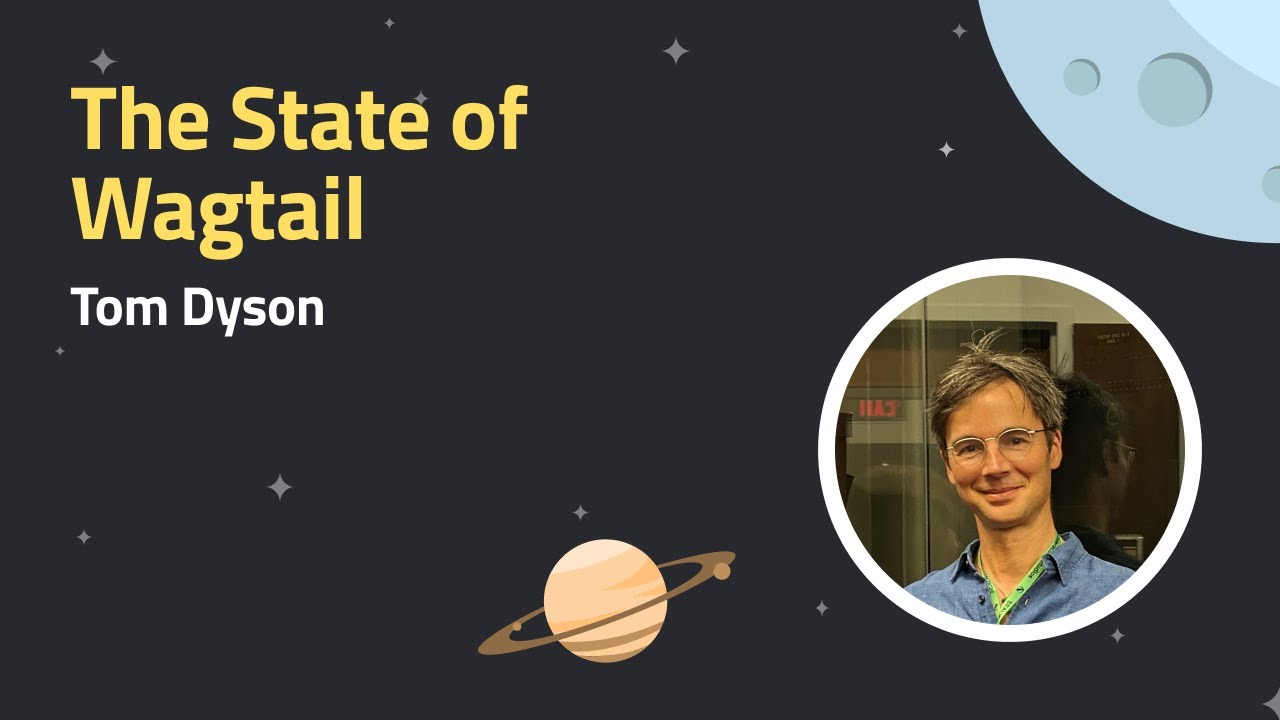
This video features Tom Dyson at Wagtail Space US 2018 in Philadelphia, Pennsylvania, USA.
Tom Dyson traces Wagtail’s development from its 2014 launch for the Royal College of Art through adoption by organisations including the NHS, Google, universities, and major public-sector and technology groups. He argues that Wagtail’s next stage depends on balancing new capabilities—headless CMS use, personalisation, machine learning, review workflows, and integrations—with improvements to accessibility, performance, documentation, and the editor experience. He also calls for a larger, more inclusive community, easier setup and contribution, a stronger commercial ecosystem, and less reliance on Torchbox while preserving Wagtail’s principles and adaptability.
Summarised automatically from the transcript.
Automatically transcribed, so expect mistakes in names and technical terms.
Speaker 1: And put this together and uh without further ado we'll dive into our first talk with uh with Tom Dyson.
Speaker 2: Great. So I'm uh I'm Tom. I'm uh I'm the co-founder and the technical director at Torchbox, where the the UK-based agency that that started Wiketel. And I I I run the the open source Wagto project from the UK. Tim has slightly stolen my thunder by doing almost all the thanks, but uh there's one person he didn't thank and um When we uh we had the idea for this originally at another another Wagtail space. Um this is something organized by Four Digits, a re great agency in Arnhem in the Netherlands. And that was in March and we finished that in saying it'd be really good to do something like this in in the US and um and Andy and Will were involved in that decision and um immediately I thought of Tim
Speaker 2: and uh it's really, you know, really thanks to Tim that uh we've been able to put this together. I mean with with the generosity of Warton but Tim's organizational help and um you know but I I I have to always always be careful about asking Tim to help because I know that he'll always say yes and just kind of keep helping. And so I want to make sure I never overset them up. But thank you, Tim, for everything you've done. Okay, I um uh uh Tim's also talked a bit about the format. So today is all about the talks. The the rough format is 25 minutes, up to 25 minutes and five minutes of questions, but I think we can be pretty flexible about the timings. At the end of today, after the talks are finished, we want to plan the sprint. So those of you who are staying for Friday and Saturday, I think it would be great for us to spend an hour
Speaker 2: looking at what um what themes and priorities we could all look at and and maybe identify some teams. Also, tomorrow there's uh there's a a tutorial, um a three-hour tutorial for those of you who would like it. Um I'll be doing this. Um And it goes from scratch, so even if you've never done any Python or Django before, the idea is that you should be able to start from scratch and at the end of the three hours, you should be able to, you should have launched a site on Wagter. Um and so if you're interested in that, and I think I've heard a couple of people would like to do that, then please come see me and um I'll make sure that we get set up ready for that tomorrow. HashwagtailSpace is uh the hashtag we're using if you tweeting about this or uh doing anything on social media.
Speaker 2: We're also streaming um We're using the BlueGene system that's live right now. This is the short code that redirects to the streaming URL. If any of your colleagues want to join in. We would like to take photographs of people and uh and also maybe do some short film interviews. Um Will here is an amazing photographer and and we'll take photos. If any of you would not like to have your photo taken Please let me in know or will know. And finally, we just we want to make sure everyone here feels happy and relaxed and safe And if you're at all worried about anything or anxious, please come see me or one of the other organizers that were standing here and we'll we'll help.
Speaker 2: Okay, so I'm gonna I wanted to start this conference by giving a very general talk about where we've got to with Wagtail over the last four years, what's happening right now, and what we're planning next. So I start with a kind of a quick history lesson. This is an overhead view of our offices. This is um uh the headquarters of Torchbox. We're based in something called uh Cornbury Park, it's part of the Witchwood Forest. It's uh it was an ancient hunting forest designated in ten ten eighty five, I think. It's in the doomsday book, a royal hunting forest. It's an amazing environment. I mean I guess I wanted to show you two things. One that we're pretty small, we're like that building there, that building. But also that we're in this beautiful rural location. And one of the advantages of being a beautiful rural location is that you have lots of animals around.
Speaker 2: So we've got like swans and this deer in the deer park and stuff. But the the one I really like, and I I I really know nothing about uh I'm I'm no ornithologist, but the one I really like is is this little creature, which from uh spring to autumn uh full fli uh uh just kinda hangs around in the grass areas outside our offices and uh it's got this really cute movement of its tail and um and it was uh because of this bird that we decided to call our comp management system wagtail this is a wagtail uh and so uh our logo which you know i i like everyone likes the logo it's actually not a very accurate logo it's got this little tail down here the tail should be much bigger and sticks out the back And moves up and down. Anyway, that's a wagtail. Apparently you don't there are no Danielle has a mm a friend, an expert friend, who says there are no wagtails in the state, so I'm sorry about that.
Speaker 2: Um so we uh play this video. We in twenty fourteen we launched Wagtail. Um we built it for the Royal College of Arts, which is one of the um preeminent art institutions in the UK. But um they uh they had done a large um evaluation of on of content management systems and they decided that they wanted something slightly different. They commissioned us to build it and they were keen for us to open source it This is uh a film from the the launch party of that. Um we we had been Torchbox has been going since 2000. Uh we have built a lot of uh large content managed public websites, we've used many content management systems.
Speaker 2: In particular we've used a lot of Drupal uh which is very big in our space, which is uh we're focused on the non-profit um public sector education generally people making the world a better place. And Drupal's been really big in that space. And uh we've built lots of sites on Drupal we were really proud of, but we we were very frustrated with it from a technical point of view. So so Wagtail was born really out of those frustrations, but also as this commission. From the Royal College of Art. The next year, 2015, we had our first sprint. This is in the office of Pre-Celps, an amazing organization in South Africa. Africa. So this is uh outside their Cape Town offices. It's a bit dark here, but uh you can see Lisa here and Cody who are now two of the the core developers. They are um we were hoping they were going to be able to come
Speaker 2: and they They had some visa issues, but they're going to be presenting some of what they're using Wagel for remotely later on this morning. In 2016, we had a call from this very secretive organization in Brooklyn and they wanted us to build something. They say we're using it for this this campaign, they couldn't tell us any of the details and they needed a they needed an API because they wanted to send out information not just for the website but to this very kind of highly segmented uh uh phone-based SMS-based campaign And uh it turned out that this was the Hillary Clinton campaign, so HillaryClinton. com ran on Whittail. They commissioned the first API, uh which is, you know, which is then open sourced. We were really excited about the day, we were also we weren't allowed to tell anyone, we were really excited about the day when we were going to say our technology ushered in the president
Speaker 2: and uh just just didn't work out quite that way. Next year 2017. I'm just kind of picking some highlights from the years. This has been a really big deal for us. So uh the NHS, the UK's National Health Service, adopted Wagtail. And not just for, you know, it's a huge organization with lots of different Lots of different parts. But uh not just for for one department, but for their main site, NHS. uk, which is one of the highest profile sites in the UK, ninety million visitors. Come on. Uh you know, it's it's the site that uh any that uh my colleagues and I would go for if we kind of see some s rash on our arm or something and we're worried we're worried what what the problem is. So is it Uh and this this is a big deal. So the NHS on I guess it doesn't have quite the same resonance here as it would in the UK, but the NHS is currently the fifth largest employer in the world. It used to be the second largest.
Speaker 2: It's now the fifth. Any any ideas what the other four might be? Chinese Red Army, very good, yeah. The number two.
Speaker 3: Trump Associates.
Speaker 2: There's the others So uh yeah, McDonald's Walmart, People's Liberation Army, and uh the US Department of Defense. Um so this is a big deal. This is um This is a big deal, I think, not just for Wagdale, but for Django and Python. This is, you know, Django running the main site of the world's fifth largest organization That obviously a pretty big deal for us as well. And um I guess this this marked a turning point for us from a commercial point of view as TorchBox because we're still working with clients who are uh you know in the sectors that I described and um and up to last year a lot of them we're still nervous about because you know know they could see the benefits of Wagtail but it's still it's not something that they're that they've heard of in the same way they've heard of with Drupal and WordPress. But NHS has has
Speaker 2: has changed that. Another thing last year happened is that uh that Google have started getting serious about Wagtail. So they're Google are running several of their large sites on Wagtail, blog. google. double click. They are starting to invest in Wagtail as well from the code point of view. So at the last sprint Kevin Chung came and made a great commit that was that's been released in in 2. 1 This is another thing that's changed for all of us, not not not just for Wagtail. So when we launched Wagtail in 2014, this is a Python line which has just done an E PHP and popularity and a second up from here and uh and now we're here and this is kind of just a luck thing really that uh we all picked a language that has exploded
Speaker 2: so this is uh this is where you know this is Python now and this is where Python is predicted to be here. And um you know we picked Django in Python because because we love working with it, but uh the explosion of interest I think has really come around machine learning and big data and uh computer science curriculums um with universities around the world where Python is you know increasingly the most popular language. Python has been is is a very important glue language now for the for all the big machine learning and big data toolkits. So that's that's fantastic for us and it's I think is a big opportunity for Wagtail. And then I think this is my final one on the kind of recent history. Wagtail 2. 0 this is a big release for us in February Uh I hope many of you have had the chance to upgrade for this. I guess that one of the dramatic things about it is that it uh like Django 2.
Speaker 2: 0 and that's why we named it, we did a kind of step upgrade, to to to launch at the same time with Django 2. 0. It's Python 3 only, so we wanted to kind of to make Make that commitment. It has the new draft tail editor, which is a massive improvement on what was there before and many other things too. So here we are, this is where we're at, Wagtail today. It's one of the top 10 open source content management systems It's used by enormous public sector organisations, so just in this country, Peace Corps, CFPB, NASA. like tech giants, Google, Salesforce, Twilio, Mozilla, and then you know people who are like more in our space like Oxfam, uh Amnesty. And and you know, appropriately given its start with the Royal College of Art, Wagtail's really big in the higher education sector. So Walton, I'll wonderful hosts, MIT, California College of the Arts, Chicago, Columbia, Rice, Caltech, you know, this this there's a big list.
Speaker 2: Caltech were hoping to be here. They they are now, they've been doing this, they were quite early adopters and they're uh They've got this problem that that many I think probably all universities have where little departments start spinning up little subsites or you know a professor's got a group and uh doesn't want to use the main Drupal site or So you can spin something up on Wagtail or Squarespace, and then you end up having 300 sites. So they've built something on Wagtail, it means that uh everyone can spin up a site on this central um central platform and they are now moving their main www Caltech site across to Wagtail. So that's where we are to now. And then and and then what's next? So this is a now a busy project. And uh we have a hundred and four pull requests, which you know I feel a bit nervous about. And we it's nice to be just two figures, but uh uh hundred and four is a lot, but it's not just a pull request, it's the messages on Slack, the questions on Stack Overflow, the things people ask me in the corridor.
Speaker 2: You know, people are full of ideas of improvements, which is amazing. You know, we should be we should have better docs, we should do inline reviews. A way that recently I've thought about trying to um trying to kind of organize and prioritize this is is by uh clustering these into three groups. So these these are the groups that I've I've been trying to think of and and I'd kind of like to encourage you to think about These clusters too, and it might be a helpful way for us to think about the work that we can do together as a community. So quality, features, and community. Let's think about some uh examples of those. So I'm I'm not gonna kind of do a comprehensive list, but these are some of the priorities I think. So under the quality heading comes things like accessibility. So we tried to do accessibility right from
Speaker 2: from from from the beginning with Wagtail. But I know that there's there's we can we can improve on this. We've had some really interesting feedback recently from a blind user in Sudan who has given us some fantastic information on ways that we can improve about the ways we can change our front icons for example. There's definitely more that we can do there. Performance, so this is, you know, we have always wanted Wagtail to feel fast. We've wanted to, I mean, and this is again, this is kind of in in a reaction to the other systems we've used. We want it to be under 250 milliseconds for page load so it feels like a seamless experience. Now performance is you know it's about minimizing queries and so on. It's also about thinking about front-end performance And this is in the UI making it feel smooth and liquid, but also meaning that you can serve on in the front end. So generally you are able to run a pretty big site on a $5
Speaker 2: digital ocean box if you you know If you need to, I want to kind of keep chipping away at that. The Streamfield UI, uh many of you will be familiar with Streamfield. When we built Streamfield, the idea was that it would be uh it would help build these kind of long-form narrative style pages, the ones that are uh you know you've seen great examples from the New York Times and Guardian and BBC and uh and and it works really well for that but actually what surprised us is that people use Streamfield film For modelling quite um kind of hierarchical data, so nested data, and quite tell it works, but the UI isn't great for that. So there's a big project happening right now. This is uh amazing contributor, Bertrand Baudage from uh from northern France, who's got some uh kickstarter And then the run front front end refactor, this is not my area of expertise, but I know that the things we did four years ago are
Speaker 2: no longer there. the best practice. You know, it's there there are better ways that we can do we can we can manage our CSS and JavaScript. So that's the quality. The next one was features. This is the this is the cool bit. I mean this is the stuff that uh people you know get most excited about because we all want new stuff. But I think it's it's important to think about the quality too because otherwise it you know it's it's easy to kind of get enthusiasm and build features but we have to keep making sure that the quality, the performance, the accessibility is good. Nevertheless, let's talk about the quality. So let's talk about features. So headless, I think this is this is this is another thing that wasn't really around four years ago. Are people familiar with this concept? So uh this is kind of decoupling your your content management system from the presentation. It's a bit what a bit like what the Hillary Clinton campaign did, that they were using Wagtail as a kind of content store and then using the API to push it out to different
Speaker 2: medium and this is this is definitely a more and more popular model so people are building front ends in React or Vue uh you know these other amazing job JavaScript toolkits and actually White Tail does this pretty well, but we're not we're not marketing this very well. There's not good documentation and people are having to learn how to do it each each time. I'm really looking forward to my Michael's talk later where he's gonna explain about how he's built a big headless, a big CMS in in the headless mode on Wagtail. Uh CX, this is a bit of sort of industry jargon, some of you may not be familiar with it. So this is like moving away from the model, the kind of the traditional model of um uh one piece of content and you publish it out to everyone, and it's more like um you know Jeff Bezos uh You said I don't want one website, I want 50 million websites or something.
Speaker 2: I can't remember what that number is up. You know, it's just like thinking about what the precise user experiences are for each of your users and making customizing content. and journeys around around what they need. And that usually means two things, personalization and A-B testing. And these are two things which are uh which there there is quite a good story for this in Wagter. There are two good modules, one for testing and one for personalization. personalization that are being used in some in some high profile places. We need to improve them and bring them in and market them and document them and so on. Machine learning, this is an area that uh you know it doesn't feel like maybe the most natural fit for a content management system. But I think there are a lot of ways, and particularly because we're on Python, we've got access to all these amazing libraries and services, that there are ways that we can start augmenting the system for uh for for for editors particularly that take advantage of some of these services.
Speaker 2: So here's an example. This is one of my favourite examples. This is actually built by a Swedish guy from Swedish agency, Freud. So it all happens quite fast, but here's some pictures on my desktop four uh eight pictures I'm gonna drag them into Wagtail you'll be familiar with that user interface close it so next my next job would be to title them but I need don't need to title them. Bottle of BSynx sits next to a glass of wine. They've got tags, they've got titles. A herd of cattle. A black and that's my dog, Moscow. Uh he's not brown but anyway it's quite close. Nigel Clark, a beautiful tall building. You might recognise that building. Um a white plate covered in the snow, that's actually some sardine heads in my case. So that wasn't so good. But um that's because this is using the uh there are a few of these vision, you know, machine vision services. And this is the Azure one, which is actually
Speaker 2: Uh it was the best it's the best one for doing titles and clearly you know they rely on big data sets and i Azure probably doesn't yet have an image of sardine heads in a white sink, so that's why You know, it had to guess a bit on that one. But uh for the other ones it's pretty good. And you can see that you know this is not perfect, but it's gonna get better. These services cost you know one cent for a thousand requests, and it means that if you've got a lot of images, if you're running, you know big news site and you want to make sure you've got good alt tags and uh and you can reference it, then we can use these services to help. You can hook into them and And it's easy. So I think there are a few other ways. There's some other ways, actually some more practical ways perhaps, which are just a bit less cool to show off, that use uh more natural language processing. So this is something we're doing for the California College of Art. They've got a lot of content, but they want to do um they want to to do kind of thematic mapping.
Speaker 2: So uh if you're an editor on a site that's got a hundred pages, it might be quite easy for you to say, I know that this new this new article is related to this. article that was written two months ago. But if you've got ten thousand or ten million pages, you it's gonna be harder for you. So you can use natural language techniques that do, for example, entity extraction to work out what the kind of the themes and the proper nouns are And do similarity matching around that. So I'm really interested in this kind of machine learning stuff. Review workflow, this is another one. This is something I This has all happened quite quickly. I talked about this at the what last Wagtail space. So at the NH the V NHS site, a lot of their content is medical, like I was saying. It was uh and it's really important that you know if I if I'm worried about something and I go to the NHS side, it's going to give me some diagnostic information. I mean if it's serious then it's going to tell me to go see a doctor, but it's going to give me some clues. And it's it's it's important that that's right.
Speaker 2: So I don't, you know, take it you know, take take the wrong action. So all this content has to be reviewed by by clinician clinicians, it has to be checked. At the moment, the way that happens is an editor writes it in, and then every six months they'll kind of do a screenshot, print it out, email it to someone, the doctor will see it, they'll print it out, they'll might like write on it They might take a photo with their phones, email, you know, this this kind of workflow is painful. And uh but it's it's how the world works, you know, people emailing around PDFs and Word documents. And I think there are better ways of doing this. This isn't specific to Wagtail, this is just like this is the way that content gets managed. So we built something in a annoying that Like if you use a GIF then uh it sort of starts halfway. Um so we're gonna have to wait for the we you're basically now gonna see the punchline
Speaker 2: before the start of the joke. Um so So you can just sort of ignore this bit a bit. But this is a proof of concept that we built in a sprint for the NHS in the UK. Is it just an idea about how we can try and circumvent that this really painful review process? Now it's going to start from the beginning and uh you can forget what you've seen already. Alright, here we go. So here's the demo site. I'm a clinician, I'm looking at this, I'm thinking that's the wrong date, so I can You know, instead of like being printed out and I'm doing a Google Doc style where you know you you can comment directly on the comment page. We can see now that that has a comment attached to it. And then I'm gonna annotate this This line here. This is using a third-party uh annotation JavaScript library. When I'm saving this, it's being pushed back uh through an API into uh Wagtail.
Speaker 2: We decided to use a kind of GitHub style overall review method. uh you interface like this so you can either say I'm just commenting in it or I'm gonna approve it or I'm gonna reject it. Obviously this isn't perfect, right? This is a three-hour proof of concept, but it is all hooked up together and then when I log in the back end I can see what the comment are and we can definitely do better with this but I think this is this is an area I'm really interested in because it kind of it solves a real world problem. Another feature I'm interested in better first class integrations with other systems. So a lot of people are doing this already they're building building tools based on on uh uh things like like Twilio for for messaging and um Salesforce is another one. So a lot of our clients use Salesforce for of CRMs. So we've built a few Salesforce CRM integrations. I know that Salesforce themselves use Wagtail.
Speaker 2: So they're using for their documentation and their uh uh their status site. I want to get in touch with the Salesforce and think about, you know, is let's make Wagdale the the the the CMS that integrates best with with Salesforce. And then my final my final block was community. And um again, this is one that I think in open source projects it's quite hard, it's quite easy to let this stuff slide or to think that, you know It just kind of takes care of itself. But I I think it it doesn't. It's really it's important to stay on top of this. I want us to be like remorselessly chipping away at the barriers to entry. to to new developers. So at the moment, you know, if you've got a Python version, if you know how to run Python on your on your laptop, you can probably get something set up, basic set thing set up in file. minutes.
Speaker 2: Then getting it hosted is harder. Daniela 's is going to demo s demo something later which really makes a massive improvement to that people, to to to to that use case. But I want to make it you know five minutes set up for someone who doesn't have a Python version environment or 30 seconds for someone who does. I mean kind of keep chip chipping away at that. Because I I think you know the difference between five minutes and one minute or thirty minutes and five minutes is really important. I think for a lot of people like me, the way that you discover technology is is in a sort of half hour lunch break when you see something that you're interested in and you try it and you want to get you you know you want to get through that that process and and feel like this is something something you're interested in works. Documentation, you know, this is uh this is always an issue for for for open source projects. I think people feel like unless they're like the you know a really top developer, it's hard to contribute, but all open source projects want
Speaker 2: people to help them with the documentation. Documentation is okay, it all makes sense, it's all accurate, but I don't think it's uh I don't think it's organized in the most thoughtful way. Again Danielle's got some really interesting thoughts and and and the right way to do technical documentation. Which I'd like us to think about. Hopefully many of you are familiar with Django Girls. This is a fantastic tutorial and uh so well thought out. And in fact, they've really thought about this topic. problem. They really make it easy using this tutorial to think about people who who aren't who haven't got any experience of this and how they can get into it. And uh you know a apart from being an amazingly initiative, an amazingly successful initiative, it's also the best Django tutorial. So it's what I appoint anyone who wants it and who's interested in learning Django. And they have this concept of extension. So we we want to write a Django girls, an extension to do tutorial about Wagtails.
Speaker 2: And once you've completed it, you can go off in different directions, and one of them could be the webcam operation. We need people to we have we respond on Slack Overflow and Slack at the moment that's handled, you know, there's a small group of people who do that by So I want to make that really good. I want to make like 50 people who can answer questions on this and for it to feel like the most welcoming, the fastest response, the most friendly community. And I want to have more sprints like this. I think getting people together in real life is undervalued. And uh we've had now many of these many of these sprints. Um I think this is maybe the seventh or eighth, uh Cape Town, Reykjavik, two in the Netherlands, three in the Netherlands, two hours in the UK. Um and I think uh it i it whenever we have one of these events we
Speaker 2: always notice afterwards the sort of the surge in enthusiasm and the new people that that come in and I think it's it's a really great way of pushing the community forward. Okay, um this is my last slide. Hey, what's the three-year plan? So we're always encouraged to think about, you know, you can't uh what's the phrase? You're not gonna get anywhere unless you I can't remember, some sort of businessy plan thing. Anyway, we ought to have a three-year plan. And uh here's some thoughts I had about about about what Wagtail could be in three years time. And the first is I think at the moment Wagtail's you know it's if you're a Django developer, you've probably heard of it and it's probably a good option for you, or if you're a Python developer. But um I think I would like Wagtail to be, you know, people think I want to use let's use Wagtail, even if they're not, you know, whatever whatever technology they're in It should be
Speaker 2: a content management system that's kind of a top choice no matter what your technical background. The second one, I mean I'm not quite sure about how to phrase this, but uh we are clearly YTL is much bigger than Torchbox now. So we're just 65 people and small proportion of that are working on Wagtail. We are investing in it a lot, but it's uh it's much bigger than us now. We have people from four continents in the in the in the team. But we still I think investing the most and we still and I I think it would be I think a good a good goal for it would be that White Tail was not at all reliant on torchbox in three years' time. Just not say you know we want to be at the heart of it, but I think it would be good if we didn't have to be. And then this this is an also a tricky one to talk about because you know people don't don't really like talking about money with
Speaker 2: these kind of big altruistic open source projects, but I I think it would be healthy for Wagtail to have a a commercial ecosystem around it, for uh for there to be more and more agencies that are specializing in Wagtail and um and you know, making money out of Wagtail and paying developers to to work on it. And uh I think it would be good maybe to for there to be some commercial plugins so people make tools that that uh that do specific things that may not be free and you know not everyone will use them but I think that that's also an indication of of of a healthy a healthy project And the ways that we will get there, I think, will be by being following this idea of being principled but adaptive. So principled, I mean, we've always we've had some kind of clear principles and philosophies about Wagtail about about being a tool that uh that doesn't have opinions, for example, about the fr about
Speaker 2: about front-end markup, that lets you build the site you want, that encourages you to do the right thing. right thing. But also we have to be adaptive because you know the in three years time the the the situation will be different. Just as in four years ago we weren't really thinking about sites that had React front ends. In three years time there's going to be other changes. That we we haven't addicted yet. We need to be able to adapt and change to that, otherwise we will become irrelevant and there'll be something else. And I think the way we can also do that is by by continuing and improving the way that we are friendly and supportive. uh and uh and inclusive and uh and i'm and and so far that's that's the experience i've had from from everyone i mean in Django generally to be honest but uh uh and python but But also here and I I really want to do that. But as well as being friendly and supportive, I also think it's really important that we crush the opposition.
Speaker 2: That's it. Thank you all very much.
It was named after the wagtail bird that lives around Torchbox’s offices. The bird’s characteristic tail movement inspired both the name and the logo.
Discussed at 4:05Wagtail 2.0 was released alongside Django 2.0, moved to Python 3 only, and introduced the new Draftail editor along with other improvements.
Discussed at 9:41Wagtail is used by major public-sector organizations, universities, nonprofits, and technology companies, including the NHS, NASA, Google, Salesforce, Mozilla, MIT, and Caltech.
Discussed at 10:26Tom groups the project’s priorities into quality, features, and community. Quality includes accessibility, performance, the StreamField interface, and front-end code; features include headless CMS support, personalization, machine learning, review workflows, and integrations.
Discussed at 12:08Wagtail can act as a content store and expose content through an API to front ends built with tools such as React or Vue. Tom says the capability works well but needs better documentation and promotion.
Discussed at 14:30Machine-learning services can help editors by automatically generating image titles, tags, and alt text, while natural-language processing can identify themes and related content across very large collections.
Discussed at 16:03Instead of printing pages or exchanging documents by email, clinicians or other reviewers could comment and annotate content directly in a browser. A proof of concept sends those comments back into Wagtail through an API and supports commenting, approval, or rejection.
Discussed at 19:53Tom wants Wagtail to become a top CMS choice regardless of a user’s technical background, become less dependent on Torchbox, and develop a healthy commercial ecosystem of agencies, developers, and possibly paid plugins.
Discussed at 24:30Note: We understand that names change, people change, and bodies change. We respect each individual's journey and privacy. If you have any concerns about a video or need us to remove content, please don't hesitate to contact us. We will handle your request with care and promptly address any issues.

Published July 19, 2024

Published July 19, 2024

Published July 19, 2024

Published July 19, 2024

Published July 19, 2024

Published July 19, 2024

